
Top Agentic AI Systems CMO’s Must Deploy in 2026

Top Agentic AI Systems CMO’s Must Deploy in 2026
.webp)
April 13, 2026
Artificial Intelligence
Top Agentic AI Systems CMO’s Must Deploy in 2026 to Transform their Marketing Engine and to Lead new frontiers
Indian marketing leaders are entering a different operating environment. Growth is no longer constrained only by media budgets, creative quality, or channel presence. It is increasingly constrained by how fast a marketing organization can sense change, translate signals into decisions, and execute across channels without creating bottlenecks. That is why the real shift in 2026 is not from traditional marketing to digital marketing. It is from manual marketing operations to agentic marketing systems.
For CMOs and marketing managers in India, this matters immediately. Customer journeys are fragmented across search, marketplaces, social platforms, CRM channels, content ecosystems, and paid media networks. Teams are often surrounded by software, but still slowed down by handoffs, reporting delays, and disconnected workflows. The next decade will not be won by the teams with the most tools. It will be won by the teams that deploy the right systems of intelligence, automation, and orchestration.
Agentic AI changes the role of marketing technology. Instead of simply helping teams create content or read dashboards, these systems can monitor conditions, generate recommendations, trigger execution, and in some cases act autonomously within defined guardrails. That does not remove human leadership. It makes human leadership more strategic. CMOs still define priorities, positioning, governance, and risk boundaries. But the operating engine beneath them becomes faster, more connected, and more responsive.
Why CMOs Need Agentic AI Systems Now
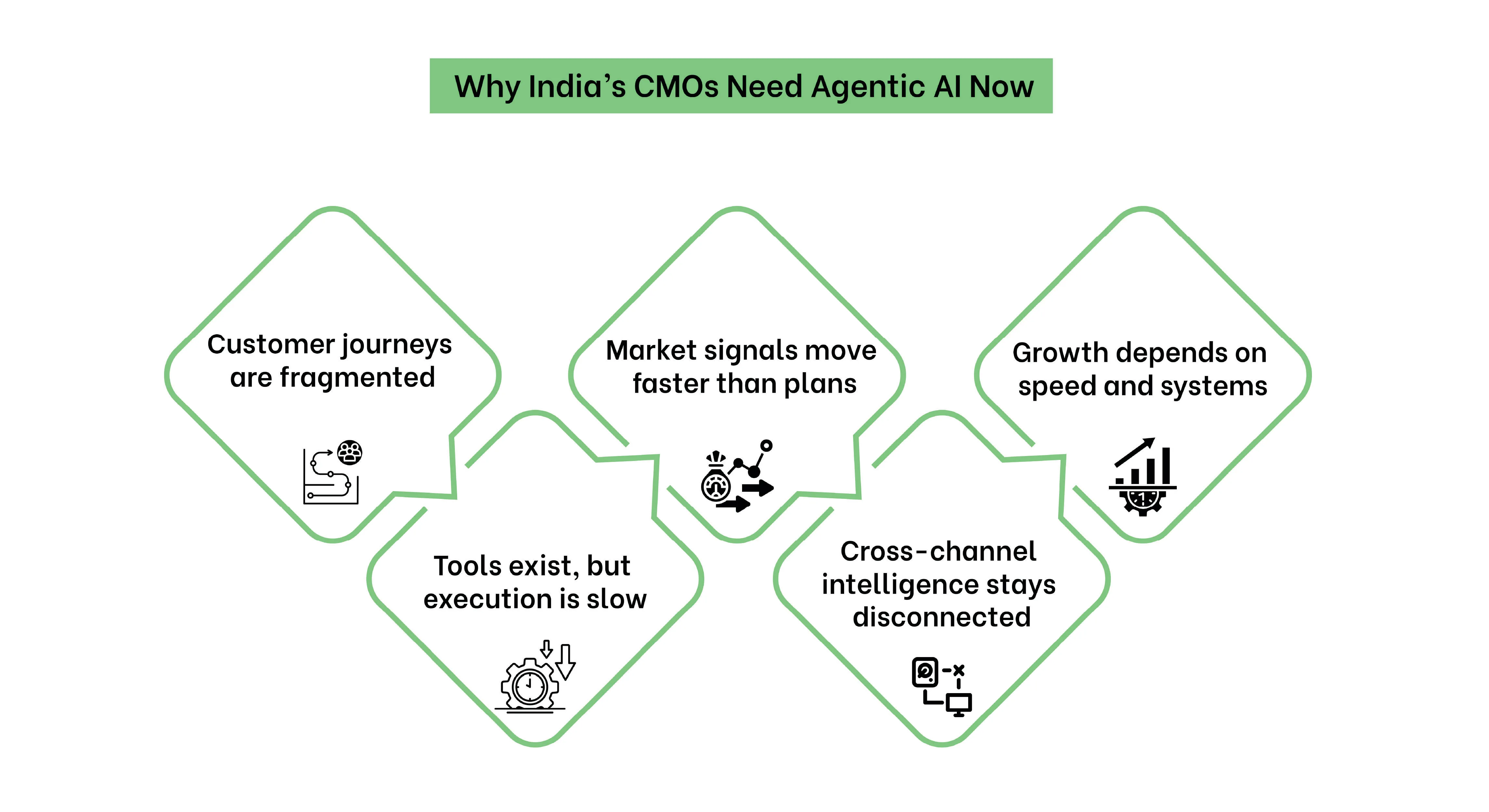
Most marketing organizations still suffer from the same structural weaknesses. SEO insights do not flow into paid media quickly enough. Paid media learnings do not consistently reshape landing pages or lifecycle flows. CRM signals remain underused. Campaign planning is periodic when demand shifts are continuous. Even strong teams lose momentum because execution remains too manual.
Agentic AI systems address this problem by turning isolated marketing tasks into coordinated operating layers. One system can identify search opportunity. Another can convert that into content direction. Another can optimize paid distribution. Another can trigger lifecycle engagement. A workflow layer can connect them all. Once these systems begin to work together, marketing moves from channel management to system-led growth management.
The Agentic AI Systems CMOs Should Deploy in 2026
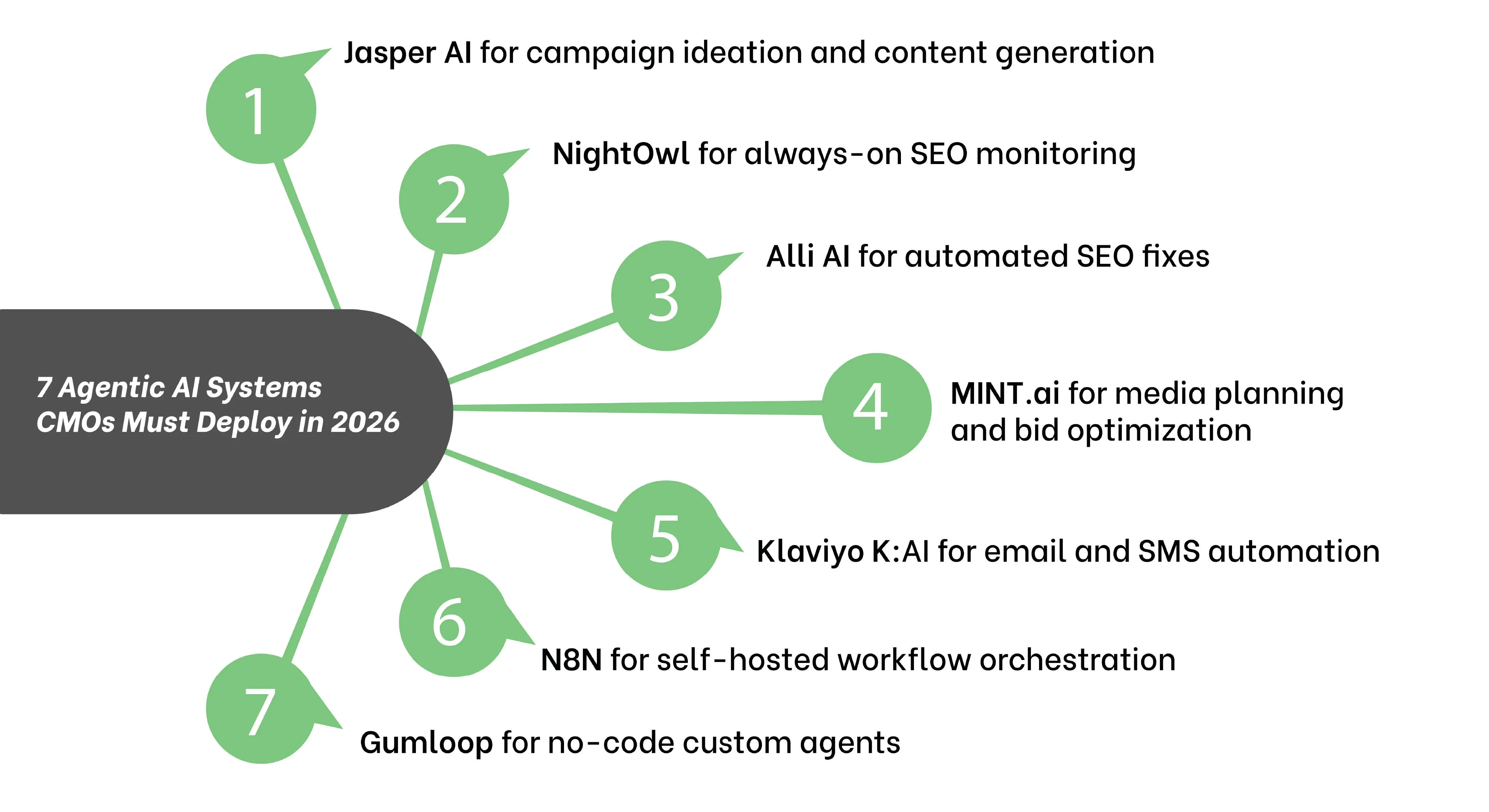
Jasper AI for Content and Campaign Intelligence
Jasper has positioned itself as an AI platform purpose-built for marketing, with agents designed to execute marketing work using embedded brand intelligence, governance, and audience context. Its platform highlights end-to-end marketing workflows, campaign support, optimization, and personalization capabilities rather than simple one-off copy generation.
For Indian CMOs, Jasper’s strategic value lies in three areas:
- autonomous campaign ideation
- high-volume ad and content generation
- personalization at scale
This means marketing teams can move faster across campaign briefs, landing pages, emails, ad variations, and audience-specific messaging without constantly rebuilding assets from scratch. In practical terms, Jasper should be viewed not as a writing tool, but as a content intelligence layer that helps compress the advertising content lifecycle.
NightOwl for Always-On SEO Intelligence
Nightwatch’s NightOwl is positioned as an AI SEO specialist that can automate research, site audits, SEO planning, keyword work, and clustering by intent. Nightwatch also explicitly describes NightOwl as handling keyword clustering, content outlining, and strategic SEO tasks through prompt-based workflows.
For CMOs, that makes NightOwl valuable as an always-on search intelligence layer. Its role is not just to report rankings. Its role is to continuously scan for issues, detect emerging opportunities, cluster keyword demand by intent, and surface prioritized recommendations.
That matters because modern search growth depends on faster interpretation of audience intent. Buyers no longer search in neat keyword buckets. They search by need, comparison, problem, urgency, and trust. A proactive SEO agent helps a marketing team respond to those patterns before competitors do.

Alli AI for Technical SEO Execution at Scale
Alli AI positions its platform around automating SEO deployment, enabling AI crawler access, and optimizing search presence at scale. Its product materials also emphasize bulk on-page automation, metadata updates, and faster implementation without the traditional friction of slow development cycles.
This is important because SEO failure is often not an insight problem. It is an execution problem. Teams know what should be fixed, but implementation is delayed by competing priorities and technical dependency.
For a CMO, Alli AI should be understood as an autonomous technical SEO layer that can:
- scan for site errors
- update titles and meta information at scale
- help operationalize technical improvements faster
When paired with NightOwl, the combination becomes powerful. One system identifies where growth is being lost. The other helps close the gap operationally.
MINT.ai for Autonomous Media Planning and Optimization
MINT.ai describes its platform and agent approach around media planning, budget allocation, forecasting, bid optimization, and advertising workflow intelligence. Its materials highlight specialized agents that can support different parts of the advertising process, including cross-channel planning and budget distribution.
For Indian CMOs managing complex media mixes, MINT.ai addresses one of the most persistent operational problems in paid growth: fragmentation. Teams often still manage channels in silos, compare spreadsheets manually, and optimize too slowly relative to the speed of auctions and audience shifts.
MINT.ai is best viewed as an end-to-end paid media intelligence layer that can support:
- media planning across channels
- budget allocation based on performance conditions
- real-time bid and campaign optimization
- tighter operational visibility into advertising decisions
This is where agentic AI starts to change media leadership from reactive optimization to continuous decision support.
Klaviyo Marketing Agent for Lifecycle and Retention Growth
Klaviyo’s K:AI Marketing Agent is positioned as an autonomous marketing agent that creates, launches, and optimizes campaigns, flows, and forms by analyzing a brand’s website and using real-time customer data. Klaviyo also frames its broader platform as a unified B2C CRM spanning email, SMS, WhatsApp, push, web events, and real-time customer profiles.
For CMOs, this matters because retention is one of the clearest areas where first-party data should become action, not reporting. K:AI can support:
- behavior-driven email and SMS automation
- predictive campaign launches
- stronger monetization of existing customer relationships
In an Indian market where acquisition costs remain under pressure, lifecycle systems like this become essential. They help brands build more timely, relevant post-purchase and re-engagement journeys rather than relying too heavily on new-customer acquisition to sustain growth.
n8n for Workflow Orchestration and Control
n8n positions itself as an AI workflow automation platform for technical teams, combining business process automation with AI capabilities, traceable reasoning, broad integrations, and the option to deploy on your own infrastructure. Its documentation also highlights self-hosted AI starter kits and deep integration with AI agents and external tools.
That makes n8n one of the most strategically important systems in this playbook.
Most CMOs do not need another front-end application. They need a backbone. They need a layer that can connect campaign systems, CRM signals, analytics tools, SEO platforms, internal approvals, and API-based logic into one coordinated engine. n8n fills that role.
Its value is especially high for organizations that care about:
- self-hosted deployment and data control
- complex workflow logic
- API-led orchestration across multiple systems
- building agentic workflows without surrendering flexibility
For Indian enterprises and growth-stage brands alike, this gives marketing teams more control over how agentic systems are actually wired together.
Gumloop for No-Code Agent Creation
Gumloop positions itself as an AI automation framework and no-code AI agent builder, with support for multiple models, connected data sources, recurring tasks, drag-and-drop workflows, and natural-language agent building. Its recent product content also emphasizes team interaction through tools like Slack and the ability to automate both workflows and autonomous agents.
For CMOs, Gumloop is useful because not every automation requirement should wait for technical implementation. Marketing teams often need lighter-weight agents for very practical needs, such as:
- monitoring competitor trends
- updating blog or website content
- running recurring research tasks
- pushing alerts into team workflows
This makes Gumloop a valuable experimentation layer. It gives teams speed and flexibility while the larger orchestration stack handles deeper integration and governance.
Related Reads :
Digital Orchestration in Multi-Campus Schools
How Agentic AI Is Transforming Social Media for AC & Cooler Brands
How These Systems Work Together
The strongest agentic marketing architecture does not treat these platforms as isolated tools. It treats them as coordinated layers.
Jasper handles content and campaign intelligence. NightOwl surfaces search opportunity. Alli AI operationalizes technical SEO changes. MINT.ai manages media planning and paid optimization. Klaviyo activates retention and lifecycle workflows. n8n connects systems, logic, and data flows. Gumloop enables fast custom agents for recurring use cases.
When connected properly, these systems create a feedback loop:
- search demand shapes content priorities
- content themes inform paid campaigns
- paid performance informs landing-page and creative refinement
- customer behavior informs lifecycle automation
- orchestration layers move insights and actions across the stack
This is how marketing evolves from a set of channel teams into a semi-autonomous growth system.
What CMOs Should Do Next
The playbook is not to deploy every system at once. The playbook is to deploy in the right sequence.
A sensible rollout for most marketing organizations would be:
- start with lifecycle and retention automation where first-party data already exists
- build always-on SEO intelligence and faster SEO execution
- strengthen paid media planning and optimization
- connect the stack through orchestration and governance
- add lighter custom agents for recurring operational tasks
This approach keeps adoption practical while still moving the organization toward a more agentic operating model. The goal is not full autonomy on day one. The goal is to reduce manual drag, increase speed, and create a system that compounds learning across channels.

The Decade Ahead Belongs to Marketing Systems
The next marketing decade will not be defined by who publishes the most content or spends the most on ads. It will be defined by which organizations build systems that can interpret signals, coordinate action, and improve continuously.
For India’s CMOs, that is now a leadership question, not just a technology question.
The agentic AI stack is no longer a future concept. The systems are already here. The real competitive gap will emerge between teams that experiment with isolated AI tools and teams that build an operating model around coordinated AI systems.
That is the real playbook for 2026. Deploy the right agentic systems now, and marketing becomes more than a function. It becomes an adaptive growth engine.
Authors

AVP & Associate Partner (Digital Transformation)
%20(5).webp)
%20(2).webp)
.webp)
.webp)
.webp)

.jpg)
.jpg)


.webp)
.webp)