Agentic AI in Marketing - Complete Guide for CMOs I 2026 Edition

Agentic AI in Marketing - Complete Guide for CMOs I 2026 Edition
.webp)
April 27, 2026
Artificial Intelligence
Why Agentic AI Is the CMO's Most Important Conversation in 2026
Marketing has always rewarded speed, precision, and personalization. But for decades, the tools available to marketers could only go so far. You could automate an email sequence, schedule social posts in advance, or even run AB tests. But you still needed a human in the loop at every meaningful decision point, which is changing rapidly.
In 2026, the most competitive marketing organizations are no longer asking how do we automate tasks, instead they are asking something far more consequential: how do we deploy AI that thinks, decides, and acts on its own to drive business outcomes?
This is something that agentic AI promises, and for CMOs, understanding it is no longer optional.
Gartner reports that 80 percent of marketing leaders now use at least one AI powered tool in their daily workflow. All the High performing marketing teams are nearly three times more likely to be using AI agent capabilities than their average performing counterparts. Marketers using AI agents report saving an average of five hours per week per team member on routine tasks with the most advanced deployments saving significantly more.
This guide is built for CMOs and senior marketing leaders who need a clear, strategic understanding of what agentic AI is, how it works, where it delivers real value, and how to deploy it responsibly at scale.
What Is Agentic AI? And How It Differs from Generative AI?
Agentic AI refers to artificial intelligence systems that go beyond generating content or answering questions, they autonomously make decisions and take actions to achieve specific goals, without waiting for human prompts at each step.
Where generative AI produces a simple output when asked a blog draft: a subject line, a campaign or a brief, whereas Agentic AI actively identifies opportunities, predicts outcomes, and carries out strategies. It observes what is happening, reasons through what should happen next, and acts accordingly.
Think of the difference this way:
- Generative AI is a highly skilled assistant, it only delivers what you ask and when you ask.
- Agentic AI is a proactive teammate, as it can do many things at once, it monitors, decides, and makes moves and then tells you what it did.
This distinction has enormous implications for marketing operations. Traditional AI acts as a reactive tool. While Agentic AI flips that model entirely and it becomes a system that works alongside your team, handling execution autonomously while freeing your strategists for higher order thinking.
The Four Types of AI Every Marketer Should Understand
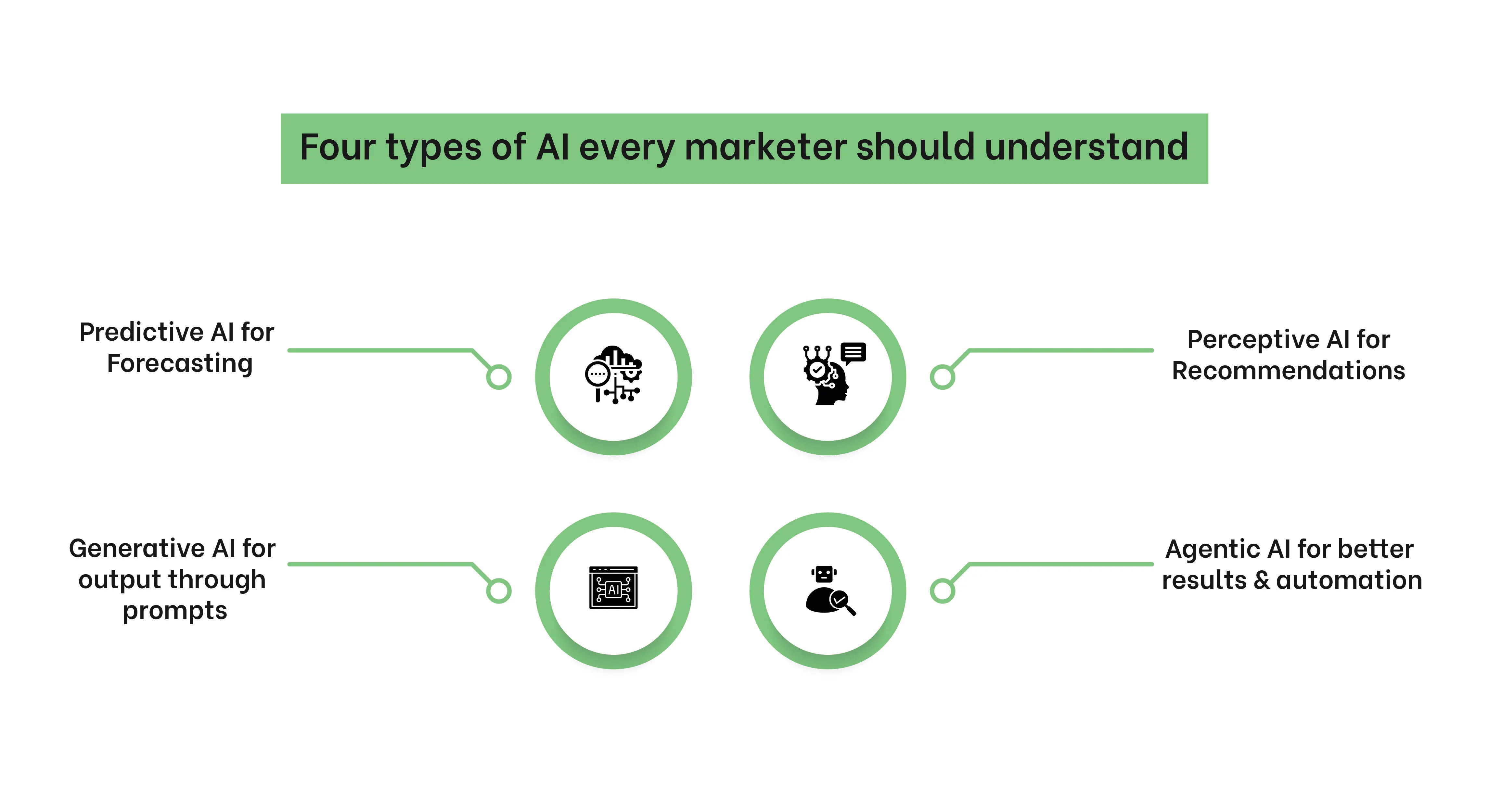
Before going deeper into agentic AI, it helps to understand where it sits in the broader AI landscape:
1. Foundational AI underpins most AI systems, enabling basic cognitive tasks like pattern detection and data recognition. It is the infrastructure layer everything else is built on.
2. Predictive AI uses historical data to forecast future outcomes churn probability, customer lifetime value, product affinity. It is widely used in CRM and loyalty platforms.
3. Prescriptive AI moves beyond prediction to recommendation. It suggests what action to take based on predicted outcomes, often incorporating business rules and optimization logic.
4. Generative AI produces new content from prompts emails, images, landing pages, code. It has become the most visible form of AI in marketing over the past three years.
Agentic AI is the next evolution. It does not wait to be prompted. It senses, reasons, and acts in real time by executing strategies, rather than justsuggesting them. This is what makes it categorically different from everything that came before.

How Agentic AI Actually Works: The Sense Reason Act Loop
Agentic AI systems operate in a continuous loop of four interconnected processes:
Sensing The agent monitors real time signals across channels customer behavior, campaign performance, content engagement, competitive activity, and contextual data like time of day, device type, or purchase history.
Reasoning: It interprets the data to understand patterns, predict outcomes, and prioritize the next best action.
Acting: The agent takes initiative by launching a reactivation campaign for lapsed customers. It reallocates ad budget to a higher performing audience segment, and also updates content for SEO before a competitor can capitalize on a keyword gap.
Learning: Every action it performs generates feedback. The agent continuously refines its decision making through reinforcement learning and real time performance data, so that each cycle becomes more effective than the last.
In practice, this means a single agentic system can automatically detect a drop in email engagement, select a reactivation strategy, generate personalized content, choose the right send time, and deploy it all without a single human touchpoint in the execution chain.
Key Benefits of Agentic AI in Marketing
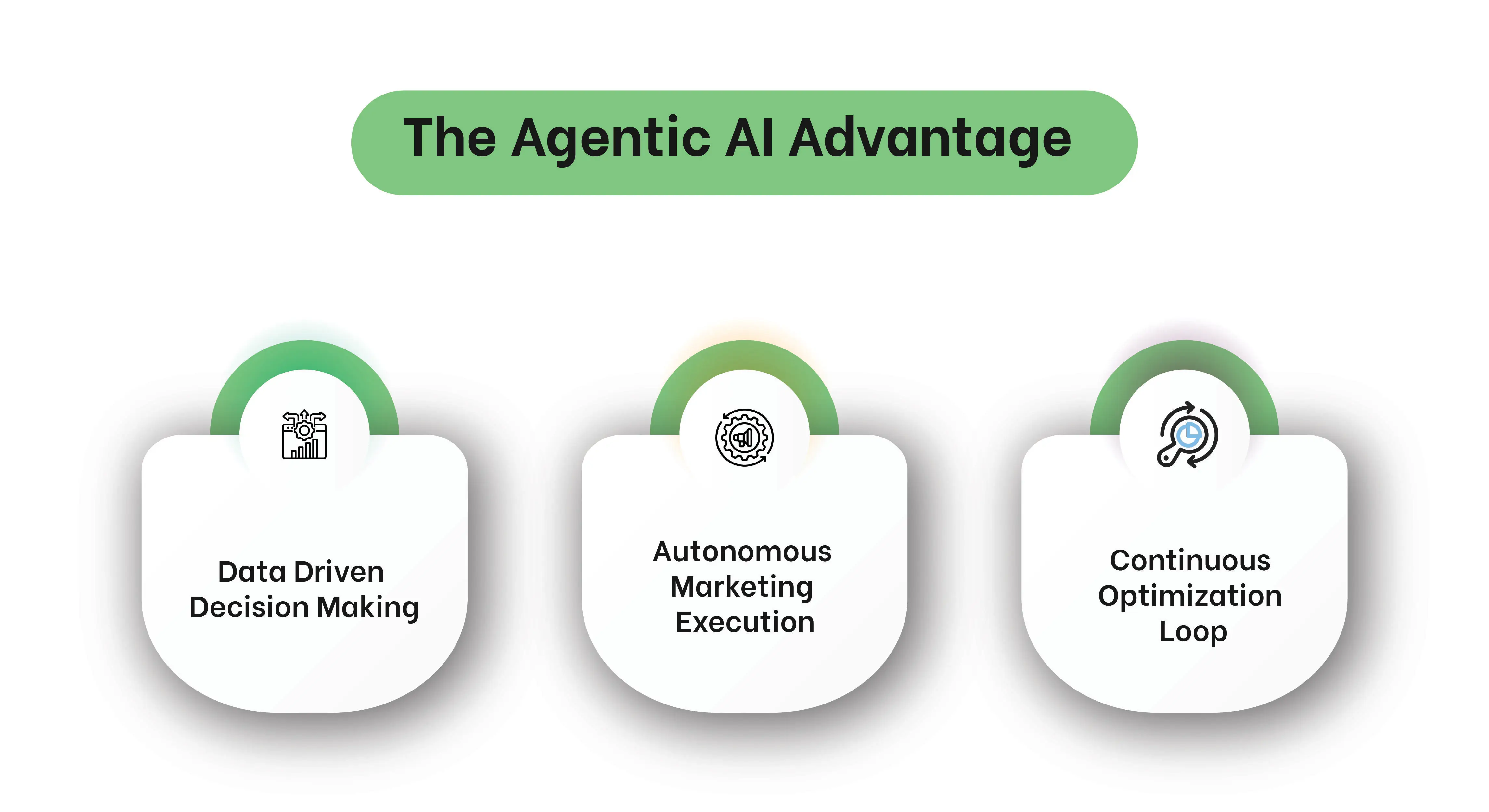
For CMOs evaluating where to invest, agentic AI delivers measurable impact across six core dimensions:
Personalization at Scale Agentic AI can tailor content, offers, and messaging for thousands of micro segments simultaneously, doing in seconds what would take a marketing team weeks to manually configure and deploy.
Agentic AI works by applying real tme decision making, rather than waiting for weekly campaign reviews, agentic systems trigger the next best action for each customer based on live behavior a cart abandonment, a price drop, a product search.
Operational Efficiency: Repetitive tasks that once consumed significant human hours audience segmentation, AB test management, performance reporting, content scheduling can now run autonomously, freeing teams for strategy and creative work.
Improved ROI: Agentic systems automatically pause underperforming campaigns, reallocate budget toward what is working, and continuously optimize timing and channel mix, compounding marginal gains into meaningful performance lifts.
Deeper Customer Intelligence: Agents surface patterns, trends, and anomalies that human analysts would miss at scale, turning behavioral data into actionable insight faster than any team could manage manually.
Competitive Speed: In markets where response time is a differentiator, agentic AI allows brands to react to competitor moves, trending content, and emerging audience signals in near real time.
Real World Use Cases Across the Marketing Lifecycle
Agentic AI is not a single function tool, its value spans the entire marketing lifecycle from awareness through acquisition, engagement, retention, and advocacy.
Autonomous Customer Journey Management
An agent monitors each customer's real time behavior and continuously adapts their journey deciding which message to send, through which channel, at what moment without human configuration at every step.
Campaign Optimization in Real Time
Instead of reviewing campaign performance weekly, agentic systems monitor engagement data continuously and adjust creative variations, audience targeting, timing, and segmentation rules while campaigns are live.
Content Operations at Scale
A media company, for example, can deploy an agent that manages the full content workflow identifying emerging search opportunities, briefing writers, tracking pieces through editorial review, optimizing published articles for SEO, and monitoring post publication performance. This kind of end to end automation can reduce the time from topic identification to published content by more than 60 percent.
Performance Advertising Optimization
A paid media agent manages Google, Meta, and LinkedIn ad spend continuously monitoring performance at the keyword, audience, and creative level, reallocating budget toward higher performing combinations, pausing underperformers, and generating new creative variants for testing.
Competitive Intelligence Monitoring
An agent tracks competitor websites, social media activity, pricing changes, product launches, and job postings 24/7 alerting marketing teams about the significant shifts and
identifying strategic gaps before they become disadvantages.
Customer Reactivation
When engagement drops, an agentic system detects the behavioral signal, selects the appropriate reactivation strategy, generates personalized messaging, and deploys it all autonomously, at scale.
Challenges and Risks CMOs Must Manage
Agentic AI is powerful, but it introduces risks that require active CMO level governance:
Ethical Bias: AI agents trained on historical data can reinforce patterns that reflect past inequities. Regular bias audits and diverse training datasets are non negotiable.
Over Reliance on Automation: Automation should expand what your team can do, not replace the strategic and creative thinking that drives brand differentiation.
Brand Voice Drift Without proper guardrails, AI generated content at scale can drift from the brand's established tone, personality, and values.
Creativity Gaps: Agentic AI is excellent at scaling content, but it cannot replicate the emotional nuance, cultural intuition, and narrative originality that defines exceptional creative work.
Data Privacy and Compliance: Autonomous systems operating on customer data require robust governance to remain compliant with GDPR, DMA, and FTC guidelines.
Regulatory Explainability: As AI takes more autonomous action, marketing teams must be prepared to explain what their systems did and why.
The Role of Governance: Moving Fast Without Losing Control
The most effective agentic marketing deployments in 2026 share a common characteristic, they combine autonomous execution speed with disciplined governance architecture.
This means every agent action is logged, reviewable, and reversible and the permissions clearly defined what the agent can do independently, what requires human approval, and what is always escalated.
The goal is not to limit what agentic AI can do, but it is important to ensure that speed, control, and consistency move together.
Agentic AI vs Traditional Marketing Automation: A Direct Comparison
The shift from traditional automation to agentic AI is fundamental. Traditional automation executes what humans defines, but Agentic AI can carry out executions that are determined by intelligence, within the boundaries humans set.
Related Reads
Agentic AI and Autonomous Growth for D2C Brands
Agentic AI Revolutionizes Customer Support into Care
Agentic AI Tools and Applications By Marketing Function
Content Marketing
Jasper AI is the leading enterprise grade content platform in 2026, offering over 100 specialized AI agents for end to end content workflows.
Writer provides AI powered writing with a strong focus on brand consistency and regulatory compliance.
Copy AI and Writesonic are strong entry level options for teams beginning their agentic content journey.
SEO and Organic Search
Ahrefs with AI features provides industry leading SEO capability with AI powered content gap analysis and keyword clustering.
Surfer SEO combines content generation with real time SEO optimization.
Clearscope analyzes top ranking pages and provides real time scoring.
SEOwind generates AI driven content briefs grounded in SERP analysis.
An advanced SEO agent operates like a full time analyst working consistently identifying ranking opportunities and monitoring changes in real time.
Performance Advertising
Google Performance, Max and Meta Advantage plus represent widely deployed agentic AI in paid media today.
Albert AI is a dedicated autonomous paid media platform.
Madgicx provides AI powered ad optimization.
AdCreative AI generates high converting ad creatives at scale.
A paid media optimization agent operating at full capacity monitors performance and reallocates budget in real time.

Social Media
Sprout Social AI offers AI powered sentiment analysis and posting recommendations.Lately AI converts long form content into multiple social posts.Brandwatch provides AI powered social listening.Birdeye Social Engagement Agent helps manage interactions at scale.Canva Magic Studio integrates AI design capabilities.Email Marketing and CRMHubSpot Breeze AI Agents provide integrated AI marketing capabilities.Klaviyo AI delivers predictive segmentation and optimization.Mailchimp AI features offer accessible automation for SMBs.Optimove OptiGenie provides self optimizing campaign agents.
Analytics and Reporting
Adobe Analytics with AI Assistant surfaces insights from complex datasets.Tableau AI transforms data analysis through natural language queries.Salesforce Agentforce for Marketing connects marketing systems into a unified agentic layer.Orchestration and Workflow AutomationAdobe Experience Platform Agent Orchestrator coordinates multiple AI agents.Gumloop provides a visual workflow builder.ZBrain coordinates multiple AI agents across functions.
How to Get Started: A Framework for CMOs
The organizations seeing the strongest results from agentic AI in 2026 did not try to deploy everything at once. They followed a disciplined progression:
Step 1 : Identify your highest-friction workflows. Where is your team spending the most time on tasks that are repetitive, data-driven, and rule-bound? These are your first candidates for agentic automation. Campaign reporting, audience segmentation, A/B test management, and content performance optimization are common starting points.
Step 2 : Audit your data infrastructure. Agentic AI is only as good as the data it operates on. Before deploying agents at scale, ensure your customer data is unified, clean, and consistently structured. Fragmented data leads to agents making poor decisions at machine speed.
Step 3 : Start with one agent, prove value, then expand. Deploy a single, well-scoped agent, who works as a campaign optimization agent, a content generation agent, or an SEO monitoring agent and measure its impact rigorously before expanding. Organizations that take this measured approach see higher success rates and build institutional confidence in the technology.
Step 4 : Build your governance architecture before you need it. Define what agents can do autonomously, what requires human approval, and what is always escalated. Establish audit trails, brand guardrails, and override protocols before deployment.
Step 5 : Train your team to work with agents, not around them. The marketer's role does not disappear with agentic AI, it evolves. Your team needs to understand how to interpret agent recommendations, override when necessary, and focus their energy on the strategic and creative work that AI cannot replicate.
Step 6 : Build toward a multi-agent ecosystem. As individual agents prove value, connect them. Your content agent informs your SEO agent. Your SEO agent guides your paid media agent. Your analytics agent optimizes all of them. The compound effect of coordinated agents significantly outperforms the sum of isolated tools.
The Future of Agentic Marketing: What's Next
The agentic AI market is projected to grow from $7.06 billion in 2025 to $93.20 billion by 2032. By 2028, 33% of enterprise software will include agentic AI capabilities, and 33% of organizations will have adopted agentic AI systems, with 15% of AI agents making daily autonomous marketing decisions.
Several developments will define the next chapter:
Multi-agent collaboration at scale will become the norm. Rather than isolated tools, marketing organizations will run coordinated ecosystems of specialized agents like a Brand Guardian Agent ensuring consistency across all channels, a Competitive Intelligence Agent monitoring the market continuously, a Customer Lifetime Value Agent orchestrating the entire customer lifecycle.
Deeper integration with first-party data will accelerate as third-party cookies continue to fade. Agentic systems that can build rich behavioral models from owned data will be the foundation of privacy-compliant personalization.
AI-native creative workflows will emerge, where human creative directors set the strategic brief and emotional intent, and agentic systems handle the production, localization, and channel adaptation of content at global scale.
Real-time customer experience orchestration is where every interaction across every touchpoint is personalized and optimized autonomously, it will shift from aspiration to operational reality for leading brands.
The CMOs who lead in this environment will be those who understand agentic AI deeply enough to deploy it deliberately and identifying where autonomous execution creates genuine value, building governance that ensures it operates responsibly, and preserving the human creative and strategic intelligence that no agent can replace.

Conclusion
Agentic AI is not a future capability, it is a present competitive advantage for the marketing organizations that have learned to deploy it well.
For CMOs, the strategic imperative is clear: this is not about replacing marketing teams with AI. It is about building marketing organizations that are faster, more precise, more personalized, and more operationally resilient than any organization running on human bandwidth alone could ever be.
The brands winning in 2026 are those that have moved from asking "what can AI generate?" to asking "what can AI do?" and building the infrastructure, governance, and talent to answer that question at scale.
The technology is ready. The question is whether your organization is.
Authors

Founder & CEO
Related
No items found.
.webp)