
How Agentic AI Reduces CAC & Boosts ROAS In D2C Beauty Brands

How Agentic AI Reduces CAC & Boosts ROAS In D2C Beauty Brands
.webp)
April 17, 2026
Direct - To Consumer
How Agentic AI Can Reduce CAC and Improve ROAS in Summer Campaigns for D2C Beauty & Wellness Brands
The Summer Sale Pressure in the D2C Beauty Industry
For D2C beauty and wellness brands, summer isn’t just another sales window. It’s one of the most critical demand driver periods of the year. Sunscreen, hydration-led skincare, anti-frizz haircare, body care, sweat-control, seasonal wellness bundles – everything shifts the consumer attention of these categories dramatically and every brand is trying to get a square foot of intent.
That’s the familiar summer pressure. Meta gets congested. The Google search competition intensifies. Marketplace noise increases. Creators and affiliates get pricier. The end result is simple: customer acquisition costs trend upwards exactly at the time the brands want to scale. Beauty as a category is already operating under difficult growth conditions, more selective consumers and stronger value, loyalty and innovation competition.
The central conundrum for D2C beauty CMOs and founders is growing revenue during peak seasonal demand without having paid acquisition cannibalize your margin Historically, most brands have tried to solve this with more media spend, more offers, and more campaign intensity. But that approach is reaching its limits. When targeting is too broad, creatives fatigue too quickly, optimization is delayed, and channel data sits in silos, additional budget does not always produce proportional returns. ROAS starts flattening even as spend rises. Meta itself explicitly flags creative fatigue and audience constraints as reasons performance weakens and cost per result rises.
This is where Agentic AI becomes important. Not as another dashboard or automation layer, but as the next evolution in marketing execution. Agentic AI enables marketing systems to observe performance signals, make decisions, and trigger actions with minimal manual intervention. In a season where timing, relevance, and optimization speed determine profitability, that shift can fundamentally change the economics of growth.
The CAC-ROAS Paradox in D2C Beauty
Every summer, beauty brands go through the same uncomfortable dance. Demand increases, budgets increase, activity increases, and yet efficiency isn’t always increasing at the same rate.
There are multiple reasons for this. First, ad competition increases. As more brands fight for seasonal launches, bundles, promotions, and awareness campaigns, auctions increase in price. Second, creative fatigue accelerates. When the same user is exposed to similar product claims, similar visual language, and similar offer structure, attention decreases, and conversion efficiency drops. Meta’s own guidance states, “If the same creatives are shown over time, the results will suffer, the cost efficiency will decrease.”
Third, audiences reach saturation. Many D2C beauty brands are looking for the same lookalikes, the same in-market buyers, and the same retargeting pools. So it is harder to reach incremental audiences. Fourth, ad management is manual and creates lag. Teams look at performance daily or weekly, and then make optimizations after the window has moved. In a seasonal environment, that lag is costly.
This is why ROAS often plateaus despite higher media budgets. The issue is not always weak demand. It is that brands are still managing channels separately instead of managing the full system of acquisition.
Paid teams optimize ads. Content teams optimize creatives. CRM teams optimize retention flows. SEO teams optimize organic pages. But the consumer does not experience these as separate channels. The consumer experiences one journey. If the ad promise, landing page message, email sequence, content layer, and retargeting flow are disconnected, CAC rises because friction accumulates across the funnel.
That is the deeper insight: most brands are optimizing channels, not systems.
In beauty, where buying decisions are shaped by trust, education, relevance, and timing, isolated optimization is no longer enough. AI-led personalization and better orchestration matter because they allow brands to respond to customer intent more precisely and at scale. McKinsey notes that personalization can reduce acquisition costs materially, lift revenue, and improve marketing ROI when executed well.
So the real challenge is not simply “how do we get cheaper clicks?” It is “how do we build a marketing engine that continuously improves efficiency across targeting, messaging, landing experiences, and retention?” That is the question Agentic AI is better positioned to answer.

What is Agentic AI in Marketing? Simplified for CMOs
The best way to think of Agentic AI is to first put it in contrast with Basic Automation and Conventional AI.
Automation is rule-based.
If a campaign is running over budget, fire an alert.
If a customer abandons a cart, fire an email.
AI is intelligence added to specific tasks.
Predict churn. Score leads. Recommend audiences. Generate ad copy.
Agentic AI takes it one step further.
Observe what is happening, decide what should happen next, execute actions across connected systems in a guardrail.
In the language of practical marketing, agentic AI is less a tool and more a member of the digital team. Monitor performance data, identify patterns, recommend or trigger optimizations, and orchestrate actions across media, content, CRM, and website workflows. Google Cloud defines agentic AI as autonomous decision making and action. Anthropic defines an effective agent as a system that uses models to dynamically orchestrate tools and workflows.
An analogy helps here. Traditional automation is a pre-programmed conveyor belt. Agentic AI is more like a marketing operations manager who notices that conversions for sunscreen are spiking in one city, detects creative fatigue in another segment, pulls budget, refreshes variants, updates retargeting logic, and triggers a landing page test.
This should be important for seasonal campaigns. Summer performance changes rapidly. Search demand changes by region, weather, category trends, and competitor activity. A weekly optimization cadence is too slow. Brands want to be able to decode signals and act quickly without constant manual intervention.
For the CMO, it is a matter of strategy. Agentic AI is not only a content generation or media efficiency tool. It is an always-on decision-maker.
Why Summer Campaigns Need Agentic AI
Summer campaigns are volatile. That is precisely why static planning struggles.
In D2C beauty and wellness, performance can change by the hour or the day. One creative person starts winning suddenly. One product bundle becomes more relevant because of a weather shift. One audience segment responds to educational messaging while another responds to urgency. Search behavior changes. Marketplace pricing changes. Competitor promotions change. This means optimization cannot happen once a week and still be considered enough.
Summer campaigns also have strong cross-channel dependencies. A paid social ad may drive discovery, but Google Search may close the conversion. SEO content may create trust before paid retargeting converts. Email and SMS may recover abandoned intent. The landing page may determine whether expensive traffic becomes revenue or wastage. If each channel is managed in isolation, the brand reacts too slowly.
This is where Agentic AI creates advantage. It can connect signals across paid media, search trends, CRM behavior, site engagement, and creative performance. It can continuously assess what is changing and what action is most valuable next. This makes marketing more responsive, not just more automated.
Speed is now a competitive advantage in beauty marketing. The brands that adapt messaging, offers, targeting, and spend the fastest are often the ones that protect ROAS most effectively. Deloitte’s recent work on AI maturity also shows that more mature AI adopters consistently report stronger value from digital initiatives, especially when AI is integrated into broader operating systems rather than deployed as isolated experiments.
That is why summer campaigns increasingly need always-on optimization engines instead of campaign calendars alone. The question is no longer whether AI can support marketing. The question is whether brands can afford to keep managing high-speed seasonal demand with low-speed operating models.
Where CAC Leaks Happen And How AI Fixes Them
Inefficient Audience Targeting
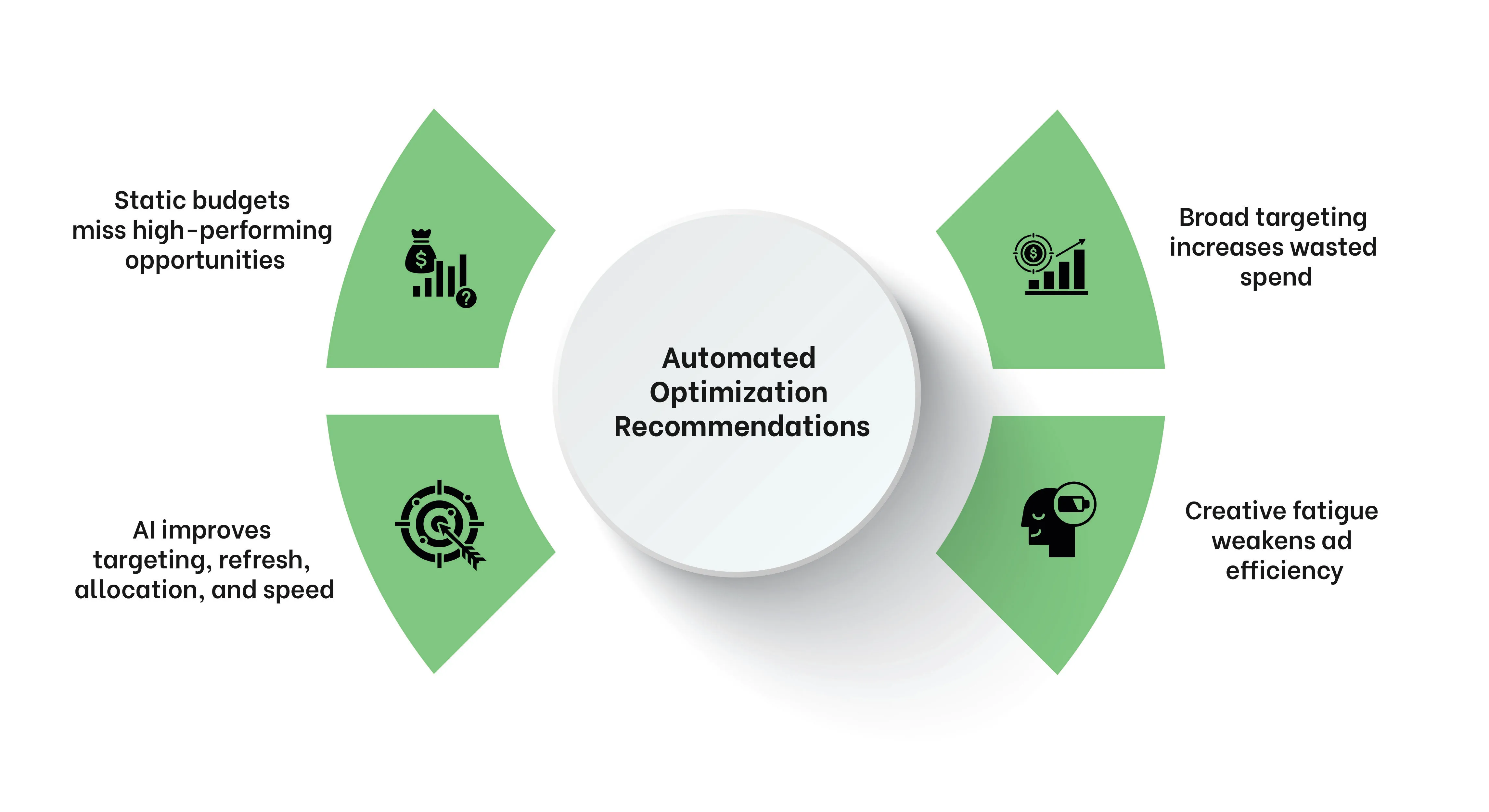
One of the biggest CAC leaks in summer campaigns comes from broad or poorly refreshed targeting. Many beauty brands continue to rely on large interest buckets, stale lookalikes, or generic retargeting pools. That may create reach, but it does not always create efficient conversion.
Agentic AI improves this by clustering audiences based on real intent signals: browsing behavior, product affinity, historical purchase patterns, content engagement, regional responsiveness, and lifecycle position. Instead of “women 24–40 interested in skincare,” brands can move toward dynamic intent-based segmentation. This reduces wasted impressions and improves relevance.
Creative Fatigue
Creative fatigue is one of the clearest reasons summer paid campaigns lose efficiency. When the same ads run too long against the same audience, engagement weakens and cost per result increases. Meta explicitly recommends refreshing creative, widening audiences, and using dynamic experiences when fatigue reduces performance.
Agentic AI helps by accelerating creative iteration. It can identify which hooks, claims, visual structures, UGC formats, and offer framings are weakening, then prompt rapid generation and testing of new variants. Instead of treating creative refresh as a monthly exercise, brands can turn it into a continuous system.
Poor Budget Allocation
Another major leak comes from static budget splits. Many teams assign fixed channel budgets at the start of the month and make only limited adjustments. But high-performing segments and products can change quickly during summer.
Agentic AI can continuously evaluate marginal returns across audiences, creatives, platforms, and products, then recommend or trigger dynamic budget reallocations within approved limits. This is especially useful when one product line begins to outperform, one geography becomes more responsive, or one platform starts generating higher-intent traffic.

Landing Page Drop-Offs
Paid acquisition often gets blamed for weak ROAS when the real issue is landing-page friction. Ad promise and on-site experience frequently do not match. A hydration-led ad may click through to a generic collection page. A sunscreen ad may land users on a cluttered page without clear summer-use-case messaging, review proof, or urgency.
Agentic AI can improve this through page personalization, message matching, variant testing, and behavior-led nudges. If traffic source, audience type, or product intent changes, the site experience can adapt with it.
Delayed Optimization
Perhaps the most expensive leak is delay. Teams often identify underperformance after the damage is already done. Weekly review cycles were manageable in slower environments. In summer beauty campaigns, they are often too late.
Agentic AI reduces this lag by monitoring performance continuously and acting faster. That does not mean removing humans. It means allowing humans to supervise a system that already spots anomalies, flags underperformers, tests alternatives, and recommends next actions in near real time.
The Agentic AI Stack for CAC Reduction and ROAS Growth
Content and Creative Intelligence
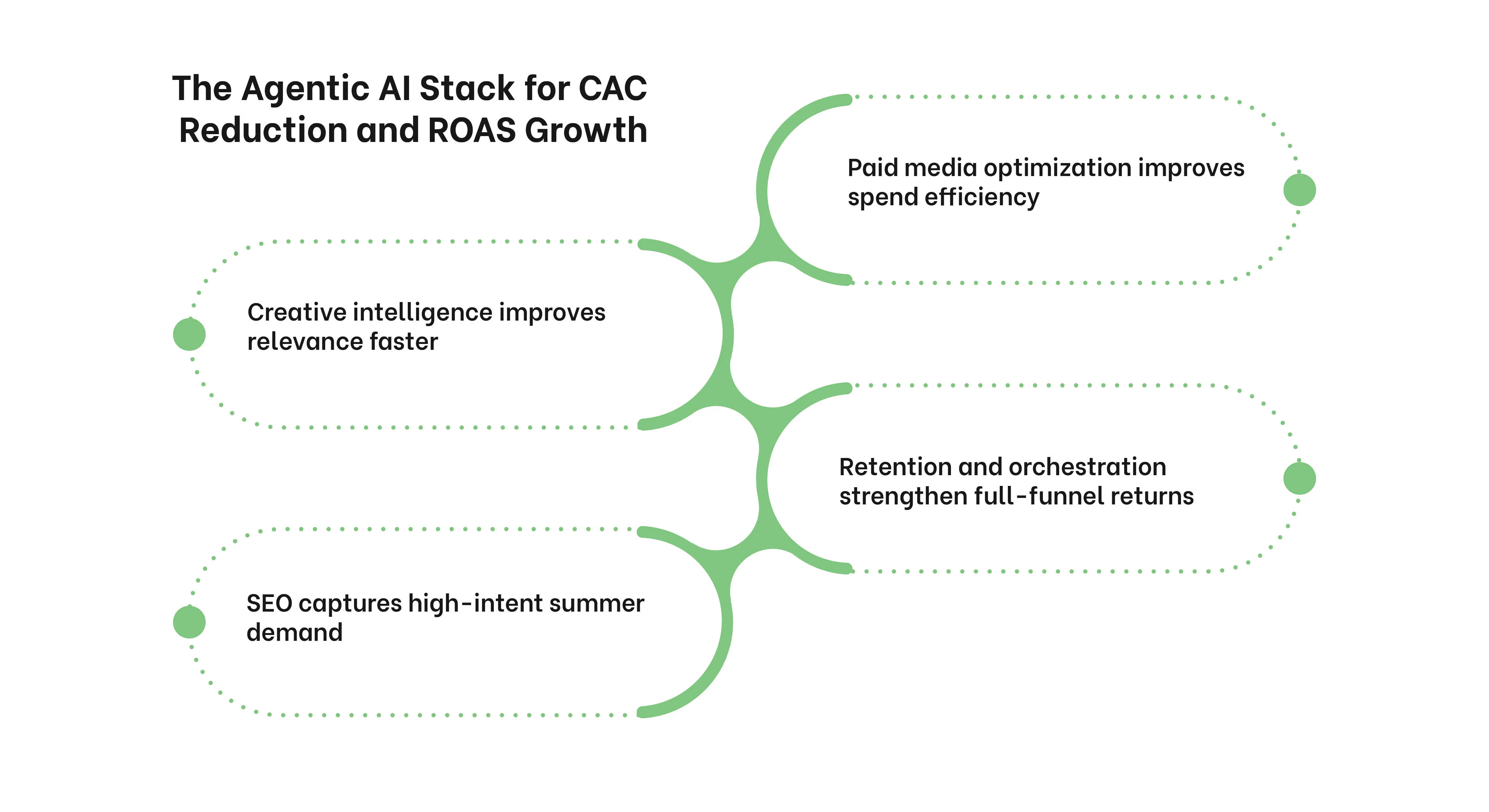
The first layer of the stack is content and creative intelligence. This is where AI supports ideation, variation, personalization, and testing.
For D2C beauty brands, this means generating multiple ad angles for different summer needs: UV protection, dewy skin, sweat-proof makeup, anti-frizz routines, travel kits, hydration bundles, and ingredient-led education. It also means adapting creative to audience maturity. A cold prospect may need education and proof. A retargeted user may need urgency and trust reinforcement.
The value is not just in producing more assets. It is in producing more relevant assets, faster. BCG notes that marketers see effectiveness and personalization as two of the most important value pools from AI in marketing.
SEO and Organic Demand Capture
Summer beauty demand does not only appear in ads. It appears in search. Users look for sunscreen for oily skin, skincare for humid weather, tan removal myths, anti-frizz solutions, body care for summer, and ingredient-specific queries.
Agentic AI can identify emerging search patterns, cluster topics by intent, recommend content opportunities, generate briefs, and even trigger refreshes to key landing pages and articles. That helps brands capture high-intent demand before it becomes paid demand.
This is strategically important because reducing dependence on paid acquisition is one of the cleanest ways to improve blended CAC over time. Strong SEO and content systems create lower-cost traffic, stronger authority, and better remarketing pools.
Paid Media Optimization
In paid media, Agentic AI can act as an always-on optimization layer. It can monitor spend efficiency, detect fatigue, compare performance across campaigns, identify diminishing returns, and recommend or execute changes to bids, budgets, placements, and audience allocation.
This does not replace platform-native automation. It sits above it, adding brand-specific intelligence across channels. Instead of optimizing Meta and Google separately, Agentic AI helps brands optimize the portfolio of demand capture.
Retention and Lifecycle Marketing
The most overlooked route to lower CAC is often stronger retention.
If a summer campaign acquires customers but fails to convert them into repeat buyers, paid efficiency remains fragile. Agentic AI strengthens lifecycle marketing by triggering better post-purchase journeys, replenishment nudges, routine-building content, cross-sell recommendations, and audience-specific offers.
McKinsey’s work on next-best-experience systems shows how AI-driven interaction design can improve revenue and reduce service costs by making customer journeys more timely and relevant.
For beauty brands, this could mean reminding customers when a product is likely to run out, suggesting complementary products based on usage patterns, or tailoring content by skin concern or purchase history.
Workflow Automation and Orchestration
The final layer is orchestration. This is what turns individual AI use cases into a real growth engine.
Orchestration connects ad platforms, analytics, CRM, content workflows, product feeds, web experimentation, and reporting systems. It eliminates manual handoffs. It ensures data flows. It allows decisions made in one part of the system to influence actions elsewhere.
Without orchestration, AI remains fragmented. With orchestration, marketing becomes a connected operating model.
That is the real stack advantage: not more tools, but better coordination.
How Agentic AI Improves ROAS, A Funnel-Wise Breakdown
Agentic AI at the Top of the Funnel Improves Targeting Quality and Creative Relevance. Instead of targeting the same message at broad audiences, it determines which hooks, products, and formats are relevant to each. It improves the CPM spend without improvement in reach and improves engagement rates.
At the Mid Funnel, It Improves Consideration. Users who have visited but not purchased can be retargeted with more of the same content that is relevant, with social proof, education, bundle framing. It can also better sequence the content across channels, increasing the probability that this user is moving forward, instead of falling off.
At the Bottom of the Funnel, It Improves Conversion Rate Optimization. It can find friction on the landing page, trigger more relevant offers, match the message seen and the message on the page, and accept the reality of what is converting now, and change it in real time.
After Purchase, it improves Retention, which is absolutely critical to ROAS economics, even if many teams measure it separately. Repeat purchases, upselling, replenishment journeys, and loyalty-triggered messaging all improve the customer lifetime value and make the acquisition economics more robust.
That is why ROAS Improvement should not be a media buying problem alone. It is a funnel design problem. McKinsey’s research into personalization and AI in marketing consistently shows that there are opportunities to improve ROI, revenue, and acquisition efficiency when the customer experience becomes more relevant and coordinated.
Implementation Blueprint for D2C CMOs
Step 1: Audit the Current Marketing Stack
Start by mapping the current growth system. Where is CAC rising fastest? Where are decisions delayed? Where does data sit in silos? Which channels are over-measured and which are under-connected? Most brands do not need more tools first. They need visibility into current inefficiencies.
Step 2: Define High-Impact Use Cases
Do not attempt a full transformation on day one. Start with high-impact use cases tied directly to margin and growth. For most D2C beauty brands, the best starting points are paid media optimization, creative testing, and lifecycle automation. SEO and content intelligence can follow once the operating model is stable.
Step 3: Deploy Agentic AI Tools Across Channels
The next step is integration. Connect ad data, first-party customer data, site analytics, CRM triggers, and content workflows. The objective is not to automate everything. It is to enable better data flow and faster decisions across the funnel.
Step 4: Set Guardrails
Autonomy without control creates risk. Brand voice, offer rules, budget limits, approval layers, escalation triggers, and testing boundaries should be clearly defined. Effective agentic systems do not remove governance. They embed it.
Step 5: Enable Teams
Perhaps the biggest shift is humans. Teams must move from manually executing every task to managing systems, interpreting signals, and improving decision logic. That is a different capability model. The most effective organizations train marketers to supervise AI, not compete with it.
Anthropic’s guidance on building effective agents is useful here: the strongest results often come from simple, composable systems with clear tools and responsibilities rather than overly complicated architectures.
Related Reads :
Agentic AI and Autonomous Growth for D2C Brands
Agentic AI Revolutionizes Customer Support into Care
Expected Business Impact — Quantified Benchmarks
For D2C beauty and wellness brands, realistic impact should be framed as directional benchmarks, not guaranteed outcomes.
With the right implementation, brands can often target:
- CAC reduction: 15–35%
- ROAS improvement: 20–50%
- Creative output: 5–10x faster and broader
- Campaign launch speed: 3–5x faster
- SEO traffic growth: 30–70% over time
These are reasonable working ranges when brands combine stronger personalization, faster optimization, better creative testing, and tighter channel orchestration. They should be treated as outcome potential, not universal promises. McKinsey’s broader research supports the direction of these gains, noting that personalization can reduce acquisition cost materially, increase revenue, and improve marketing ROI, while AI in marketing and sales has been associated with meaningful uplifts in revenue and sales ROI.
The key point is this : value comes from system redesign, not tool adoption alone.
Common Mistakes to Avoid
The first mistake is thinking of AI as a tool, not a system. If brands are only using AI to generate copy and other parts of the funnel remain siloed, the impact will be limited.
The second mistake is thinking of AI as poorly integrated. If ad data, customer data and website behavior are not integrated, the system cannot make strong decisions.
The third mistake is ignoring data quality. Bad inputs produce bad outputs. Agentic AI amplifies operating quality, but it also amplifies operating weakness.
The fourth mistake is over-automation without human judgment. Brands still need clear approvals, strategic direction and judgment on brand risk.
The fifth mistake is expecting immediate transformation. AI systems get better over time with testing, learning and iteration. The organizations that scale value are typically the ones that commit to operating model change, not just pilot activity. Recent BCG and Deloitte work confirms that many firms invest in AI, but only a smaller group realize material value at scale because integration and maturity matters.

The Future — Autonomous Marketing Systems
The future of marketing is moving from campaign management to system architecture.
The winning D2C beauty brands will not simply be the ones with the biggest budgets or the most content. They will be the ones with the best feedback loops. The ones that can sense shifts faster, personalize journeys better, and reallocate effort continuously.
That is what AI-led growth engines make possible.
For Indian D2C beauty and wellness brands, this shift is especially important. Competition is intense, category education still matters, retention is a major profitability lever, and paid media economics remain volatile. Early adopters of agentic operating models can build an advantage that is difficult to copy because it lives in execution quality, not just campaign ideas.
The long-term shift is clear: marketers will spend less time coordinating tasks and more time designing decision systems.
The New Growth Playbook
The new summer growth mantra in D2C beauty is a CAC versus ROAS tightrope act. Brands want scale, but scale with no efficiency kills margin faster than it builds growth.
Agentic AI flips the script by empowering brands to move from fragmented campaign execution to connected marketing systems. Brands can observe quicker, decide smarter, and act faster across paid media, SEO, content, landing pages, and retention.
That is the real shift.
The opportunity is not just smarter summer campaigns – it is a more robust growth engine for all seasons thereafter. Brands that make this shift early won’t only optimize campaigns better. They’ll run marketing differently.
And in a more competitive D2C beauty market, that difference will count.
Authors

AVP & Associate Partner (Digital Transformation)
%20(5).webp)
%20(2).webp)
.webp)
.webp)
.webp)
.webp)

.jpg)
.jpg)


.webp)