How Generative AI Reshaping Consumer Retail Decisions

Generative AI Is Quietly Changing Retail Decisions For Consumers

February 4, 2026
Artificial Intelligence
Generative AI Is Quietly Changing Retail Decisions For Consumers
Key Takeaways
- Indian shoppers are increasingly using Generative AI as a trusted advisor for product discovery, comparison, and validation.
- GenAI is shifting retail influence from search rankings and ads to contextual answers and recommendations.
- Consumer brands must rethink customer experience, content strategy, and discovery through the lens of AI-mediated journeys.
- Optimizing for GenAI search requires clarity, credibility, and consistency rather than keyword tactics.
- GenAI success is not dependent on technology alone, but organisational readiness, culture, and governance.
The Invisible Shopping Guide
A consumer in Mumbai wants to buy a new pair of running shoes. Instead of browsing multiple e-commerce apps or scrolling through influencer reels, she asks a generative AI tool a simple question:
“Which running shoes are best for flat feet and Indian roads under ₹6,000?”
The answer she receives is structured, calm, and practical. It explains cushioning, durability, brand reputation, and suitability for Indian conditions. A few brands are named with reasons. Many others are not mentioned at all.
The above example represents a common yet profound shift in how retail decisions are made today. Generative AI is becoming an invisible but influential layer in the Indian shopping journey. It does not replace marketplaces or brand websites, but it increasingly determines which brands enter the consumer’s consideration set in the first place. For consumer brands, this marks a fundamental change in how discovery, trust, and experience are built.
India has emerged as one of the fastest adopters of Generative AI in consumer decision-making. A recent study has found that more than 70 percent of Indian consumers are open to using GenAI tools for shopping-related decisions. This includes researching products, comparing alternatives, understanding value, and validating brand claims.
Several factors accelerate this trend in India. Smartphone penetration is high, digital commerce is deeply embedded, and consumers are accustomed to navigating complexity across price, quality, and trust. GenAI reduces cognitive load by synthesizing information into digestible guidance.
Unlike traditional search engines that return links, GenAI offers answers. This distinction matters because it shifts power from those who rank highest to those who are easiest to understand and most credible.
Indian consumers are not using GenAI to shop impulsively. They are using it to feel confident. In categories such as beauty, wellness, electronics, fashion, and home products, GenAI acts as a neutral interpreter between brand messaging and personal needs.
Shoppers commonly rely on GenAI to shortlist products based on suitability rather than popularity, compare ingredients or specifications, summarize reviews, and decode technical information into plain language. Many also use it to verify influencer claims or marketing promises, especially in categories where misinformation is common.

What This Shift Means For Consumer Brands
For decades, consumer brands have optimized for reminder-driven discovery. Shelf presence, search rankings, and media frequency were always central to any marketing or branding activity. GenAI changes this by inserting an advisory layer between consumer intent and brand exposure.
If a brand is not clearly understood by AI systems, it risks becoming invisible at critical decision moments. GenAI does not reward volume. It rewards coherence. The implication is clear. Consumer brands must shift from promotional thinking to explanatory thinking. There are several key factors that need to be understood in this context. Understanding these factors leads us directly to their solutions of how brands can use GenAI for better customer experience.
- Emergence Of GenAI Search And Answer-Led Discovery - Traditional search optimization focuses on ranking. GenAI search focuses on reference.
When a consumer asks an AI system for recommendations, the system synthesizes information from multiple sources and produces a single response. Brands are not competing for clicks. They are competing to be mentioned. This means success depends on whether a brand is clearly associated with a problem, a use case, or a context. GenAI systems look for consistency across sources, factual clarity, customer sentiment, and topical authority.
Brands that rely on fragmented messaging or exaggerated claims struggle to appear credible in AI-generated answers. In contrast, brands with clear positioning and educational content are referenced more often.
- Using GenAI As A CX Multiplier - Generative AI does not stop influencing the journey at discovery. It is reshaping expectations across the entire customer experience. The answer to these enhanced expectations lies in AI-powered assistants on brand websites, apps, or support channels.
Research on GenAI in retail indicates that brands integrating AI-driven insights into customer experience and content strategy see higher engagement, improved satisfaction, and faster conversion cycles. These gains come not from novelty, but from relevance.
How Consumer Brands Can Upgrade Their GenAI Game
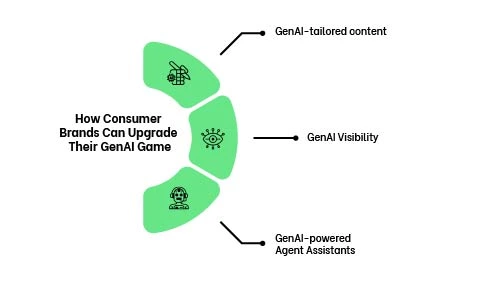
Optimizing for GenAI search is not just a technical trick. It is a strategic discipline rooted in communication quality. There are several ways for brands to feature and rank higher in GenAI searches of prospective consumers:
- GenAI-tailored content - Brands must shift from keyword-centric content to question-centric content. Indian consumers ask practical, context-rich questions shaped by climate, lifestyle, budget, and cultural preferences. Content that anticipates and answers these questions stands a better chance of being surfaced by GenAI.
Equally important is structure. AI systems favor content that is easy to parse, consistent across platforms, and grounded in facts. Product descriptions, FAQs, blogs, and marketplace listings should tell the same story in the same language. A single, unified narrative across channels helps AI systems build confidence in recommending a brand.
- GenAI Visibility - Generative AI learns from the open web, and customer voice plays a critical role in shaping that learning. Reviews, discussions, and feedback provide context that brand-owned content alone cannot supply. Brands that encourage authentic, detailed reviews and address concerns transparently are better positioned in GenAI-driven discovery. When brand claims align with real customer experiences, AI systems are more likely to surface them as trustworthy options. This alignment between promise and proof is becoming a decisive factor in visibility.
- GenAI-powered Agent Assistants - When customers interact with AI-powered brand assistants they expect the same clarity and personalization they experience during pre-purchase research. Leading consumer brands are beginning to embed GenAI across touchpoints to meet this expectation.
This means AI-driven advisors that help customers choose the right variant, shade, or size; content that simplifies complex ingredient or nutrition information; and post-purchase guidance that adapts to usage behavior. In categories like beauty and apparel, this approach has already shown measurable results.
Research indicates that AI-enabled personalization can lift conversion rates by 10-15 percent while reducing returns by up to 20 percent. For Indian brands operating at scale, these improvements directly impact profitability.
For a D2C wellness brand operating in, say, India’s crowded herbal supplements market. Initial growth would depend heavily on paid acquisition and influencer partnerships. Organic discovery is limited, and customers often seek reassurance before purchase.
Then the brand invests in educational content explaining ingredients, sourcing, and benefits in the context of Indian diets and lifestyles. Messaging was standardized across its website, marketplaces, and support channels. Customer questions are analyzed and addressed proactively.
Within the next six months, organic traffic increases by over 30 percent, customer support queries reduce, and the brand begins to appear more frequently in AI-generated responses related to immunity and wellness. Conversion rates improve not because of louder promotion, but because of clearer understanding.
Starting Strategic Without Overwhelming The Organization
Not every brand needs a sweeping GenAI overhaul on day one. The most effective approach is to start with a few high-impact use cases aligned with core business goals.
Many brands begin by using GenAI to accelerate content creation, summarize customer feedback, or support internal research. These applications deliver immediate productivity gains while building familiarity and trust.
Senior leaders play a critical role by using GenAI themselves. When leadership engages actively, adoption accelerates across the organization.
Related Reads :
Pre-emptive business transformation can be the key to resilience during uncertain times.
Create Sustainable Value With Unrivaled Winning Strategies
Governance, Responsibility, And Trust
As GenAI becomes customer-facing, governance becomes essential. Brands must establish clear guidelines around claims, data usage, and AI-generated content. Oversight mechanisms ensure consistency, fairness, and compliance.
Responsible AI is not a constraint. It is a foundation for trust. In a market like India, where consumers are increasingly discerning, transparency and accountability strengthen brand equity.
Why People And Process Matter More Than Models
Organizations are rapidly adopting generative AI to boost productivity for back-end tasks. While these implementations show promise, real value can also come from using it to improve consumer experience.
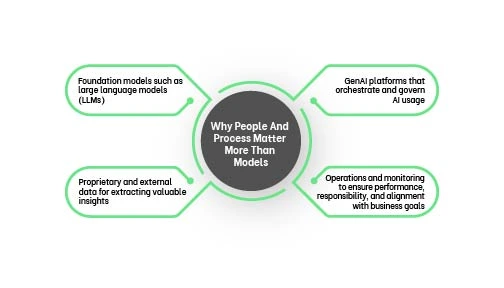
Organisations need a strong digital and organizational backbone to support GenAI at scale. A robust enterprise GenAI foundation rests on four core capabilities:
- Foundation models such as large language models (LLMs)
- GenAI platforms that orchestrate and govern AI usage
- Proprietary and external data for extracting valuable insights
- Operations and monitoring to ensure performance, responsibility, and alignment with business goals.
With these elements in place, organizations can create GenAI-driven value for their consumers.

Conclusion
Generative AI is reshaping retail from discovery to decision. In India, this transformation is happening rapidly and quietly. Consumers are already asking AI before they ask friends, influencers, or sales associates.
The brands that succeed will not be those that chase every new tool. They will be the ones that focus on clarity, credibility, and customer understanding. In a world where machines mediate discovery, being human in how you explain, educate, and support becomes the ultimate advantage.
The future of retail will belong to brands that are not only searchable, but understandable.
Read Our Other Insights : AI Transforming Retail Pricing and Store Operations
Authors
.webp)
Sr Consultant (Digital Growth & Marketing 4.0)
%20(5).webp)
%20(2).webp)

.webp)
.webp)
.webp)
.webp)

.jpg)
.jpg)