
AI Transforming Retail Pricing and Store Operations | Cognitute

How AI Is Rewiring Merchandise Pricing And Retail Store Operations
.webp)
March 31, 2026
Artificial Intelligence
How AI Is Rewiring Merchandise Pricing And Retail Store Operations
Why I believe the next era of retail advantage will not be built on better promotions alone, but on intelligent pricing systems that turn stores into adaptive commercial engines
I have spent enough time around growth, transformation, and operating-model conversations to know that retail leaders rarely struggle because they lack ambition. More often, they struggle because the commercial system underneath the business is too rigid for the market they are now competing in.
That is exactly what I see happening in merchandise pricing and retail store operations.
For years, most retailers have tried to improve performance through familiar levers: sharper promotions, tighter procurement, better store formats, more digital traffic, faster fulfillment, stronger loyalty mechanics. All of those still matter. But I believe a deeper shift is underway. AI is not just making retail more automated. It is making retail more adaptive.
That distinction matters.
Automation helps you do the same thing faster. Adaptation helps you make better decisions as conditions change.
And in retail, conditions now change constantly. Customers compare prices faster. Competitors react faster. Demand patterns shift faster. Inventory gets stranded faster. Margin disappears faster. Stores feel the pressure first.
So when I look at AI in retail, I do not start with chatbots or content generation. I start with the commercial heart of the business: pricing, promotions, inventory, execution, and store-level decision-making.
That is where the real rewiring is happening.
This is also where many leadership teams are underestimating the scale of the opportunity. They still think of pricing as a merchandising lever and stores as an execution channel. I think that mental model is getting outdated. Pricing is becoming a dynamic intelligence layer. Stores are becoming real-time sensing and response environments. And the retailers that connect those two faster than others will create a very different kind of advantage.
Not a louder advantage. Not cosmetic advantage. System-level advantage.
This piece is my attempt to unpack that shift in a way that is useful for operators, founders, CXOs and transformation leaders. I want to move beyond the shallow narrative of “AI will optimize prices” and get to the more important question:
What happens when AI starts rewiring the logic of how retail decisions get made, executed, and learned from across the store network?
That is the real story.
Executive Summary
I see AI changing retail in two tightly connected ways.
First, it is turning merchandise pricing from a periodic, merchant-led, spreadsheet-heavy activity into a faster, more context-aware operating capability. That includes retail price optimization, dynamic pricing in retail, markdown optimization, promotion strategy, and inventory-linked price decisions.
Second, it is changing retail store operations by connecting price decisions to shelf execution, replenishment, labor prioritization, task management, markdown timing, and customer experience.
This means the future of retail pricing is not really about price in isolation. It is about building an adaptive commercial system where AI helps answer questions like:
- What should this item cost right now?
- In which stores?
- In which channel?
- For which customer segment?
- Against which margin target?
- Given what inventory position?
- With what effect on replenishment, labor, and customer trust?
That is a fundamentally different operating model.
I also believe many retailers are framing the opportunity too narrowly. The most important gains will not come from aggressive real-time price changes for every SKU. They will come from tighter alignment across:
- price architecture
- promotional discipline
- demand forecasting
- markdown timing
- inventory optimization
- shelf accuracy
- store execution
- omnichannel consistency
In other words, AI is not just helping retailers find a better price. It is helping them build a better decision system. That sounds exciting, and it is. But it also raises real questions. The moment you bring AI into pricing, you are also bringing in issues of trust, governance, fairness, team design, and operational feasibility. A retailer can absolutely make mathematically smarter decisions and still make strategically worse ones if it fails to define guardrails.
My view is simple: the winners in this space will not be the retailers that automate the most. They will be the ones that combine AI with the clearest commercial logic, strongest operational discipline, and most deliberate trust architecture.
That is the leadership challenge now.
Introduction: retail does not have a pricing problem. It has a decision-speed problem.
When leaders tell me they want to “improve pricing,” I often think they are describing a symptom rather than the root issue.
The deeper problem is usually this: the business is making too many important commercial decisions too slowly, too broadly, and with too little operational feedback. That is not because people are weak. It is because the legacy system was built for a slower market.
In the traditional model, pricing is often set through a familiar pattern. Merchants review historical performance. Analysts compare some competitor data. Promotions are layered in through a calendar. Markdown decisions happen once sell-through starts looking weak. Stores then execute tags, signage, and exceptions as best they can. After the period ends, everyone reviews what happened and makes a few adjustments next cycle.
That system is not irrational. It made sense in a world with lower price transparency, simpler channels, and slower competitive movement. But that is not the world retailers live in now.
Today, customers do not just see your price. They see your competitor’s price, your marketplace listing, your delivery promise, your stock availability, your offer mechanics, your product reviews, and your substitutes. They may see all of that before they ever enter your store or land on your product page.
That means pricing is no longer a periodic signal. It is part of a live competitive environment. And the store is no longer just the endpoint of strategy. It is where strategy gets stress-tested in real time.
That is why I think the old conversation around AI in retail is too shallow. The better question is not whether AI can help set prices. Of course it can. The better question is whether AI can help retailers build an operating model that is fast enough, granular enough, and disciplined enough for the reality they now face.
I believe the answer is yes. But only if leaders understand that this is not just a technology upgrade. It is a redesign of how the commercial machine works.

What AI in merchandise pricing actually means, beyond the buzzwords
Whenever a new technology wave hits retail, the language gets blurry fast. So let me define this clearly.
AI in merchandise pricing is the use of machine learning, predictive analytics, optimization models, and decision intelligence to improve how retailers set, adjust, test, and execute prices across products, stores, channels, and time periods.
That includes:
- base price setting
- competitor-aware pricing
- promotion optimization
- markdown optimization
- local pricing logic
- inventory-linked price decisions
- targeted offers
- assortment-sensitive pricing
- channel harmonization
It does not only mean prices changing every hour.
I think that misconception has slowed down a lot of useful strategic thinking. The phrase dynamic pricing in retail often creates an image of constant volatility, where shelf prices move every few minutes and customers feel manipulated. That is one possible expression of AI pricing, but it is far from the whole picture.
In practice, many of the most valuable AI-led pricing decisions are less flashy and much more operationally important.
For example:
- deciding when not to discount a product that would sell anyway
- identifying when a markdown should be narrower by store cluster
- knowing which competitor moves actually matter
- seeing when a promotion is driving incrementality versus subsidizing planned demand
- detecting when inventory age should trigger a different price response
- aligning app offers with shelf-level realities in store
- understanding which products should protect perception and which can flex for margin
That is where the game changes.
AI is not valuable because it creates chaos faster. It is valuable because it can bring more intelligence to complexity without forcing a business to simplify reality into crude averages.
That is why I find this moment so interesting. For a long time, retailers had to choose between control and granularity. AI is beginning to let them pursue both.
The idea I find most exciting: pricing is becoming a living system
Here is the biggest idea I would put in front of any retail leadership team right now:
Pricing is no longer a number. It is a system of interdependent decisions.
Once you see that clearly, a lot of the future snaps into focus.
A price point is never just a price point. It is tied to:
- inventory health
- customer perception
- promotional cadence
- category role
- store labor
- shelf accuracy
- basket composition
- substitution patterns
- replenishment behavior
- markdown risk
- channel economics
That means every price change is, whether you realize it or not, an operational decision.
I think this is where retailers can unlock a much more powerful management model. Instead of managing price, inventory, and stores as adjacent functions, they can begin to manage them as a shared intelligence system.
That opens up a new possibility: the store becomes not just a place where prices are executed, but a place where the business learns.
Imagine a retail network where price actions, stock behavior, local traffic, shelf compliance, promo response, and basket changes all feed back into the next commercial decision. Not in a retrospective deck six weeks later. In a living loop.
That changes the rhythm of management.
It also changes what leadership needs to care about. The question is no longer just, “Did the promotion work?” It becomes, “What did this system learn about customer elasticity, store readiness, inventory risk, and margin quality from the way this action performed?”
That is a much more interesting question.
And it is the kind of question AI is particularly good at helping retailers answer.
Why the old pricing model is reaching its limit
I do not think the old model is broken because retailers were careless. I think it is reaching its natural limit because the market has become more fluid than the model was built to handle.
Let me describe the old model in human terms.
A category manager knows the category. A pricing analyst knows the historicals. A promo team knows the calendar. A store operations lead knows how much execution pain the field can absorb. A supply chain lead knows where stock is tight and where it is aging.
The problem is that all of those truths sit in different places, at different speeds, with different incentives.
So decisions get made in fragments.
The merchant wants volume.
Finance wants margin.
Marketing wants excitement.
Stores want simplicity.
The supply chain wants stability.
Ecommerce wants speed.
Everyone is rational in their own lane, and the total system ends up being less rational than it should be.
That is why I do not see AI as a clever add-on. I see it as a forcing function. It exposes the cost of fragmented commercial decision-making.
It also exposes how much value is lost in the handoffs.
A promotion is launched, but replenishment is late. A markdown is approved, but the store does not execute it cleanly. A price move is made online, but store teams are not aligned.
A clearance event begins, but it is too broad because the system cannot isolate where the inventory problem really sits. A competitor move triggers a reaction, even though that product was not actually important to the customer’s value perception.
These are not dramatic failures. They are ordinary retail leaks.
But when they happen across hundreds of stores and thousands of SKUs, they become strategic. That is why I believe AI pricing matters less as a model and more as a management upgrade. It gives retailers a chance to close the gap between decision quality and decision execution.
The most important shift: AI is merging pricing with store operations
This is where I think the conversation gets really interesting.
Most discussions about AI pricing stay trapped in the pricing team. They focus on algorithms, competitor intelligence, elasticity, and discount depth. All of that matters. But the bigger transformation happens when those pricing decisions start affecting the store.
Because the store is where pricing becomes real.
A shelf label is real. A missing promo sign is real. A stockout on a promoted item is real.
A confused associate trying to explain a mismatch between app price and shelf price is real.
A clearance table that was not reset in time is real.
This is why I keep coming back to a simple belief: the future of retail pricing will be won or lost in store operations. If AI recommends a brilliant price and the store cannot execute it, the value is theoretical.
If AI helps the business understand which actions are worth executing, in which stores, with what labor load, and with what likely return, then something much more powerful happens. Pricing becomes operationally intelligent. That is the rewiring.
It is not just about choosing the right price. It is about making the whole commercial machine work with more coherence. I find that exciting because it pushes retail into a more integrated future. It forces central teams and field teams to operate from the same logic rather than from different assumptions.

Seven ways AI is changing merchandise pricing right now
1. It is making base price architecture smarter
In many retail businesses, base prices are still shaped by broad category rules, rough value ladders, and historical precedent. AI can improve that by identifying more nuanced demand patterns, product roles, and local sensitivities.
What excites me here is not the idea of hyper-complex pricing for its own sake. It is the possibility of building cleaner architecture.
A retailer should know which products are price beacons, which products can carry margin, which products drive cross-basket behavior, and which products are strategically defensive. AI helps separate those roles more clearly.
That creates a stronger foundation for every decision that follows.
2. It is changing how retailers respond to competitors
A lot of retailers still waste margin by reacting too broadly to competitor pricing.
I think one of the most powerful uses of AI is not faster matching. It is a smarter restraint.
Not every competitor's move deserves a response. Not every visible price gap hurts you. Some products are highly exposed. Some are more insulated by convenience, brand strength, or assortment uniqueness. AI helps retailers understand where competitive pricing truly affects demand and where the business is simply giving money away by overreacting.
That is a more mature way to think about retail price optimization.
3. It is exposing the real economics of promotions
Promotions are one of the most emotionally loaded parts of retail. Teams love them because they feel active. Customers notice them because they are visible. Leadership likes them because they create momentum. But I have seen too many businesses confuse motion with value.
AI can help retailers answer a much tougher question: did the promotion create incremental demand, or did it simply discount the demand that would have come anyway? That is a critical difference.
If a business gets better at measuring incrementality, cannibalization, halo effects, and store-level execution quality, promotions start to look very different. The retailer stops thinking only in terms of sales spikes and starts thinking in terms of margin quality and operational burden. That is a healthier commercial conversation.
4. It is transforming markdowns from art into managed strategy
Markdowns are where a lot of margin silently disappears.
In sectors like fashion, beauty, grocery, and seasonal retail, markdown timing is one of the most consequential choices in the system. Move too late and you carry pain. Move too early and you surrender recoverable value. Move too broadly and you train customers to wait.
AI helps because it can forecast the likely sell-through outcome of different markdown paths based on stock age, local demand, seasonality, size curves, and store context.
I think this is one of the clearest examples of AI making retail more intelligent rather than merely more automated.
5. It is bringing personalization into value delivery
Not every pricing advantage needs to be public. One of the more promising areas is AI-led targeted offers, where retailers use loyalty and behavior signals to deliver value more selectively. This can be very effective. But I also think it is one of the areas where leaders need to be most thoughtful.
A pricing system that becomes too opaque can damage trust. A loyalty program that behaves like a secret discount engine can train unhealthy customer expectations. A retailer that personalizes everything may lose the strength of having a clear public value position. So yes, targeted pricing and offers are powerful. But they should serve strategy, not replace it.
6. It is making omnichannel pricing harder to fake
For years, many retailers have lived with a quiet contradiction. They claim to offer seamless omnichannel experiences, but their pricing logic across stores, websites, apps, and marketplaces is often inconsistent in ways that are difficult to defend.
AI raises the bar here because it can expose those inconsistencies much faster. That may feel uncomfortable at first, but I think it is healthy. It pushes businesses to answer foundational questions about channel economics and customer expectations.
Should every price match across channels? Not always.
Should every difference have a reason? Absolutely.
7. It is creating actual learning loops
This may be the most underrated shift of all. In the old model, retailers often review pricing outcomes in lagged summaries. By the time the postmortem happens, the context is gone and the learning is weak.
AI makes it possible to build tighter learning loops. That means the system can begin to understand not just what happened, but why it happened, where it happened, and under what conditions a similar decision should or should not be repeated.
This is where pricing starts to feel less like judgment under uncertainty and more like an improving capability. That is hugely important over time.
The store is becoming an intelligence environment
I want to stay on this idea because I think it has massive implications for how we design retail for the next decade. For a long time, stores were treated mainly as physical distribution points for pre-decided strategy. The head office made choices. Stores executed them.
That model is giving way to something more interesting. Stores are becoming information-rich operating environments. Think about the signals that can now flow through a store ecosystem:
- POS behavior
- basket composition
- stock velocity
- local sell-through
- footfall patterns
- shelf compliance
- digital label updates
- markdown execution
- staff task completion
- loyalty-linked behavior
- local weather and event effects
- in-store substitution patterns
Once those signals become visible, the store stops being merely the endpoint of decision-making. It becomes part of the decision engine. That changes what “store operations” means.
It is no longer just about consistency, labor, and standards, though those remain essential. It is also about responsiveness. The best retail operations teams will increasingly act like field-level intelligence systems, helping the business adapt faster and with more precision.
I think that is one of the most exciting leadership opportunities in retail right now because it upgrades the role of the store instead of reducing it.
Five big operational shifts I see coming inside the store
1. Price execution will become more precise and less manual
One of the biggest hidden costs in retail is the messiness of price execution.
Shelf labels lag. Promotional materials are late. POS does not reflect the intended offer. Associates spend time resolving exceptions.
As digital shelf infrastructure, task orchestration, and AI-led monitoring improve, pricing execution will become far more accurate. That means fewer mismatches, fewer service headaches, and tighter commercial control.
2. Replenishment will become more commercially aware
Traditional replenishment systems often operate as if pricing and promotions are separate layers added after the fact. That is no longer good enough.
I expect the most advanced retailers to link price actions more tightly with stock forecasts, local demand signals, and channel behavior. That means replenishment will become more dynamically aware of commercial intent.
This is one of those shifts that may sound technical, but the business effect is enormous. A promotion that is stocked correctly is a growth driver. A promotion that creates empty shelves is just a margin giveaway.
3. Labor planning will become more strategic
I rarely see enough discussion about labor in AI pricing conversations, and I think that is a mistake.
Every price reset, markdown event, shelf correction, and promo execution task consumes labor. If the model increases store complexity without accounting for store capacity, it is not optimizing the system. It is externalizing the cost.
The smarter future is one where AI recommendations account for operational effort, not just revenue opportunity. That creates a more humane and more effective store model.
4. Local pricing will become possible, but not unlimited
AI gives retailers the ability to localize decisions more precisely by store cluster, demand profile, and competitive context.
That is powerful. But I would caution against assuming maximum localization is always best.
The real question is not “How localized can we get?”
It is “How much localized complexity can the organization absorb while still staying understandable to customers and executable in stores?” That is where thoughtful operating design matters.
5. Waste reduction will become a commercial advantage
In categories with shelf-life pressure, expiry constraints, seasonal relevance, or fast fashion dynamics, AI can materially improve how retailers move inventory before it loses value.
I think this is one of the most underappreciated strategic gains from AI store operations. Better markdown discipline is not just a margin story. It is also a waste story, a sustainability story, and an operating discipline story. And increasingly, those narratives are converging.
The next frontier is not dynamic pricing. It is dynamic retail orchestration.
This is one of the newer ideas I think leaders should pay attention to.
We have spent a lot of time talking about dynamic pricing, but I believe the bigger future is dynamic retail orchestration. By that, I mean a system where price is only one of several levers being continuously tuned against live business conditions.
Imagine a retailer that does not just ask, “Should this item be discounted?”
Instead, it asks:
- Should this item be discounted?
- In which stores?
- Or should it be bundled?
- Or moved in placement?
- Or targeted to loyalty members?
- Or supported with replenishment?
- Or protected because it anchors category trust?
- Or left alone because the apparent pricing issue is actually an execution issue?
That is a much more sophisticated question set. And I think that is where the real future lies. Not in letting AI change prices all the time, but in letting AI help retailers choose the best combination of actions across pricing, promotion, inventory, placement, and labor.
That is a richer operating logic. It also means the future winners may not be the retailers with the most advanced pricing engine. They may be the retailers with the best cross-functional orchestration layer. That idea deserves more attention.
What many retailers still misunderstand about AI pricing
I want to be direct here because this is where I see a lot of wasted energy.
The mistake is assuming AI will create value simply because it creates more granularity.
Granularity is not a strategy.
A business can absolutely price by store, by cluster, by daypart, by channel, by segment, and still create confusion, destroy trust, and overwhelm operations. More intelligence in the system is only helpful if the system itself has clear principles.
So before a retailer gets excited about model sophistication, I think it needs to answer some basic questions:
- What are we trying to be known for on price?
- Which categories matter most to value perception?
- Where do we want stability and where do we want flexibility?
- How much variation can our stores execute well?
- What kind of price behavior will customers accept from us?
- Which decisions can be automated safely and which need human review?
If those answers are fuzzy, AI will not solve the problem. It will scale the confusion.
That is why I keep coming back to the leadership layer. This is not a model question first. It is a management question first.
Why trust is now a pricing capability
This may be the most important non-technical point in the whole article. In the old world, price trust was often managed through visible consistency and broad promotional logic. In the AI era, trust has to be designed more deliberately.
I believe customer trust is becoming a pricing capability in its own right. That means retailers need to think beyond what the model can do and ask what customers will tolerate, understand, and accept.
For example:
- Frequent changes may be acceptable in travel or mobility, but feel manipulative in staple retail categories.
- Personalized offers may feel rewarding in a loyalty context, but unfair if the logic becomes too opaque.
- Aggressive markdowns may help move stock, but can also train customers to wait for discounts.
- Cross-channel price gaps may be tolerated when they are explainable, but not when they feel random.
That is why every AI pricing program needs a trust architecture.
I would build it around a few principles:
- price stability for trust-sensitive categories
- clear rules for promotions and markdowns
- guardrails around personalization
- defined limits on volatility
- human review for sensitive decisions
- auditable explanations for major price moves
- internal alignment across finance, commercial, legal, and CX
This is not bureaucracy. It is a strategic design. I actually think the retailers that win trust in an AI-shaped market will gain a much stronger brand advantage than those that simply optimize most aggressively.
Related Reads :
Digital Orchestration in Multi-Campus Schools
360° Customer Intelligence for Modern D2C Brands
The real obstacle is not the algorithm. It is the operating model.
I have seen enough transformation programs to know that organizations love to blame tools for problems that are really structural. If an AI pricing initiative underperforms, the root cause is often one of these:
- unclear pricing architecture
- low-confidence data
- fragmented ownership
- too many overrides
- weak field execution
- no change management
- conflicting KPIs
- poor measurement logic
Those are not model issues. They are operating model issues.
And this is where leaders need to be honest with themselves.
If your merchant team does not trust the data, they will override the model.
If your store teams are already overloaded, they will resist additional complexity.
If your finance team measures only immediate margin impact, they may reject actions that improve overall economics.
If your organization still treats ecommerce and stores as separate commercial realities, omnichannel pricing will remain inconsistent.
So yes, AI is transforming retail. But it is also exposing which retailers have the management maturity to use it well.
That is one reason this topic sits so naturally at the intersection of Strategy Consulting, Business Transformation, Digital Transformation, and Data Analytics. The challenge is not simply to install intelligence. It is to redesign how the business thinks and acts around it.
A better way to think about maturity: from pricing function to commercial nervous system
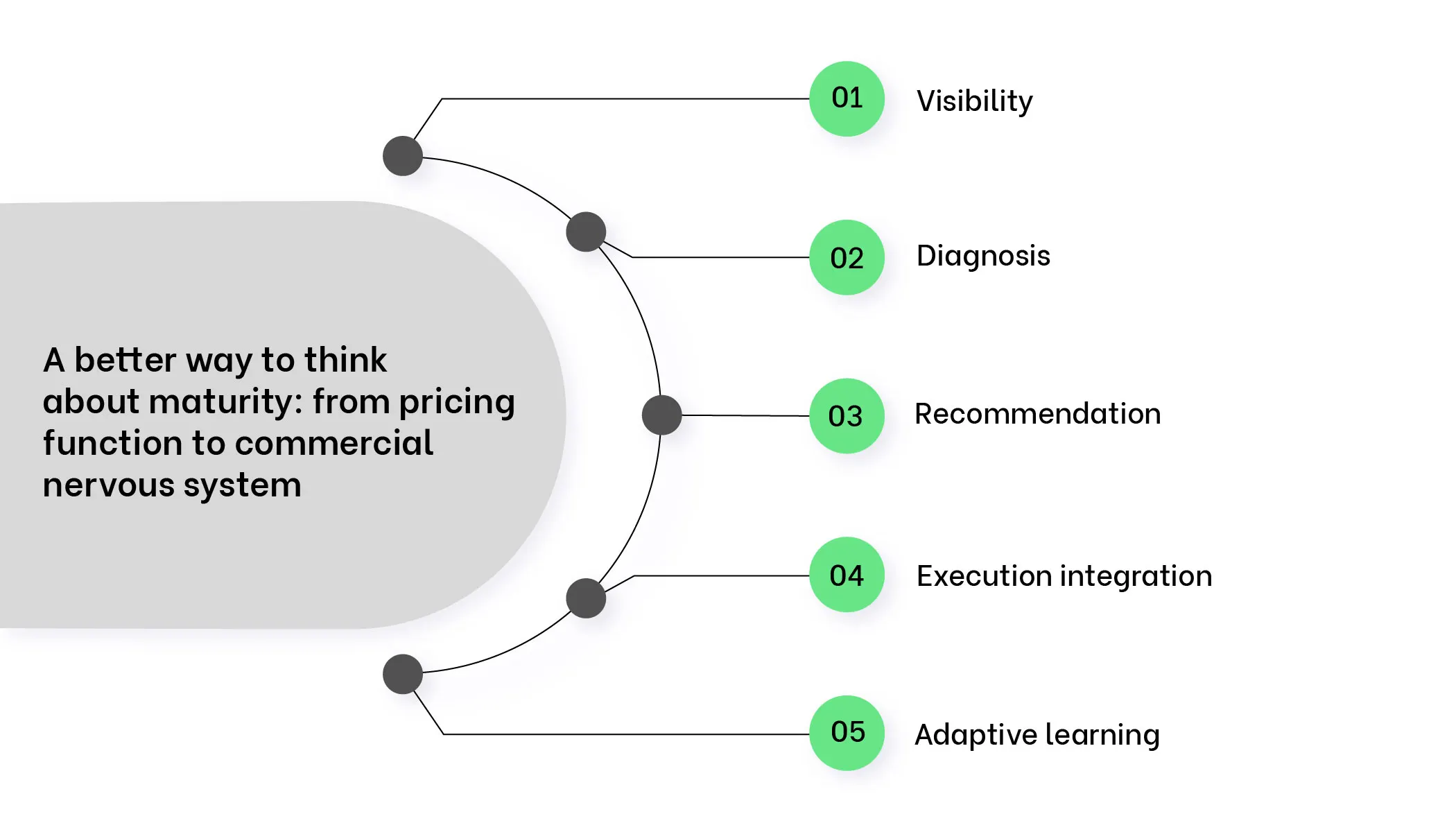
Here is a framework I find helpful.
Instead of asking whether your business has an AI pricing capability, ask where you are on the journey from isolated pricing function to integrated commercial nervous system.
Stage 1: visibility
You can see core data on sales, prices, stock, promotions, and basic competitor benchmarks.
Stage 2: diagnosis
You can understand elasticity, promotion response, markdown effectiveness, and meaningful differences across store clusters or channels.
Stage 3: recommendation
The system can suggest pricing or promotional actions with enough confidence to influence decisions.
Stage 4: execution integration
Those recommendations are connected to approvals, store tasks, replenishment logic, and operational measurement.
Stage 5: adaptive learning
The business is continuously learning from outcomes and improving how it prices, promotes, stocks, and executes.
Most retailers talk about Stage 5 while still wrestling with Stage 2. I do not say that critically. I say it because realism is useful. The good news is that retailers do not need perfect maturity to create value. But they do need enough honesty to start in the right place.
Category strategy still matters more than the technology
One of the risks in AI conversations is that businesses start speaking as if all categories should behave the same way once the data gets good enough. I do not believe that.
A grocery retailer, a premium beauty brand, a value fashion chain, and an electronics specialist should not pursue the same pricing behavior just because they have access to similar AI tools.
Category economics still matter.
Brand positioning still matters.
Customer trust still matters.
The role of promotions still matters.
The store labor equation still matters.
In grocery, the biggest opportunity may be waste reduction, competitor index control, and value architecture on essentials. In fashion, the highest returns may sit in markdown optimization, size-curve management, and localized sell-through decisions.
In beauty, the more interesting question may be how to preserve premium perception while using targeted offers intelligently. In electronics, competitor-aware pricing matters more, but margin defense is often more subtle than constant matching.
This is why I think leaders need to resist generic AI playbooks. The most effective strategy is always category-aware.
The omnichannel challenge is becoming impossible to ignore
If there is one area where AI will force harder conversations, it is omnichannel pricing consistency. Customers already live in a fluid journey.
They browse online, check in-app, visit stores, compare marketplaces, ask assistants, and jump between fulfillment options.
The business, meanwhile, may still operate with separate economics, different teams, and inconsistent pricing logic across those surfaces. AI will make those inconsistencies more visible, not less.
That is uncomfortable, but useful.
It pushes a retailer to answer a foundational question: what does a coherent value proposition actually look like across channels?
I do not think that always means price parity everywhere. Different channels have different economics. But I do think it means that any differences should be strategic, explainable, and operationally manageable.
That is where this topic begins to touch digital visibility and AI-led discovery as well. As AI assistants, answer engines, and search experiences increasingly shape product consideration, retailers will need clearer price-positioning narratives and stronger content structures around value, offer logic, and category differentiation. That is why the future of pricing is not entirely separate from SEO / AI SEO and Content 360. Discovery, consideration, value communication, and pricing trust are becoming more entangled.
A story from the field: the dangerous comfort of broad discounting
Let me put this in more human terms.
One pattern I have seen repeatedly is this: a retailer hits slower sell-through in a category, panic rises, and leadership reaches for a broad promotion or markdown event. The action creates movement, so everyone feels some relief. The business then repeats the pattern the next time uncertainty appears.
On the surface, that feels pragmatic. In reality, it often creates three silent problems.
First, it teaches the organization to solve ambiguity with discounting.
Second, it teaches the customer to wait.
Third, it hides the real issue, which may be assortment quality, local mismatch, replenishment drag, or poor store execution.
What excites me about AI is that it can interrupt this reflex.
Instead of broad discounting, the retailer can ask smarter questions:
Where is demand actually weak?
Which stores are driving the issue?
Which SKUs are aging versus simply moving slower?
What is the likely outcome of different markdown paths?
Would a targeted offer work better than a blanket discount?
Is the real problem price, or is the product invisible on the shelf?
That is a much more mature commercial conversation. And it is exactly the kind of upgrade retail leadership should want.
What I would do first if I were leading this agenda
If I were advising a retail leadership team on where to start, I would keep the first phase very disciplined.
First, define the pricing philosophy
Before any model work, I would clarify:
- category roles
- value architecture
- promotion logic
- markdown philosophy
- trust-sensitive categories
- cross-channel principles
- acceptable volatility
This is the strategic core.
Second, identify where the margin leakage really is
I would not start with a broad ambition to “do AI pricing.” I would start with the biggest economic leak.
Is it markdown loss?
Promo inefficiency?
Competitor overreaction?
Inventory aging?
Store-level inconsistency?
Price execution error?
The best first use case is the one where the economics are visible and the operational path is manageable.
Third, fix only the data that matters for the pilot
I would avoid boiling the ocean. But I would insist on a minimum viable data backbone for the use case: sales, stock, cost, promo history, product hierarchy, and execution data where possible.
Fourth, design the human workflow
Who sees recommendations?
Who approves?
What gets automated?
What triggers a review?
How are overrides captured?
How are store tasks generated?
Without this, the model will remain a sidecar.
Fifth, measure system outcomes, not just immediate sales
I would track gross margin, sell-through, stock health, execution accuracy, waste, promo incrementality, and operational burden together.
That is how you avoid false positives.
The leadership tension nobody can avoid: automation versus judgment
I do not think the future belongs to either full automation or full human control. I think the future belongs to businesses that get good at deciding where automation belongs and where judgment matters more. Some price decisions are repetitive, lower-risk, and highly patterned. Those should be automated or near-automated.
Some decisions touch brand reputation, customer fairness, sensitive categories, or complex cross-functional trade-offs. Those need human review. Art is not choosing one philosophy. It is designing the boundary well.
This matters because poorly chosen boundaries create two different types of dysfunction. Too much automation creates mistrust and brand risk. Too little automation creates drag and prevents value from scaling.
The right answer is usually somewhere in the middle, and it differs by retailer, category, and market. That may sound obvious, but it is where a lot of leadership teams get stuck. They treat automation like a binary question instead of a portfolio design challenge.
New idea: pricing should be treated like product management
Here is another idea I think deserves more airtime. I believe modern retail pricing should increasingly be run with the discipline of product management.
What do I mean by that?
A strong product team does not just ship features. It defines goals, monitors behavior, iterates, learns from users, prioritizes trade-offs, and continuously improves the system. Pricing needs that same mindset.
Instead of treating pricing as a recurring admin process, retailers should treat it as a managed capability with:
- clear objectives
- defined user impacts
- performance telemetry
- test-and-learn logic
- decision governance
- continuous iteration
That shift is subtle but powerful. When pricing becomes a product-like capability, the business gets better at learning, not just acting. I think that is where many retailers still need to evolve.
Common challenges retailers will face
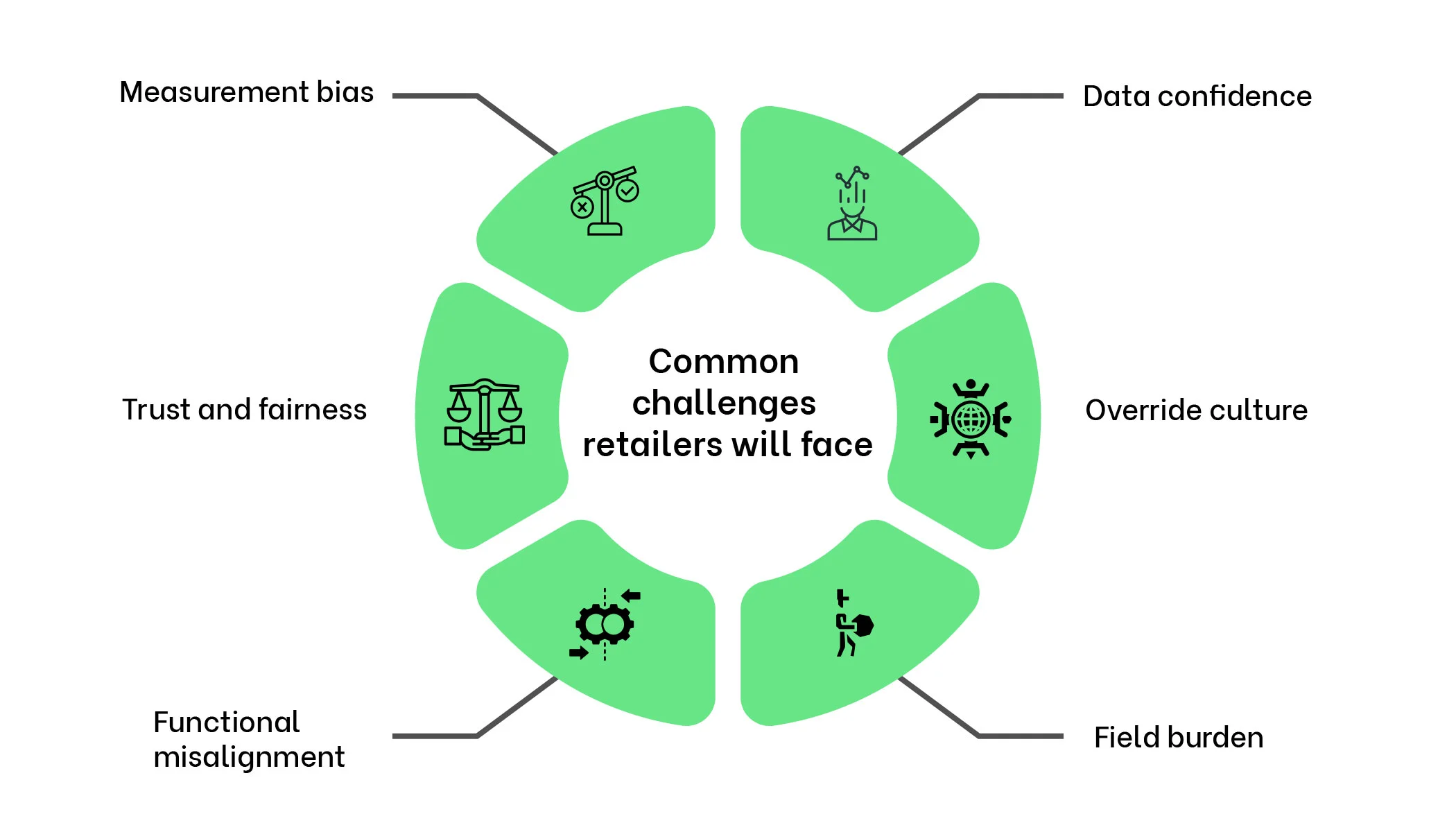
No thought-leadership piece on this topic is honest unless it talks openly about friction. Here are the challenges I think will define the next phase of AI pricing adoption.
Data confidence
If teams do not trust the data, they will not trust the model.
Override culture
If every recommendation gets manually second-guessed, the system never compounds the value.
Field burden
If stores experience AI-led pricing as more work, not smarter work, resistance will rise quickly.
Measurement bias
If leadership evaluates every action too narrowly or too quickly, valuable changes may be abandoned before their full economics are visible.
Trust and fairness
If pricing becomes too volatile or too opaque, customers may push back.
Functional misalignment
If merchandising, finance, operations, ecommerce, and marketing do not share the same intent, the AI layer will amplify internal contradictions. These are not reasons to slow down. They are reasons to design better.
What great looks like
The retailers I would bet on are not the ones that talk most loudly about AI. They are the ones that quietly build a commercial system with the following characteristics:
- clear price architecture
- disciplined promotion design
- intelligent markdown logic
- strong competitor awareness without panic
- connected store execution
- inventory-informed pricing actions
- human guardrails where trust matters
- data good enough to build confidence
- learning loops that improve decisions over time
That is what operational maturity looks like in the AI era.
It is not a futuristic theater.
It is an intelligent retail design.
And yes, it often requires support across strategy, transformation, data, customer experience, and content systems. That is why this topic naturally connects to Growth & Innovation, Business Transformation, Customer Experience Transformation, and Data Analytics work. The shift is bigger than pricing software. It is about designing a business that can sense, decide, and respond with more precision.

Conclusion: the future of retail belongs to adaptive operators
When I step back from all the noise around AI, I come back to a simple belief. The future of retail will not be won by the businesses that merely digitize old habits. It will be won by the businesses that build adaptive operating systems.
Merchandise pricing is one of the clearest places where that future is taking shape.
What used to be a periodic commercial task is becoming a live intelligence capability. What used to be a store execution problem is becoming part of a system-wide learning loop. What used to be a margin conversation is becoming a trust, agility, and operating-model conversation.
That is why this moment matters.
AI is not just helping retailers price more precisely. It is forcing them to decide what kind of commercial system they want to be.
Do they want to keep relying on broad rules, reactive discounts, fragmented signals, and manual correction? Or do they want to build a retail model where price, promotion, inventory, and stores work as one coordinated intelligence layer?
I know where I would place my bet.
The retailers that win the next decade will not be the ones that use AI to chase every micro-change in the market. They will be the ones that use AI to create clarity, discipline, and responsiveness across the entire commercial engine.
That is the real rewiring.
And I think we are only at the beginning.
Key Takeaways
- I believe AI is turning pricing from a static retail function into a living decision system.
- The biggest opportunity is not flashy real-time pricing. It is smarter coordination across pricing, promotions, markdowns, inventory, and store operations.
- Stores are becoming intelligence environments, not just execution endpoints.
- Customer trust is now a pricing capability and should be designed deliberately.
- More granularity does not automatically create more value. Strategy and governance still matter.
- The real constraint in AI pricing is usually the operating model, not the algorithm.
- The retailers that win will use AI to build adaptive commercial systems, not just faster pricing tools.
FAQ section
What is AI in merchandise pricing?
AI in merchandise pricing is the use of machine learning and predictive analytics to improve how retailers set base prices, promotions, markdowns, and localized pricing decisions. It helps retailers move from static, rule-based pricing to more adaptive and evidence-based pricing.
Why does AI matter for retail store operations?
It matters because pricing decisions affect real operational outcomes in stores, including shelf execution, labor planning, replenishment, markdown timing, and customer experience. AI helps connect these decisions so stores can execute with more accuracy and less friction.
How does dynamic pricing in retail actually work?
Dynamic pricing in retail uses changing signals such as demand, competition, inventory, or timing to influence price decisions. In practice, that does not always mean constant price changes. Often, it shows up as smarter markdowns, more effective promotions, or store-cluster-based pricing adjustments.
What are the key benefits of AI pricing for retailers?
The biggest benefits include stronger margin control, better markdown timing, improved promotion efficiency, better alignment between pricing and inventory, more precise competitor response, and more consistent store execution.
What are the common challenges in AI-driven retail pricing?
The most common challenges are poor data quality, low trust in model recommendations, too many manual overrides, unclear governance, operational overload in stores, and weak cross-functional alignment.
Can AI pricing damage customer trust?
Yes, it can if retailers allow price behavior to become too volatile, opaque, or inconsistent. The answer is not to avoid AI pricing, but to design clear guardrails around fairness, category sensitivity, personalization, and approval control.
What is the difference between retail price optimization and markdown optimization?
Retail price optimization covers the broader discipline of improving prices across base pricing, promotions, and channel strategy. Markdown optimization is a more specific use case focused on deciding when and how deeply to discount inventory that is aging, seasonal, or overstocked.
What is the best way to implement AI in retail pricing?
The best approach is phased. Start with a clear pricing philosophy, identify the biggest area of margin leakage, fix the minimum viable data for that use case, design the human workflow, and then scale based on what the organization can execute well.
Authors

AVP, Digital Growth
%20(5).webp)
%20(2).webp)

.webp)
.webp)
.webp)

.jpg)
.jpg)


.webp)