
The People Problem in Digital Talent Transformation | Cognitute

The People Problem in Digital Talent Transformation | Cognitute

January 20, 2026
Digital Transformation
The People Problem Behind Digital Talent Transformation
Digital transformation is exploding like never before. However, the opposite is true for the talent that drives this technology aka digital talent is. Across industries, leaders are realizing that technology investments alone do not deliver outcomes. It is the people who translate tools into transformation. And today, those people are in dangerously short supply.
A recent global CIO survey revealed that 65% believe limited talent is holding back their digital initiatives, the highest level recorded in a decade. This is not merely a hiring challenge. It is a strategic hurdle sitting right at the intersection of competitiveness, innovation, and in the end, the value of the business/service itself.
The Talent Capability Crises
Most organizations track headcount gaps. Few assess the performance drag that follows. Digital talent shortages may be quantified in multiple ways - headcount gaps in role fulfillment and performance drag in the existing workforce.
Projects tied to AI, automation, cybersecurity, or cloud may routinely slip or collapse due to expertise gaps. Every delayed product release slows down revenue realization; especially for fast-moving startups and mid-cap firms.
When non-specialists fill critical digital roles, systems become more reactive rather than proactive, leading to
- Higher downtime and tech debt
- Increased cybersecurity risks
- Rising operational costs
The result may be a transformation that looks digital but actually behaves like yesterday’s business. Poorly skilled staff that struggle with everyday work pressure are also ill-equipped to handle any growth and process innovation tasks.
Another expensive bottleneck is when organizations resort to outsourcing when they lack in-house capability. While outsourcing has its place, it can also:
- Inflate long-term costs
- Create expertise dependency
- Slow responsiveness
Additionally, vendors may hardly be expected to have the same level of dedication and loyalty as internal employees.
To top it all, the hiring teams struggle to fill up existing requirements only to find that all technology rapidly becomes obsolete. Hence, the new digital talent need to not only be aware of the latest technology but be able to rapidly adapt to future advancements too.
Related Reads :
Building D2C Profitability with Cost Analytics
360° Customer Intelligence for Modern D2C Brands

From Talent Crisis to Capability Advantage in India & APAC
India and APAC have become the epicenter of the global talent shift. Research suggests that India will be the only major economy with a skilled tech talent surplus by 2030. Yet even here, the situation is more complex than a simple supply advantage. India has:
- Strong foundational STEM talent
- Limited availability of advanced AI/ML, cloud, and cybersecurity expertise
- Uneven digital maturity across SMBs and legacy enterprises
Across APAC, organizations are competing for the same scarce niche talent — often paying higher salaries without unlocking proportionate business value.
The only way out of this mess is not look outside but think inward. This is what a lot of organisations are doing. They are building ecosystems of continuous learning, cross-functional collaboration, and empowered experimentation. Here are some of the ways how :
1. Develop the Workforce You Already Trust
Your future digital leaders may already be on your payroll. Internal talent:
- Knows systems, customers, and culture
- Has institutional loyalty
- Can be upskilled faster and more affordably
Indeed upskilling protects knowledge and accelerates transformation. It also delivers the highest ROI in digital capability building.
2. Hire for Agility — Not Just Today’s Skills
Static skills have a shrinking shelf life. Instead, recruit:
- Adaptive thinkers
- Problem solvers
- People comfortable with change
Tesla scaled new competencies fast by choosing talent eager to push boundaries — not just those with the right résumé keywords. Several other companies hire polymaths i.e. engineers who can shift disciplines as technology evolves, thus enabling faster innovation cycles. Singapore’s top tech teams often hire based on problem-solving benchmarks, not just certifications
3. Break Silos With Cross-Functional Teams
Digital transformation is not IT-owned; it is business-driven. Reliance Jio’s success in telecom and digital commerce has been powered by integrated teams spanning tech, retail, network engineering, and consumer marketing.
General Electric’s Digital Industrial Teams brought together:
- Cloud + Data Talent
- Product owners
- Domain specialists
This resulted in customer-aligned innovation delivered faster and at scale.
4. Build a Culture That Learns Relentlessly
The only sustainable competitive advantage is learning velocity. Levers include:
- Innovation labs and hackathons
- Rotational programs
- On-the-job and peer learning
- Leader-led digital coaching
Accenture and Microsoft run immersive digital skill academies across India and Singapore — sharpening both tech talent and business transformation capabilities.
When learning is normalized, change is no longer threatening — it becomes identity.
5. Remove Friction: Modernize Work Itself
Top talent refuses to fight outdated systems. Leaders must:
- Dump legacy constraints
- Modernize tools
- Empower rapid decision-making
- Recognize experimentation, not perfection
Digital-native companies like Grab, Meesho, and Gojek scale innovation by giving teams autonomy and removing “governance drag.” When people can perform at their best, they stay, grow, and innovate.

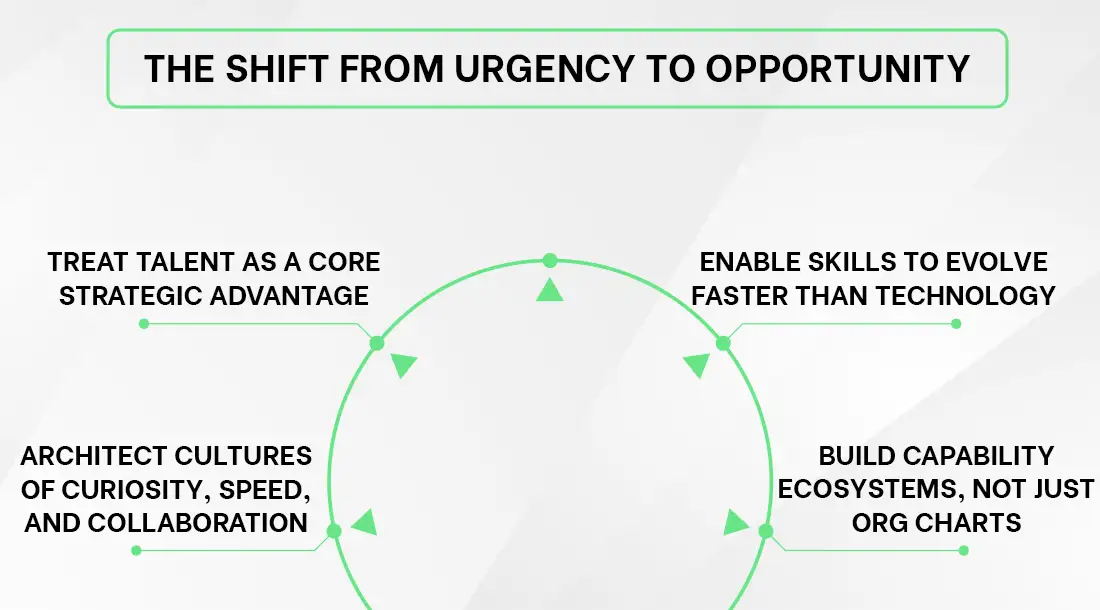
The Shift From Urgency to Opportunity
The digital talent shortage is not temporary, it is structural. Success now belongs to organizations that :
-
Digital transformation fails without digital talent. And digital talent fails without a transformation-ready culture.
Read Our Other Insights : Generating Full-Funnel Intelligence for D2C Brands
Authors

Co Founder, Director & CBO
.webp)





%20(2).webp)