
360° Customer Intelligence for Modern D2C Brands | Cognitute

What 360º Customer Understanding Really Means For D2C Brands

January 22, 2026
Customer Experience
What 360º Customer Understanding Really Means For D2C Brands
Key Takeaways
- Growth in D2C is now driven by intelligence, not only acquisition spending.
- Integrated data across marketing, CX, and operations enables foresight that improves revenue, retention, and profitability.
- Real-world scenarios show measurable benefits in repeat revenue, inventory optimisation, and media ROI.
- Brands such as Nykaa, BlueStone, Lenskart, and leading GCC personal care companies already use integrated analytics as a competitive advantage.
- Successful data integration requires granular unification, real-time intelligence, predictive modelling, and cross-functional collaboration.
- A 360º customer understanding approach allows brands to detect issues faster, personalise better, optimise costs, and deliver stronger customer experiences across every touchpoint.
Executive Summary
Direct-to-consumer brands today compete in an environment where growth is no longer driven only by acquisition spend or product innovation. The decisive advantage now lies in a brand’s ability to integrate marketing, customer experience, and operations data into a single intelligence layer. When executed well, this produces foresight that guides decision-making, improves profitability, and strengthens long-term loyalty. When executed poorly, brands operate through fragmented dashboards that describe what happened instead of predicting what will happen.
Across India and APAC, forward-looking brands such as BlueStone, Nykaa, Lenskart, Bath & Body Works GCC, and Beauty Expo Singapore exhibitors have already demonstrated measurable improvement using integrated data ecosystems. These brands have seen benefits such as 20 to 35 percent improvements in paid media ROI, 15 to 25 percent reduction in drop ratios across funnel stages, and significant expansion in repeat purchase contribution.
This article explores how integrating cross-functional data creates a 360º understanding of customers, presents two real-world business scenarios, and outlines how D2C leaders can build a foresight-driven organisation.
The New Reality Of D2C Decision-Making
The first era of D2C was defined by digital arbitrage. Brands could grow by simply scaling paid campaigns, offering discounts, or optimising conversion rates. That era has ended. Customer acquisition costs have risen by 30 to 60 percent across multiple verticals in India. Digital noise has intensified. Marketplaces have matured into algorithm-driven ecosystems that increasingly favour brands with strong product and supply chain fundamentals.
In this environment, a brand’s greatest competitive asset is no longer only traffic volume but the intelligence created from every customer interaction. The brands that win are those that unify marketing, CX, and operations data to understand customer behaviour with accuracy and speed.

How A Beauty Brand Reduced Funnel Drop-offs And Increased Repeat Purchases
A fast-growing beauty brand in India had healthy traffic volumes but struggled with rising acquisition costs and stagnant repeat revenue. Marketing believed that the issue was campaign quality, while operations pointed to delivery delays. CX teams observed a rising trend in first-order dissatisfaction.
When the brand integrated cross-functional data, the actual story emerged.
- Marketing data revealed that customers from Instagram Reels had a 35% higher bounce rate.
- CX data showed that 22% of first-time buyers rated packaging experience poorly.
- Operations data revealed a pattern where specific SKUs frequently went out of stock, causing delayed dispatch.
The integrated insight was clear. Customers acquired through certain channels were more likely to purchase high-velocity SKUs that often faced stock volatility. This mismatch created poor early experiences, leading to low repeat purchase rates.
The brand implemented targeted changes:
- SKU-level forecasting based on channel-wise propensity.
- Reallocation of media spend towards audiences with higher retention probability.
- Packaging upgrades for specific product lines.
- A post-purchase communication refresh.
Within two quarters, the brand recorded measurable gains:
- 25% improvement in repeat revenue.
- 12% lower drop-off from PDP to checkout.
- 18% improvement in media ROI.
- 10% improvement in overall NPS.
The transformation did not come from acquiring more customers but from understanding the existing ones better.
Why 360º Customer Understanding Matters Now
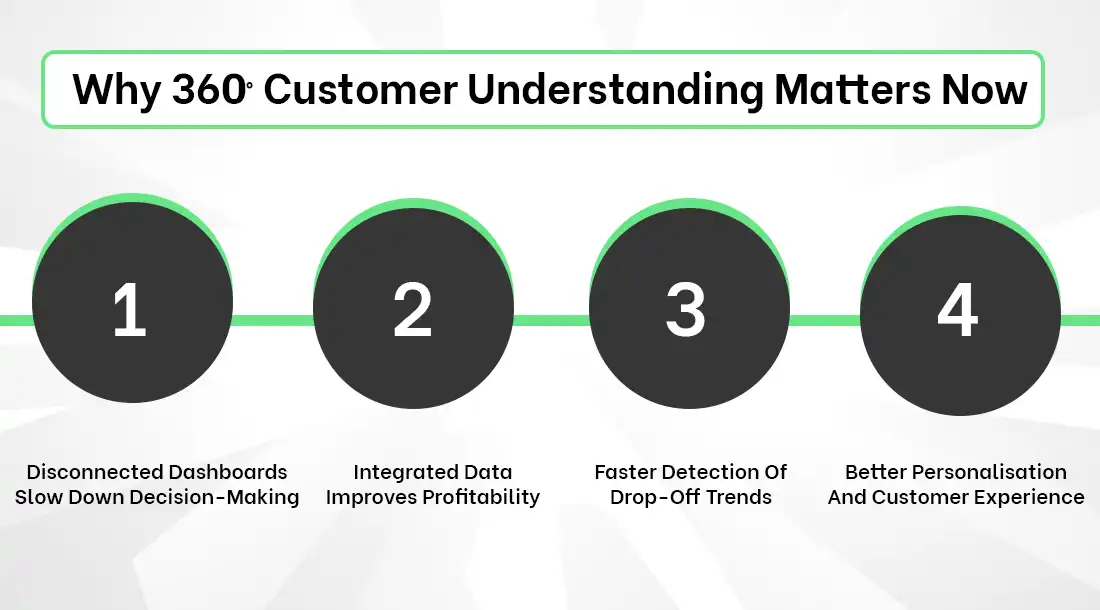
1. Disconnected Dashboards Slow Down Decision-Making
Most D2C teams work in organisational silos. Marketing focuses on upper funnel efficiency, CX focuses on post-purchase resolution, and operations focuses on supply chain accuracy. When data lives in separate systems, leadership receives delayed insights that are often contradictory.
A 360º system synchronises:
- Media performance and spending patterns.
- Customer journey behaviour and dissatisfaction triggers.
- Inventory levels, dispatch timelines, and fulfilment accuracy.
- Marketplace algorithmic signals.
- Repeat purchase cycles and SKU loyalty.
This produces real-time intelligence rather than backward-looking reports.
2. Integrated Data Improves Profitability
Profitability is closely tied to efficient allocation of capital and operational predictability. When cross-functional data is integrated:
- Media spends shift towards high-LTV cohorts.
- CAC reduces due to better targeting and funnel optimisation.
- Cost leakage across refunds, returns, and RTO reduces.
- Inventory risk reduces and full-price sale contribution increases.
For example, Lenskart has reported that data-led decisioning improved customer acquisition efficiency and powered store-level performance forecasting, contributing to consistent profitability improvements across regions.
3. Faster Detection Of Drop-Off Trends
Drop-off issues often originate outside the department that detects them.
Examples:
- A rise in checkout abandonment may be caused by stockouts, not pricing.
- Decline in repeat purchases may originate from packaging quality.
- High RTO percentages may be linked to audience cohorts, not logistics cost.
A unified view ensures the correct root cause is identified instantly.
4. Better Personalisation And Customer Experience
Nykaa and BlueStone exemplify how integrated data drives personalised experiences. Nykaa uses behaviour and transaction datasets to tailor content and offers, which has contributed to expanded brand visibility and higher engagement. BlueStone leverages integrated data across digital browsing and store interactions to deliver more accurate product recommendations.
Related Reads :
Understanding Decision-Making in a Data-First World
The People Problem in Digital Talent Transformation
Building A 360º Customer Understanding Framework
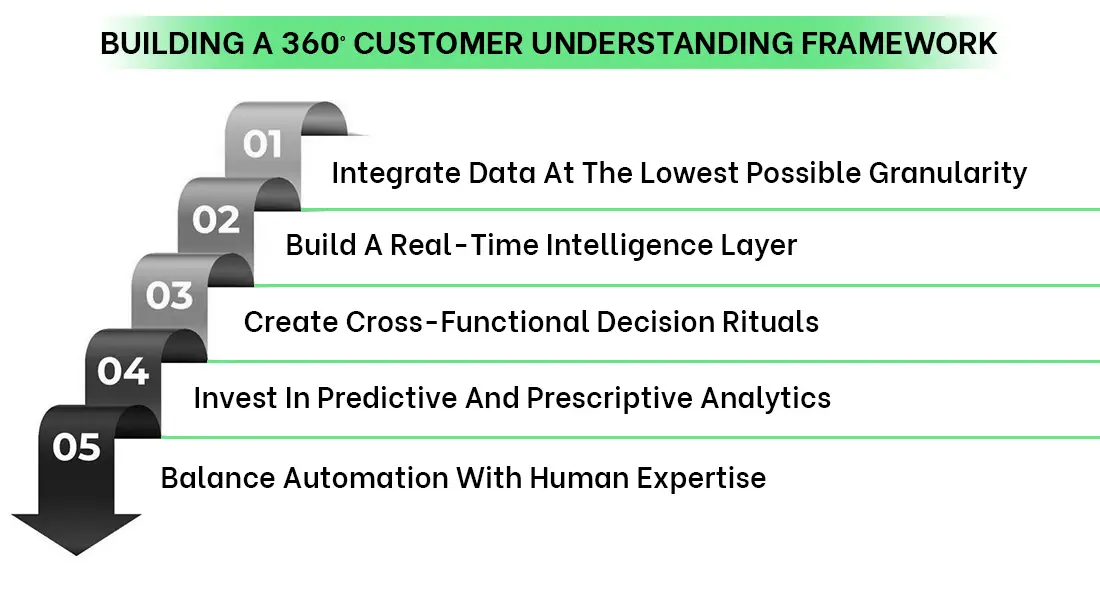
1. Integrate Data At The Lowest Possible Granularity
Brands should unify data at SKU, order, and customer levels across marketing, marketplace, CRM, logistics, and operations. Granular data allows precise identification of patterns and gives leaders the ability to run high-quality experiments.
2. Build A Real-Time Intelligence Layer
A centralised intelligence system should automate:
- Alerts for anomalies such as spike in drop-offs or RTO.
- Predictive demand forecasts.
- SKU-level profitability insights.
- Audience propensity models.
- Cohort behaviour trends.
Real-time guidance allows brands to take action within hours instead of weeks.
3. Create Cross-Functional Decision Rituals
Integrated data only works when teams collaborate.
Recommended rituals include:
- Weekly foresight meetings across marketing, CX, and operations.
- Joint KPI reviews aligned to retention and margin, not just top-line.
- Shared dashboards with unified definitions of success.

4. Invest In Predictive And Prescriptive Analytics
Forward-looking brands build predictive intelligence around:
- Repeat purchase probability.
- SKU-level demand.
- High-risk delivery regions.
- Buyer segment migration.
- Lifetime value early prediction.
Prescriptive analytics then recommends what action to take and by when.
5. Balance Automation With Human Expertise
Technology amplifies decision speed, but teams must define guardrails, category understanding, and intervention logic. The most successful D2C brands achieve synergy between algorithmic insights and human judgement.
The Business Impact Of Integrated Data Ecosystems is profound. Brands across India and APAC (and indeed everywhere else) that have committed to data integration report consistent improvement across metrics.
They have noticed sizeable upshifts in paid media ROI, repeat contribution, full-price sell-through, as well as, reduction in funnel drop-offs and reduced RTO and refund costs.
These outcomes demonstrate that integrated intelligence is not a technology investment but a business growth investment.
Read Our Other Insights : Building D2C Profitability with Cost Analytics
Authors

AVP, Digital Growth






.webp)
.webp)