
Generating Full-Funnel Intelligence for D2C Brands | Cognitute

How Data-Rich D2C Brands Generate Full-Funnel Intelligence

January 7, 2026
Digital Transformation
How Data-Rich D2C Brands Generate Full-Funnel Intelligence
Data Abundance Is Not Necessarily Translated Into Better Decisions
Most D2C brands today are not short on data. They collect impressions, clicks, add-to-cart events, orders, returns, reviews, customer tickets, delivery timelines, and repeat purchase signals across multiple platforms. Yet many leadership teams still struggle to answer fundamental questions with confidence.
Which customers will be profitable six months from now?
Which channels truly drive repeat value, not just first orders?
Where exactly does margin leak across the funnel?
Which operational decisions will improve experience without hurting cost?
The challenge is not data availability. The challenge is fragmentation. When marketing data, customer experience data, and operations data live in disconnected systems, brands become data-rich but insight-poor. When things go south, reports explain what happened after the fact but fail to guide what should happen next.
Full-funnel intelligence changes this equation. It transforms raw, fragmented data into forward-looking insight that drives better growth, stronger retention, and healthier margins.
The Cost Of Fragmented Data In D2C Businesses
Fragmentation has tangible business consequences. Across India and APAC, D2C brands commonly experience the following symptoms:
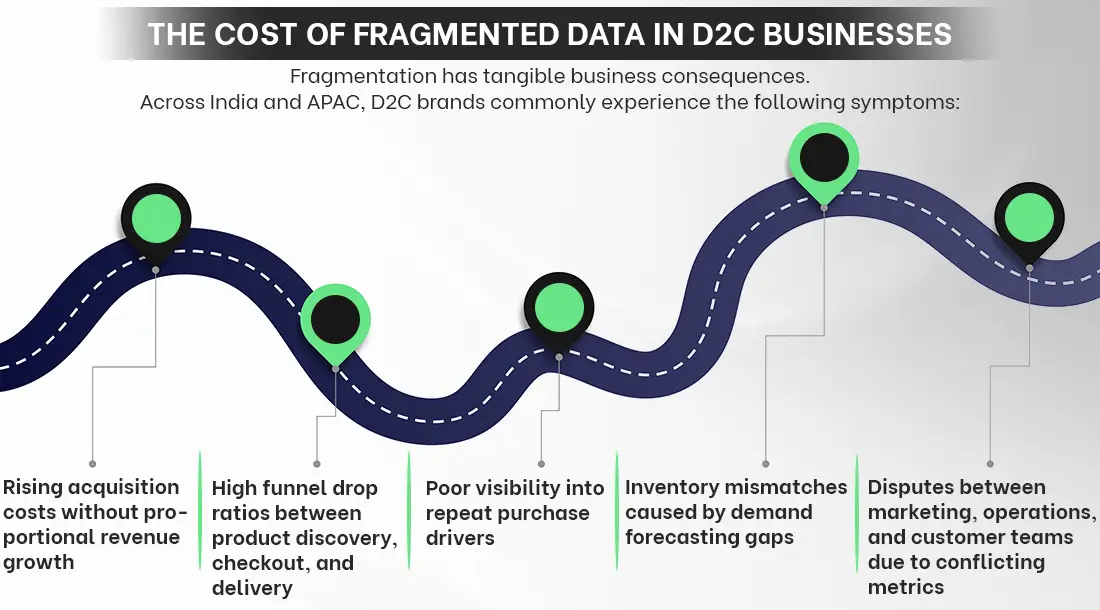
- Rising acquisition costs without proportional revenue growth
- High funnel drop ratios between product discovery, checkout, and delivery
- Poor visibility into repeat purchase drivers
- Inventory mismatches caused by demand forecasting gaps
- Disputes between marketing, operations, and customer teams due to conflicting metrics
Industry studies indicate that companies using integrated analytics improve marketing ROI by 15 to 30 percent, while those relying on siloed reporting often overspend by double digits on underperforming channels. Brands that fail to unify data also experience higher return-to-origin and refund ratios, directly impacting margin and customer trust.
The result is reactive decision-making. Teams respond to lagging indicators rather than shaping outcomes proactively.
What Full-Funnel Intelligence Really Means
Full-funnel intelligence is not another dashboard or reporting layer. It is the ability to understand customer behaviour across every stage of the journey and connect it to commercial outcomes.
This includes:
- Awareness and reach performance across paid, organic, and influencer channels
- Engagement quality and intent signals on product pages
- Conversion behaviour and checkout friction
- Fulfilment accuracy, delivery timelines, and return patterns
- Post-purchase satisfaction, service interactions, and reviews
- Repeat purchase behaviour and lifetime value evolution
When these signals are integrated at customer, cohort, and SKU levels, brands move from hindsight to foresight.

Understanding Funnel Drop-Offs Through Data Integration
To understand the issue better, let us take the case of a fast-scaling beauty brand in India. The brand experienced strong top-line growth driven by social and influencer marketing. However, conversion rates stagnated and repeat purchases remained lower than category benchmarks.
Initial analysis from individual teams showed conflicting narratives:
- Marketing data suggested healthy traffic and engagement
- Customer teams reported dissatisfaction related to delayed delivery
- Operations focused on fulfilment capacity rather than demand quality
Once the brand unified data across media, website behaviour, logistics, and customer feedback, a clearer picture emerged.
Key insights included:
- Customers from short-form video platforms showed higher bounce rates on PDPs
- These customers disproportionately purchased fast-moving SKUs prone to stockouts
- Delivery delays correlated strongly with low second-order probability
Actions taken:
- Media spend was reallocated towards cohorts with higher retention probability
- Inventory forecasting incorporated channel-level demand signals
- Delivery promises were recalibrated by geography
- Post-purchase communication was improved for delayed orders
Within two quarters, the brand achieved:
- 14% in PDP-to-checkout drop-off
- 22% improvement in repeat purchase contribution
- 18% uplift in paid media ROI
- Improved brand ratings across major marketplaces
The improvement did not come from spending more but from seeing the funnel clearly.
Related Reads :
Building D2C Profitability with Cost Analytics
360° Customer Intelligence for Modern D2C Brands
Insight-Ready Matters More Than Being Data-Rich
Data-rich organisations often suffer from decision paralysis. Teams wait for reports, debate metrics, or rely on intuition when numbers conflict.
Insight-ready organisations behave differently. They:
- Detect performance issues early
- Understand cause-and-effect relationships
- Act with confidence and speed
- Align teams around shared truths
According to multiple industry benchmarks, companies that embed analytics into daily decision-making are significantly more likely to outperform peers on revenue growth and operational efficiency. In D2C, this translates directly into higher conversion rates, lower CAC, and improved lifetime value.
Several well-known brands across India and APAC demonstrate the power of integrated data:
- Nykaa uses behavioural, transaction, and content engagement data to personalise experiences and optimise campaign performance, contributing to higher engagement and repeat rates.
- Lenskart integrates digital and store-level data to forecast demand, optimise assortment, and improve customer acquisition efficiency.
- BlueStone connects online browsing behaviour with store interactions to deliver more relevant recommendations and improve conversion outcomes.
These brands share one trait. They treat data as a strategic asset rather than a reporting obligation.
Practical Steps for Building Full-Funnel Intelligence
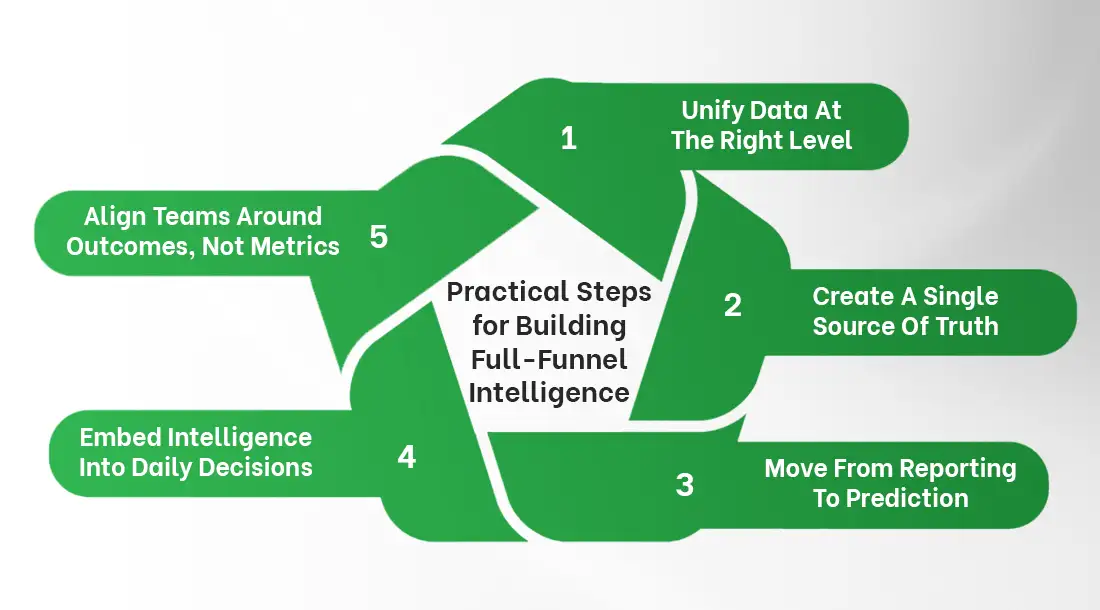
1. Unify Data At The Right Level
Data integration must occur at the most granular level possible:
- Customer ID
- Order ID
- SKU
- Channel
- Geography
This enables accurate attribution and meaningful analysis.
2. Create A Single Source Of Truth
Conflicting numbers erode trust. Definitions of CAC, conversion, repeat purchase, and return rates must be standardised across teams.
3. Move From Reporting To Prediction
Insight-ready brands invest in predictive models for:
- Repeat purchase probability
- Demand forecasting
- Churn risk
- Inventory depletion
- High-risk delivery zones
Prediction enables intervention before performance declines.
4. Embed Intelligence Into Daily Decisions
Insights must inform real actions:
- Media budget shifts
- Inventory reallocation
- Delivery promise adjustments
- Personalised offers
- Customer communication triggers
Analytics that does not change behaviour has limited value.
5. Align Teams Around Outcomes, Not Metrics
Marketing, operations, and customer teams should be aligned around shared outcomes such as contribution margin, retention, and customer satisfaction rather than isolated functional KPIs.

The Business Impact Of Being Insight-Ready
Data alone does not create advantage. Interpretation, integration, and action do. In an environment where acquisition costs remain volatile and customer expectations continue to rise, D2C brands must graduate from fragmented reporting to full-funnel intelligence.
D2C brands that successfully transition from fragmented data to full-funnel intelligence typically see:
- 15-40% improvement in marketing ROI
- 10-25% reduction in funnel drop ratios
- 8-20% uplift in repeat revenue contribution
- Lower refund and return-to-origin rates
- Improved brand visibility due to consistent experience delivery
These outcomes reinforce a simple truth. Intelligence compounds over time. Each insight strengthens the next decision.
Becoming insight-ready is not a technology project. It is a leadership commitment to clarity, alignment, and disciplined execution. Brands that make this shift will not only grow faster but grow smarter, stronger, and more resilient over time.
Read Our Other Insights : Building a Zero-Waste Funnel with Analytics
Authors

AVP, Digital Growth
.webp)





.webp)
.webp)