
Digital Ops Planning for People & Processes | Cognitute

Digital Ops Planning that Aligns People, Processes & Tech Beyond Automation

January 12, 2025
Digital Transformation
Digital Ops Planning that Aligns People, Processes & Tech Beyond Automation
Key Takeaways
The article below covers the following in depth :
- Digital Operations Planning aligns businesses end-to-end and ensures Business Model + Processes + People + Technology work together toward efficiency, automation, and customer-centric outcomes.
- Well-informed choices and holistic planning prevent costly mistakes.
- Why organizations adopt Digital Ops tools and Core components of effective Digital Ops Planning
- Bottom-line impact : +ve ROI appears in 1–2 years, Better and faster work, Effective team collaboration and early detection of problems, Sustainable scaling
Business Scenario
Consider a D2C Fashion & Apparel company. The brand is rapidly building its market presence and growing. It consequently goes on a hiring spree to support the different functions. Every team has its own goals earmarked and they all work towards it using different tools - CRM, ERP, spreadsheets, WhatsApp, email.
However, at the high-level quarterly review meeting, most department heads blame the others for problems in meeting goals - “It’s not us… THEY didn’t give us the data on time!!” The result is utter confusion and chaos. Work relationships and bottom lines suffer. The scaling efforts crumble under their own weight. The immediately apparent signs of this chaos are : no real-time view of demand, no idea why delays happen (at least until it’s too late) and revenue leakage everywhere. The scaling is clearly not sustainable.
Why is it that despite so many digital and highly accurate options available, no clear solutions seem to be in sight?
The above scenario is all too common for many a growing businesses.But the costs of not addressing the same are all too real - missed demand trends, piling inventory, overshooting departmental budgets and millions in lost revenue and market share.
DIGITAL OPERATIONS PLANNING may be the answer to this problem.
What is Digital Ops Planning?
Digital Operations Planning is the structured process of designing how an organization will run its operations using digital tools, automation, data, and AI to improve performance. In other words, digital Ops planning is meant to ensure that the Business Model, Processes, People and Technology are all aligned to deliver efficient, data-driven, automated, and customer-centric operations.
In today’s times, when technology is of paramount importance in every aspect of running a business - right from product ideation and design to sourcing raw materials, manufacturing and selling the finished product - we are all bombarded with tools that specialize in one aspect or the other.
The problem arises when all these tools and processes work in silos. They solve the immediate departmental problems while not taking into account the holistic needs of the company at large. This is also where resilient business transformation becomes critical, enabling organizations to build adaptable, future-ready systems that can withstand market shifts while scaling efficiently.In other cases, there lies the assumption that one size fits all. While a particular set of Ops Tools may be suitable for , say, Educational Services Sector; it may not give the desired results for a Manufacturing Unit.
Therefore, out of the plethora of options available, it is important to understand what suits a particular business/need the best.
Testing the Waters of Digital Ops Planning
While digital Ops Planning may be used for any organisation that wishes to impact speed, cost, accuracy, customer experience, and scalability, a few important points must be taken into consideration.
In essence, good planning must constitute the following:
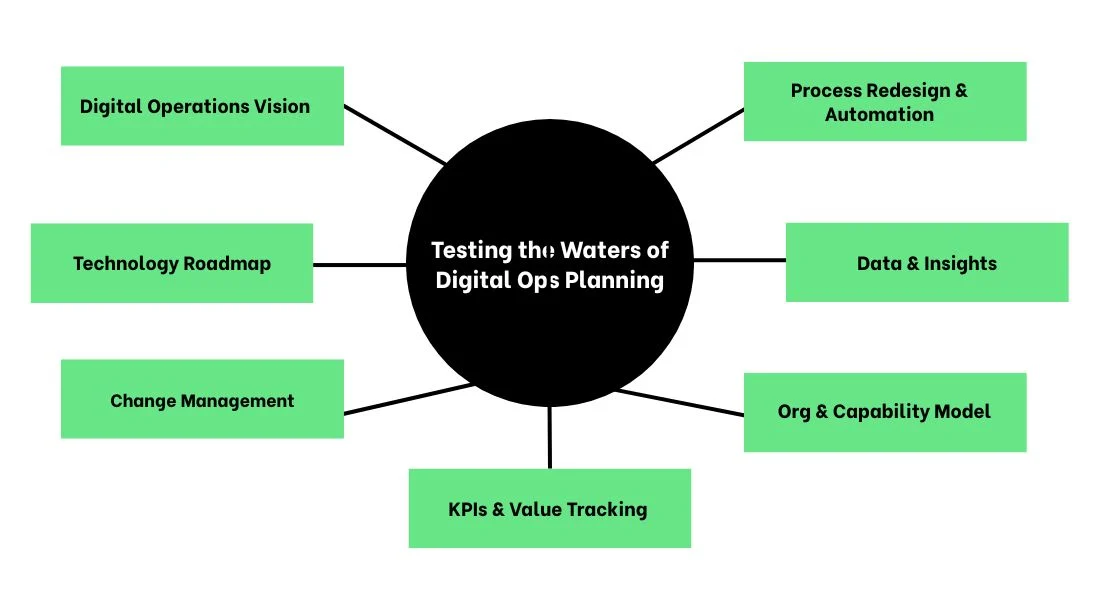
- Digital Operations Vision - Ops are meant to support business goals and must evolve in line with them.
- Process Redesign & Automation - Ideal flow for all process redesign : Mapping processes → eliminating waste → automating
- Technology Roadmap - Systems, platforms, integrations, AI & analytics to be used for optimal results.
- Data & Insights - What data is needed, how is it cleaned and processed and how it drives decisions
- Org & Capability Model - Skills, roles, governance, partnerships across the various departments
- Change Management - Adoption plan, communication, training
- KPIs & Value Tracking - Cost, efficiency, CX, speed, quality, ESG, etc.
In absence of effective digital Ops Planning, companies often make the following mistakes :
- Invest in tech without ROI
- Automate broken processes
- Remain trapped in departmental silos
- Fail to scale effectively despite growth

When and Why Organisations Use Such Tools
- Standardize and document processes - especially when organisational growth and scale makes it hard to manage by conventional methods. Tools like BPM suites help bring consistency, visibility, and governance.
- Automate repetitive tasks - approvals, data entry, notifications, routing work, compliance flows - freeing people for more value-added work.
- Orchestrate cross-functional workflows - integration and orchestration across various departments matters. BPM/BPA tools bring in the sync across systems.
- Improve speed, quality, compliance, transparency - Clear checks and balances on automation, monitoring, compliances makes the process more error-free with faster turnaround and better documentation and clear, reliable decision-making backed by solid numbers.
- Scale operations - In a growing business, manual processes can become serious bottlenecks. It is easier and more streamlined to scale operations digitally. This also provides increased agility and scope for continuous improvement and self-learning cycles.
Key Techniques & Concepts
Some of the underlying techniques / approaches that digital-ops planning tools often use and support are:
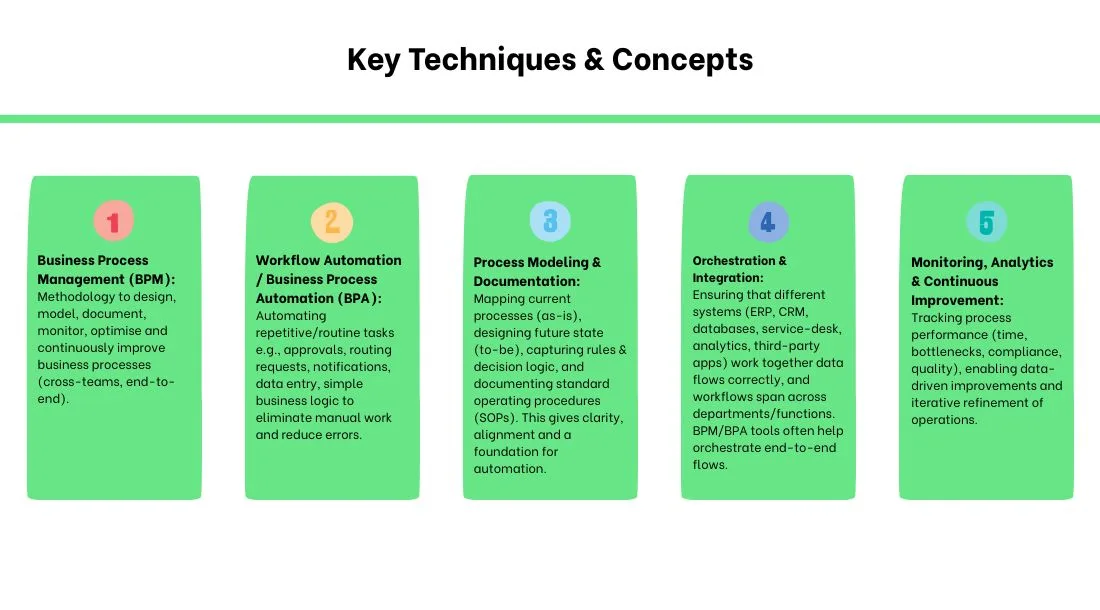
- Business Process Management (BPM): Methodology to design, model, document, monitor, optimise and continuously improve business processes (cross-teams, end-to-end).
- Workflow Automation / Business Process Automation (BPA): Automating repetitive/routine tasks - e.g., approvals, routing requests, notifications, data entry, simple business logic to eliminate manual work and reduce errors.
- Process Modeling & Documentation: Mapping current processes (as-is), designing future state (to-be), capturing rules & decision logic, and documenting standard operating procedures (SOPs). This gives clarity, alignment and a foundation for automation.
- Orchestration & Integration: Ensuring that different systems (ERP, CRM, databases, service-desk, analytics, third-party apps) work together - data flows correctly, and workflows span across departments/functions. BPM/BPA tools often help orchestrate end-to-end flows.
- Monitoring, Analytics & Continuous Improvement: Tracking process performance (time, bottlenecks, compliance, quality), enabling data-driven improvements and iterative refinement of operations.
Related Reads :
Building D2C Profitability with Cost Analytics
360° Customer Intelligence for Modern D2C Brands
Popular Tools & Software for Digital Ops / BPM / Automation
Given below are some of the widely used tools and platforms that support digital-ops planning and execution. The correct Fit for an organisation depends on its size, complexity, domain, and long term goals the management wishes to accomplish.
- Appian - Suitable for medium to large organisations that need robust, integrated workflows, especially where multiple systems need to cooperate. Great for building end-to-end business processes. Is scalable and integrates well across systems.
- Bizagi BPM platform: Good for organisations that need a formal, structured process-automation engine. Allows users to model processes (with BPMN), build workflows, automate them, and execute - from designing to deployment.
- Adonis BPM & process-management suite: Supports process documentation, modelling, optimisation, quality management, audit/compliance, SOP versioning.
- Camunda Process orchestration & automation platform - handles complex end-to-end flows, integrates different systems, and automates various business processes within the organisation.
- Enterprise Resource Planning (ERP) Suites (e.g., ERPNext ) - Though not a BPM tool per se, ERP systems help unify core business functions (sales, inventory, finance, HR, manufacturing, CRM, etc.). This in turn helps with resource planning, inventory, supply chain, finance, etc. and provides a backbone for operations along with automation/integration.
There are several others such as Kissflow, Pipefy, Monday.com, Cflow and many more.
Things to Keep in Mind / Trade-offs
- Process / Complexity Fit - Simple automation tasks do not require complex planning tools. Sometimes manual intervention or human judgment is better. Automating a bad process or overautomation increases inefficiency. Hence, process-design & mapping (BPM) should precede automation. Also note that complex, heavy-duty BPM suites or open-source engines may have steeper learning curves and require skills that may be absent in your current workforce. Constantly depending on IT for trouble-shooting may be counter productive.
- Implementation overhead: BPM/BPA process initiation in an organisation is a time consuming, costly process. Without workforce buy-in, tools may stay under-utilised.
- Integration challenges: When many legacy systems are involved, connecting them reliably can be difficult. Also, avoid tools that may not scale easily for a growing business.
- Governance, security & compliance: automation must respect data privacy, audit needs, and user roles; BPM tools must support governance capabilities.
Recommendations :
- For small teams / simpler operations: Kissflow, Pipefy, Monday.com Work OS, Cflow because of ease of use, reasonable cost, quick ROI.
- For growth or evolving operations needing structure and scalability: Appian, Bizagi, Flowable, Adonis because they offer BPM standards (e.g. BPMN), better process governance, and long-term flexibility.
Ideally, a good digital Ops planning tool should start showing real benefits in the first year itself. Tools that take more time are likely to become obsolete with technology advances.

What This Means for You / Your Business
Using BPM / digital-ops tools is not simply about adopting new software it also requires a process-oriented mindset. When implemented correctly, they can substantially increase Operational Agility, Efficiency And Resource Utilization. They can also deliver measurable ROI from digital investments in the initial 1-2 years. Finally, they help companies become more process-oriented, efficient, adaptable, and aligned all essential for sustainable long-term digital transformation success.
Authors

AVP & Associate Partner (Digital Transformation)
.webp)









.webp)
.webp)