
Understanding Decision-Making in a Data-First World | Cognitute

Understanding Decision-Making In A Data-First Future

January 19, 2026
Data Analytics
Understanding Decision-Making In A Data-First Future
Executive Summary
As organisations confront rapid market shifts, heightened competition, and fluid customer behaviour, leadership in 2026 must go beyond intuition and isolated reports. Decision-making needs to be grounded in unified, real-time insight that aligns strategy with execution. This requires an organisational shift to data-informed leadership where analytics, artificial intelligence, automation, and predictive technologies become integral to decisions that affect reach, revenue, ROI, brand visibility, and customer behaviour.
Leading brands across India, APAC, and the Middle East have already seen measurable improvements by leveraging analytics for strategic decisions. Nykaa and Lenskart in India are optimising customer segmentation and inventory using advanced models. E-commerce platforms such as Noon in Dubai use real-time dashboards to align campaign spend with on-ground performance. The results are significant improvements in conversion, marketing ROI, and customer retention.
This article explains why organisational change is critical for data-informed leadership, the latest techniques and technologies enabling it, and how business impact is realised across key metrics.
Why Decision-Making Must Evolve In 2026
Rapid digital transformation has altered markets and customer expectations. In this new era, leadership decisions must be faster, more accurate, and more predictive. Traditional decision-making that relies on periodic reports and intuition cannot cope with the speed of change.
Three major pressures are accelerating the shift:
Market Complexity
Customer preferences are no longer static. Digital channels, social influence, and cross-border trends together create behaviour that shifts daily. Understanding these patterns requires real-time insights rather than quarterly summaries.
Cost Of Growth
Marketing costs and customer acquisition expenses have risen across platforms. Organisations that fail to precisely measure ROI on reach and engagement waste capital on low-yield channels.
Demand For Personalised Experience
Customers expect relevant experiences at every touchpoint. Operational decisions that ignore data end up eroding both loyalty and brand visibility.
In 2026, leaders must make choices that balance speed, cost, and customer value. This requires organisational change towards data-informed decision-making.
What Data-Informed Leadership Means
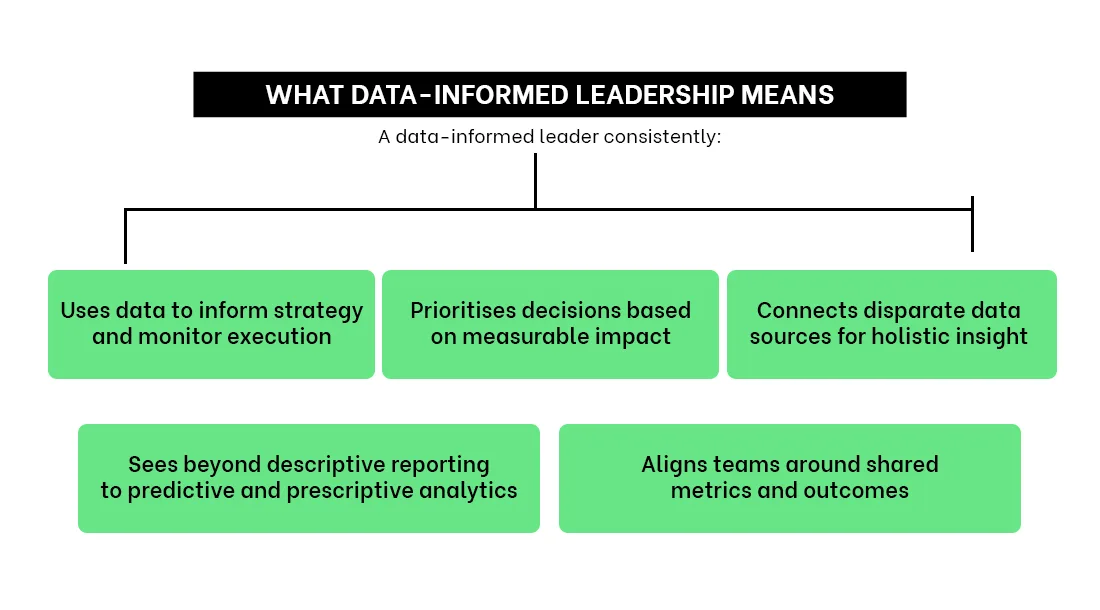
Data-informed leadership is a decision-making paradigm in which analytics and evidence guide strategic and operational choices. This approach does not disregard experience. Instead, it systematically combines experience with insight to produce better outcomes.
A data-informed leader consistently:
- Uses data to inform strategy and monitor execution
- Prioritises decisions based on measurable impact
- Connects disparate data sources for holistic insight
- Sees beyond descriptive reporting to predictive and prescriptive analytics
- Aligns teams around shared metrics and outcomes
In contrast to data-driven decisions, which focus on automation based on data alone, data-informed leadership emphasises human judgement guided by insight.
Related Reads :
Driving Exponential Productivity Through Organizational Change
The Next Digital Transformation Wave in India
Organisational Change Required For Data-Informed Leadership
To embed data-informed leadership in an organisation, structural, cultural, and capability changes are necessary.
1. Structural Change: Unified Intelligence And Collaboration
Silos fragment decision-making. Marketing, product, service, finance, and operations must contribute to a unified data strategy. Organisations are adopting structures such as:
- Integrated Data Teams
Teams with members from analytics, product, operations, and marketing collaborate to define insights that matter to business outcomes. - Shared Data Platforms
Single sources of truth reduce confusion and misalignment between departments. - Common Metrics And Definitions
Standardised KPIs for reach, conversion, retention, and churn allow consistent decisions.
For example, Indian beauty and lifestyle brand Nykaa integrated digital and in-store data, enabling unified segment behaviour analysis that improved targeting precision. The result was improved customer lifetime value and higher full-price conversion rates.
2. Cultural Change: Trust In Data And Scientific Thinking
For data-informed leadership to succeed, organisational culture must evolve:
- Encourage Evidence-Based Dialogue
Decisions backed by evidence reduce ambiguity and elevate the quality of strategic discussions. - Reward Correct Decisions And Learning From Failure
When teams can test hypotheses without fear of failure, innovation accelerates. - Embed Analytics In Daily Conversations
Dashboards and insights become a part of leadership forums, strategy meetings, and performance reviews.
Middle East marketplace Noon has trained category and performance teams to ask analytical questions routinely instead of making top-level decisions on intuition alone. As a result, performance reviews now focus on data signals rather than gut feeling.
3. Capability Change: Skills And Accessibility
Organisations must invest in skills and technology:
- Training non-technical leaders in analytics interpretation
- Hiring data translators who bridge analytics and business units
- Deploying user-friendly analytics tools
Lenskart’s investment in internal analytical capability enabled business teams to interpret predictive demand models without constant reliance on specialist data scientists. This increased agility in planning inventory and marketing investments.

Latest Techniques And Technologies Enabling Data-Informed Decision-Making
The technical landscape of 2026 offers powerful tools that elevate decision quality.
1. Real-Time Dashboards And Alerts
Leaders can no longer wait for weekly or monthly reports. Real-time analytics platforms provide immediate visibility into conversion, order flow, and campaign performance. Alerts trigger action when anomalies occur, such as sudden increases in drop ratios or unexpected dips in engagement.
Brands in Dubai e-commerce have used real-time dashboards to adjust campaign spend mid-hour during peak shopping periods, leading to higher capture of revenue opportunities.
2. Predictive Analytics And Machine Learning
Predictive models tailor decisions based on past patterns and future probabilities. Common use cases include:
- Forecasting customer lifetime value
- Predicting propensity to churn
- Anticipating demand spikes
- Optimising marketing mixes
Predictive analytics can increase precision in budgeting and allocation decisions. According to industry benchmarks, organisations applying predictive forecasting improve revenue accuracy and budget utilisation by 20 to 30 percent.
3. Prescriptive Analytics
Prescriptive analytics goes beyond prediction. It recommends specific actions to achieve a desired business outcome. This approach considers constraints, risks, and business context.
Use cases include:
- Optimal pricing strategies that balance conversion and margin
- Media mix allocation that maximises incremental reach
- Promotion timing that improves frequency and repeat purchase
Prescriptive analytics reduces guesswork and enables systematic optimisation at scale.
4. Natural Language Interfaces And Augmented Analytics
Augmented analytics uses AI to generate insights in natural language, making analytics accessible to non-technical leaders. Questions such as:
- Which campaign delivered the best incremental revenue last quarter?
- What customer behaviour led to increased repeat purchases?
- What regions show rising drop-off in checkout?
These natural language interfaces make analytics conversational and actionable.
5. Data Mesh And Federated Architecture
Data mesh architecture decentralises ownership while standardising governance. Domain teams own their data but adhere to unified standards. This produces faster integration and reduces overload on central data teams.
In practice, this means finance, marketing, operations, and customer service can contribute high-quality data while keeping consistency across organisational insights.
Impact On Key Business Parameters
Data-informed leadership translates into measurable business outcomes:
Reach And Engagement
Precision targeting and segment analysis improve efficiency of campaigns. Brands using analytics have seen:
- 15-40 % improvement in campaign reach efficiency
- Better brand visibility due to consistent performance signals
Reducing wasted impressions increases effective audience size without higher costs.
Revenue Growth And Conversion
Understanding customer behaviour at every stage boosts overall conversion. Analytics-led optimisation often results in:
- Lower funnel drop ratios across discovery, product view, and checkout
- Higher average order values driven by personalised recommendations
Brands in India have reported double-digit conversion lifts after using behavioural analytics to redesign key funnel experiences.
Improved ROI
Precise measurement and scenario analysis help optimise budgets:
- Better media mixes reduce redundant spend
- Predictive allocation lowers CAC while protecting LTV
- Real-time optimisation prevents overspending during low-yield windows
Customer Retention And Lifetime Value
Analytics identifies segments with higher propensity to repeat purchase and loyalty. Targeted campaigns can improve repeat revenue contribution by 15 to 25 percent.

Brands Successfully Implementing Data-Informed Decisioning
Several well-known brands provide instructive examples:
Nykaa
Integrated data across digital and offline channels. Analytics informed assortment and promotion decisions, improving retention and full-price sell-through.
Lenskart
Used predictive demand models to align inventory with regional demand. Improved availability and reduced stockouts resulted in stronger customer satisfaction.
Noon
Implemented real-time dashboards for campaign and operations monitoring, enabling dynamic spend shifts and responsiveness to performance signals.
These brands demonstrate that successful adoption is not about technology alone but about organisational alignment and leadership commitment.
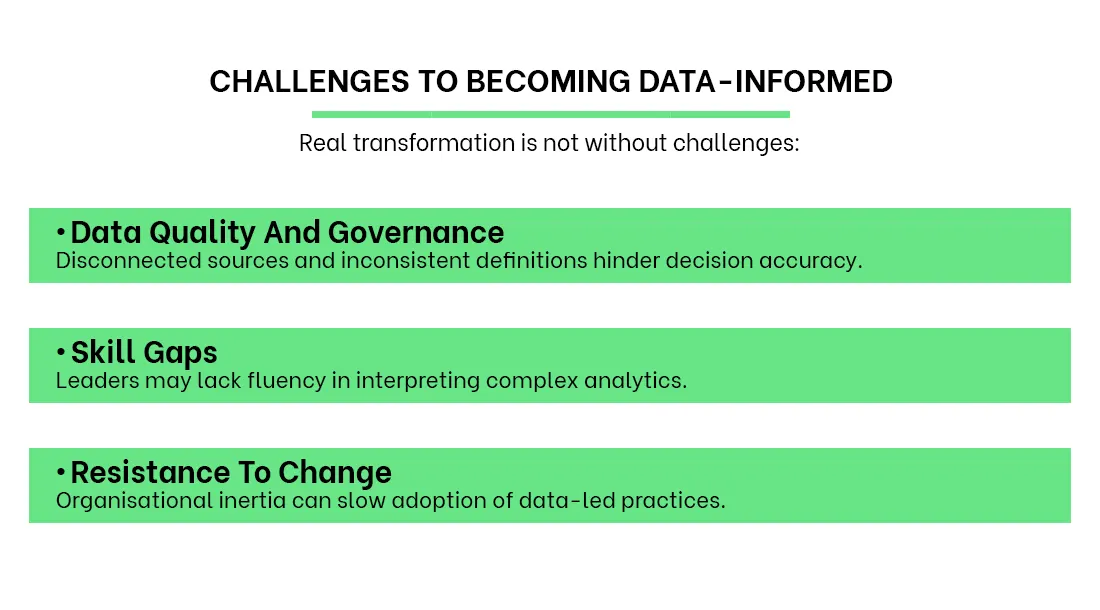
Challenges To Becoming Data-Informed
Real transformation is not without challenges:
Conclusion
The pace, scale, and uncertainty of modern markets demand leadership that is as analytical as it is strategic. Organisations that evolve their decision-making systems by integrating analytics into everyday decisions will outperform their peers. Data-informed leadership combines evidence with judgment, enabling organisations to act with clarity and precision.
As 2026 unfolds, leaders must embrace technologies and organisational change that make insight the foundation of every strategic choice. The brands that succeed will be the ones that make better decisions, backed by better data, faster than the competition.
Read Our Other Insights : Generating Full-Funnel Intelligence for D2C Brands
Authors

Co Founder, Director & CBO
Related
No items found.
%20(2).webp)
.webp)