Building a Zero-Waste Funnel with Analytics | Cognitute

Building a Zero-Waste Funnel with Analytics | Cognitute

February 19, 2026
Data Analytics
Using Analytics For The Creation of Zero-Waste Funnel
Customer journeys are rarely linear. A user can move from awareness to browsing to checkout, only to drop off at an unexpected point due to friction. Even small usability issues can destroy millions in potential revenue. When brands focus on scale without attending to friction, funnel waste grows silently and cumulatively.
A zero-waste funnel is a structured approach to identifying, measuring and eliminating drop-offs across the customer journey. It depends on analytics, behavioural insights, and disciplined optimisation of user experience (UX), conversion rate (CRO), and purchase behaviour.
This article explains why the zero-waste funnel matters, highlights real-world applications, and explores how brands today have leveraged analytics to transform experience into measurable business value such as improved reach, revenue, and ROI.
The Unseen Cost Of Funnel Drop-Offs
Customer drop-offs may occur at any stage of the funnel. It could be at Discovery,Product View, Add to Cart, Checkout or Payment Completion or even Post-purchase engagement for subsequent orders.
Every drop-off results in multiple costs from lost revenue, wasted acquisition spend or reduced brand visibility. This may result in higher overall CAC as conversion drops and lower retention and repeat purchase rates.
Industry research demonstrates the impact. According to Baymard Institute, e-commerce average cart abandonment rates exceed 70 percent globally. McKinsey & Company suggests that improving conversion rates by a mere five percent can increase profits by more than 25 percent when combined with more efficient UX and analytics.
As per Google, even in digitally mature markets, user experience issues are cited as one of the top three reasons for online abandonment.
These numbers mean that small frictions, if unaddressed, scale into larger revenue gaps.
Understanding The Zero-Waste Funnel
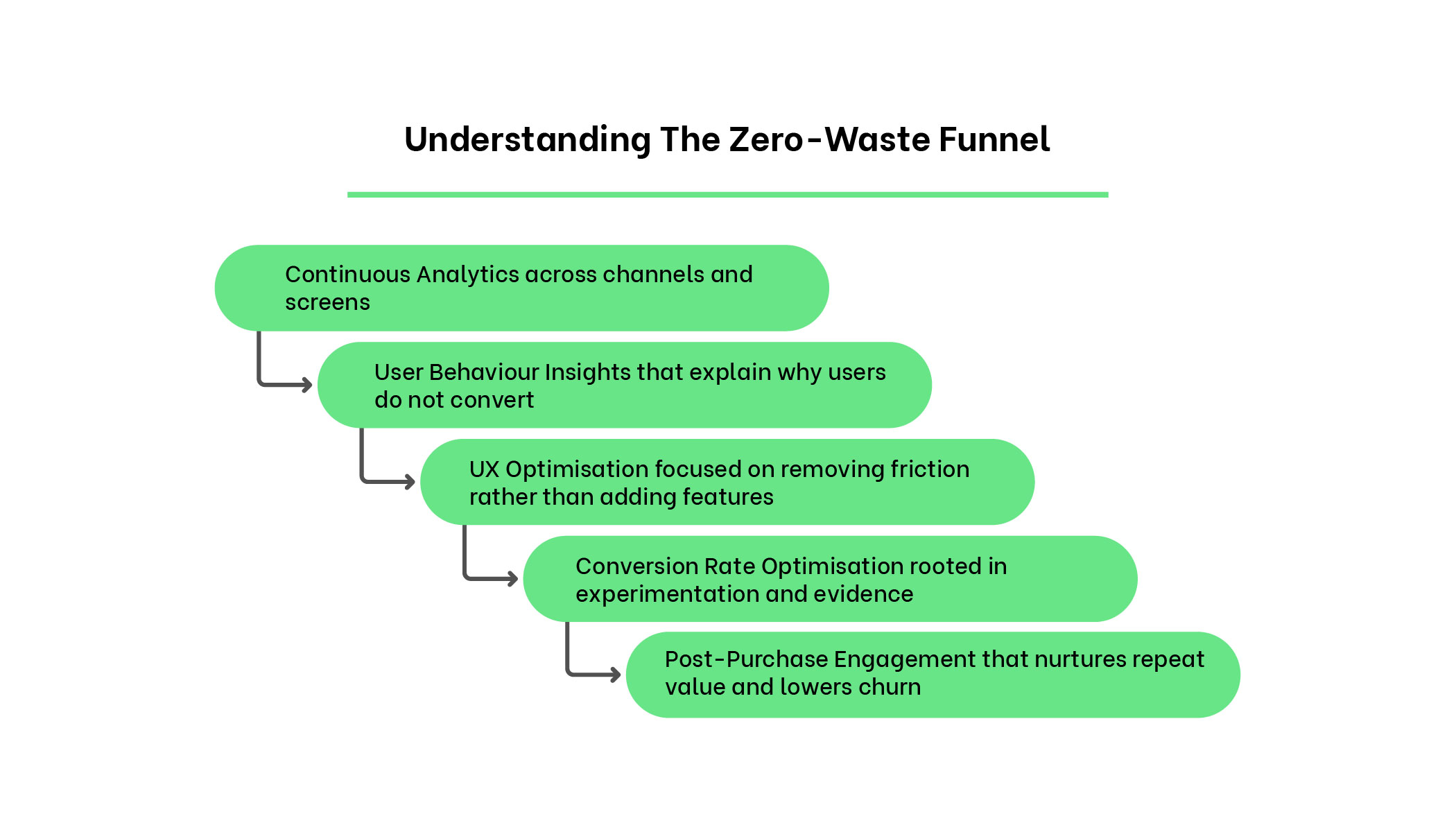
Zero-waste means minimising unnecessary loss at each step of the user journey. The goal is not perfection but insight-driven optimisation that turns friction points into conversion opportunities.
Key aspects include:
- Continuous Analytics across channels and screens
- User Behaviour Insights that explain why users do not convert
- UX Optimisation focused on removing friction rather than adding features
- Conversion Rate Optimisation rooted in experimentation and evidence
- Post-Purchase Engagement that nurtures repeat value and lowers churn
The zero-waste funnel acknowledges that customers are human and unpredictable. It uses analytics to map patterns rather than make assumptions.
For this reason, analytics needs to be deep, not superficial. Brands often rely on high-level metrics such as visits or orders, without understanding underlying behaviour. True funnel analytics answers questions such as:
- Which user segments bounce at specific screens?
- At what point does friction escalate drop-offs?
- What content or layout changes correlate with better conversion?
- Which post-purchase communications drive repeat orders?
- How do external factors such as delivery times and payment options influence abandonment?
To answer these, brands must integrate multiple types of analytics:
- Heatmap and Session Replay Analysis to see where users hesitate or abandon
- Funnel Segmentation by channel, device, geography, and campaign
- Cohort Analysis to track behaviour over time
- A/B Testing to quantify impact of UX changes
- Predictive Behaviour Models to forecast likely drop-offs before they occur
Related Reads :
How Generative AI Reshaping Consumer Retail Decisions
360° Customer Intelligence for Modern D2C Brands

Zero-Waste Funnel In Action
Consider the case of a well-known Indian apparel brand experiencing healthy traffic and high product discovery rates. However, the brand sees steep drop-offs at the recommended products carousel and cart stages. Analytics identified two key friction points:
- The carousel layout confused users on mobile screens, leading to long hesitation and abandonment.
- Cart page performance dropped when multiple variants were selected.
Actions taken based on data insight must include:
- Revamping the carousel to a simplified, mobile-first horizontal scroll
- Reducing visual clutter and highlighting the checkout call to action
- Streamlining variant selection with a single-step modal
- Running controlled A/B tests for each change
These simple measures resulted in key observations over the subsequent weeks such as, an amazing 18% increase in product view-to-cart conversion, 15% reduction in cart abandonment, 12% lift in checkout completion, 20% increase in revenue per thousand sessions.
This demonstrates how UX analytics can directly influence the top and middle of the funnel.
Impact Of Analytics Driven Optimization
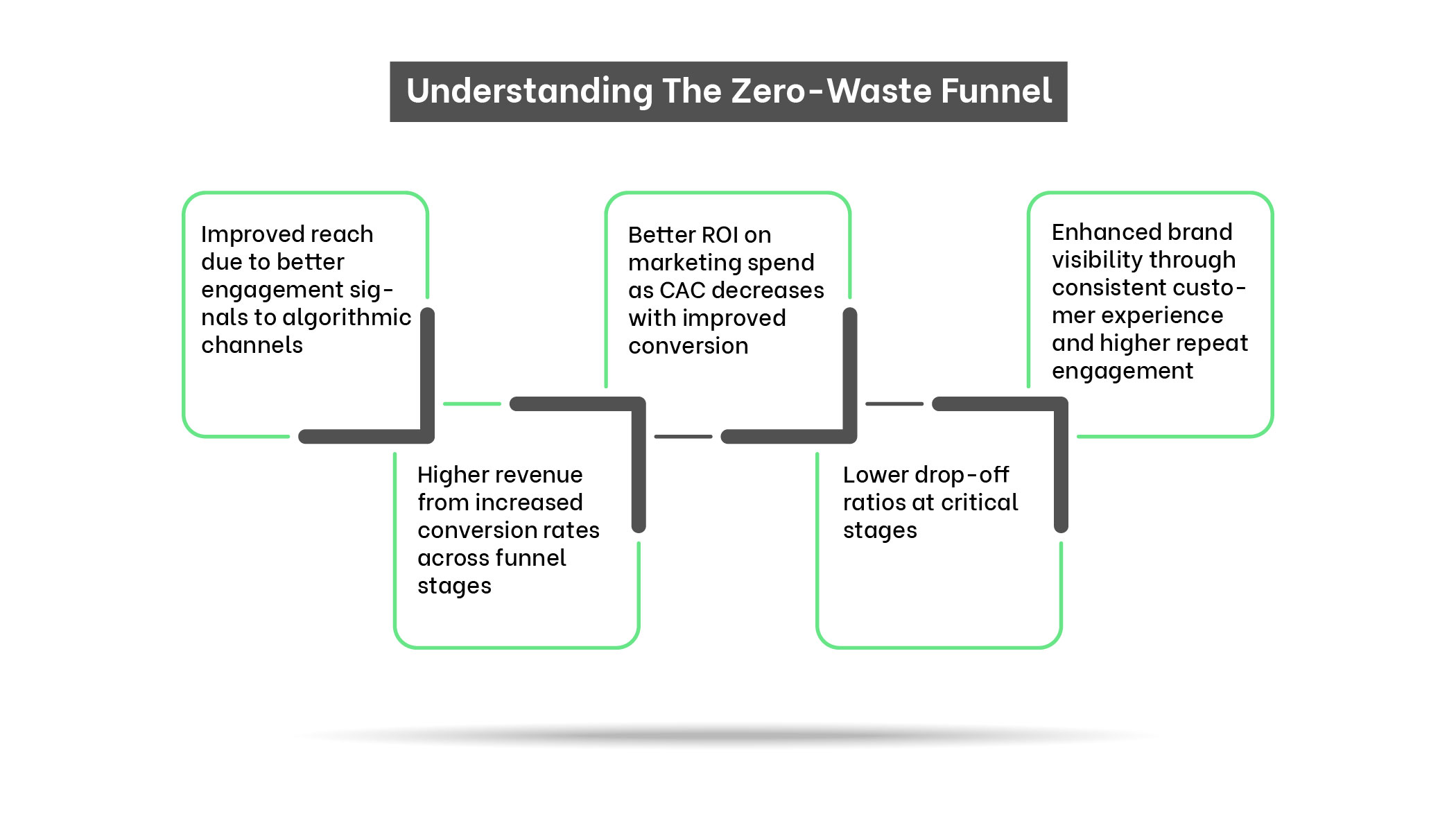
Brands that adopt analytics-driven optimisation achieve measurable outcomes:
- Improved reach due to better engagement signals to algorithmic channels
- Higher revenue from increased conversion rates across funnel stages
- Better ROI on marketing spend as CAC decreases with improved conversion
- Lower drop-off ratios at critical stages
- Enhanced brand visibility through consistent customer experience and higher repeat engagement
A few key principles for eliminating funnel waste are :
- Segmentation by channel, device, geography, and behaviour ensures that optimisation efforts hit real pain points.
- Optimise For Customer Perception, Not Just Metrics. This requires an understanding of how customers feel to predict they behave.
- Not all changes are equal. Prioritise A/B experiments that promise the largest impact on conversion and revenue.
- Align Teams Around Shared Intelligence. Marketing, UX, engineering, and data science must share definitions and signals so decisions are coherent.
- Treat Post-Purchase As Part Of The Funnel and not the end at payment. Repeat purchase and customer advocacy are integral to lifetime value.

Conclusion
The path from awareness to loyalty is filled with hidden frictions that can silently erode revenue and brand value. Analytics transforms fragmented data into actionable insight, enabling brands to detect bottlenecks early, optimise experience continuously, and improve long-term revenue performance.
A zero-waste funnel is not a destination. It is an operating mindset that treats drop-offs as opportunities and customer behaviour as the ultimate guide. When brands adopt this mindset, they benefit not only from improved conversion rates and revenue but also from stronger customer loyalty and sustained market relevance.
Authors
%201.jpg)
Team Leader - Organic Growth