
Common ESG Pitfalls Organizations Must Avoid | Cognitute

What pitfalls should organizations avoid while transforming towards Environmental Social Governance (ESG)

May 27, 2025
ESG & Sustainability
ESG Transformation Critical Pitfalls Organizations Must Avoid
Across industries, sustainability has become a strategic priority for achieving competitive advantage in business. Environmental, social, and governance (ESG) targets now reflect the long-term sustainability ambitions of organizations, covering areas such as fair wages across supply chains, diversity and inclusion, net-zero carbon commitments, and equity outcomes. As expectations from regulators, investors, and consumers continue to rise through the mid 2020s, ESG performance increasingly shapes how organizations are evaluated.
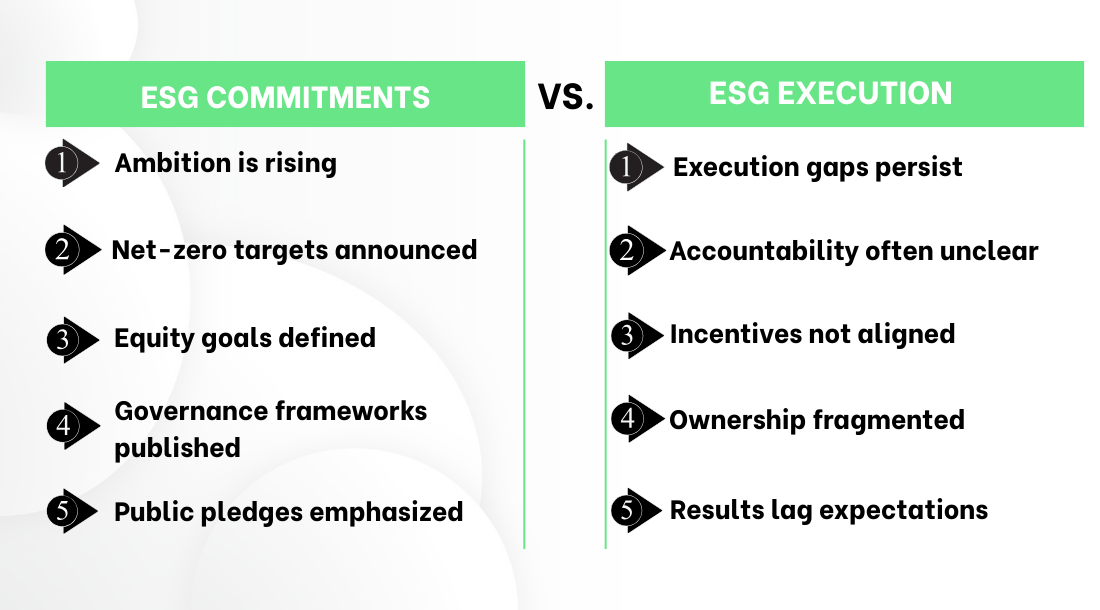
However, making commitments of this magnitude does not guarantee execution or follow-through. For ESG sustainability and ESG management to be effective, organizations require targeted and disciplined corporate mobilization. Across industries, a consistent set of ESG risks and pitfalls continue to undermine execution, even among organizations with clearly stated ambitions.
Lack of Accountability and Incentives
The first step in ESG transformation is establishing goals, initiatives, and commitments for a more sustainable organization. However, without a structured accountability model, progress frequently stalls. This remains a common pitfall for organizations at earlier stages of sustainability maturity, particularly when ESG responsibilities are treated as supplementary rather than integral to business performance.
A typical approach among less mature organizations is to assign accountability for ESG outcomes to a small leadership or sustainability group. In this model, organization-wide sustainability targets depend heavily on a limited set of individuals, removing clear accountability and incentives from the broader workforce. When sustainability goals are not linked to incentives and performance management across the organization, ESG priorities struggle to compete with short-term operational and financial objectives.
Organizations at more advanced stages of sustainability maturity adopt a different approach. Rather than centralizing accountability, they translate high-level ESG commitments into clear, quantified KPIs at business-unit and functional levels. These near-term targets are embedded across the organization and extended throughout the supply chain. Sustainability metrics are then incorporated into compensation and performance frameworks, ensuring that incentives reinforce ESG outcomes at all levels rather than only at the executive tier. This approach enables employees to understand how their daily decisions directly influence organization-wide sustainability performance.
Failure to Incorporate ESG standards in the Day-To-Day
When sustainability is not embedded into day-to-day decision-making and processes across all levels of the organization, the mindset of the workforce may continue to view sustainability outcomes as not being a company-wide responsibility. This mindset divide will limit employees’ ability and willingness to align their daily decision-making and processes with long-term sustainability goals due to the perception that only the sustainability team or core leadership group is accountable for this. Organizations with mature ESG transformations identify key business processes that produce the largest sustainability impact, allowing a focused change in areas such as procurement, product development, capital expenditure, and business planning.
It is essential to integrate sustainability criteria and ESG governance so that sustainability goals are closely linked to overall business goals. Sustainability should be discussed and evaluated in the same format as business progress. This process involves the reconfiguration of business reviews to incorporate sustainability KPIs in addition to financial KPIs. Incorporation of sustainability KPIs allows leadership teams and organization executives to have regular insight into ESG progress.

Insufficient Commitment by Senior Leadership
A key determinant for the efficacy of ESG transformation is the strength of the commitment made to long-term sustainability by senior leadership. Lack of management support at the top level is a key barrier to organization-wide sustainability progress. It is not enough for leaders to personally believe in sustainability commitments; external engagement is necessary to produce a consistent message of commitment to all levels of the organization.
There are a number of ways in which senior leadership can effectively demonstrate commitment. Within the organization, this can be demonstrated internally by frequent discussions with employees regarding sustainability outcomes and KPIs. When an effort is made to have these conversations consistently, connection of sustainability to business value, organization mission, and long-term success or compensation can be demonstrated - particularly when resilience is embedded as a strategic pillar for navigating crises.
Many executives for organizations that incorporate sustainability as an effective key pillar will choose to become thought leaders in the areas of ESG sustainability and ESG governance, by producing publications or giving talks on these topics. This allows sustainable change to be influenced not just within the organization, but externally, both within the industry and across industries.
Limited Workforce Capabilities
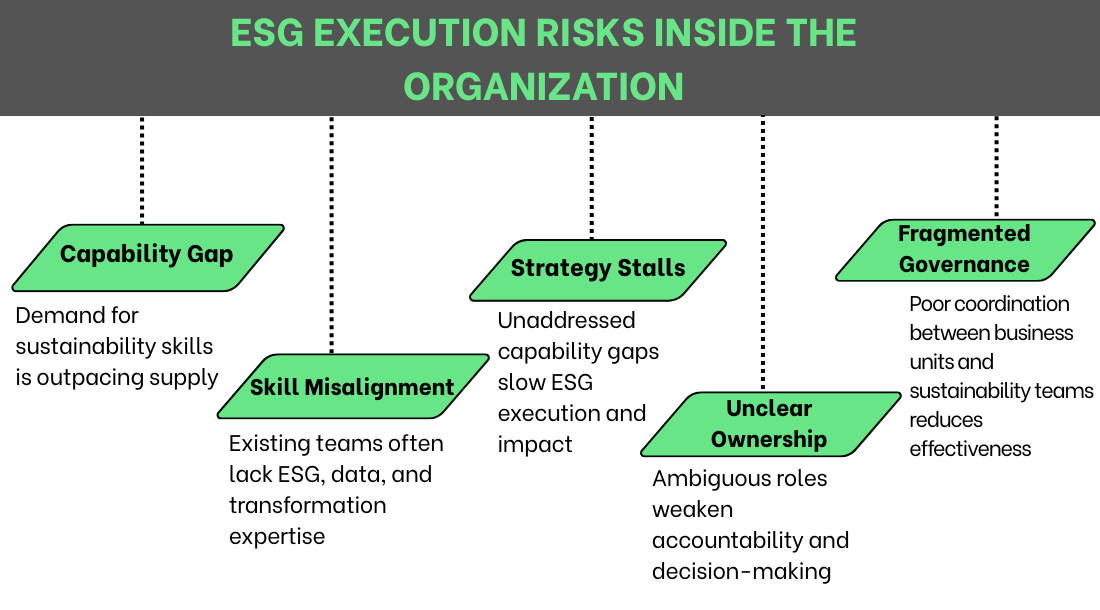
Transforming toward environmental, social, and governance sustainability criteria require follow-through by appropriate workforce talent and organization capabilities to create ESG impact. Across industries, demand for sustainability skill sets in talent is set to become higher than supply. This puts organizations who have not already recruited or invested in sustainability skill sets at a competitive disadvantage, but organizations may find it challenging to identify the skill shifts that are necessary for ESG strategy.
Incorporating new business models and ESG-driven changes to services, processes, and products requires an often-significant change in skill set, which may not be possessed by the existing workforce. This pitfall can lead to stalling of sustainability strategies and reduced effectiveness of ESG management.
To overcome this ESG risk, organizations must begin with a focus on their sustainability agenda and then work backward. Once targets are clearly defined, organizations can then pinpoint the relevant skill sets required to meet ESG targets. With clear parameters of desired skill sets in place, leadership teams can evaluate skill gaps across the organization by carrying out a targeted capability assessment. With gaps identified, strategies to fill these gaps can be implemented via the acquisition of new talent to acquire more specialized skill sets, external partnerships, or upskilling of the workforce to build capabilities - a step that’s often core to broader organizational change and capability building for long-term impact.
Poorly Defined Roles and Responsibilities
Sustainability goals require cross-functional coordination of business units and the central sustainability team if they are to be achieved effectively and completely. A complex organization is a significant barrier to sustainable business strategy if sustainability efforts are not well-organized and centralized. Without a clear definition of the roles and responsibilities of teams and departments within the organization in ESG strategy, progress becomes slow and inefficient and execution is confused. This in turn drives a negative workforce mindset and reduced commitment across the organization.
Definition of roles and responsibilities in transformation for ESG can be improved by establishing a team consisting of experts in the design and execution of sustainability initiatives. Frequent collaboration and consultation with experts in these areas allow business units to consult freely regarding sustainability initiatives, reducing inefficiency and improving sustainability strategy. Correctly utilizing a center of expertise via a defined interaction model allows a sustainability lens to be applied to decision-making across all levels of the organization.
Early on in an organization’s sustainability strategy, the use of a central sustainability leadership team who works alongside executive leadership allows collaboration on ESG goals and targets. The central sustainability team is able to coordinate initiatives, goals, and incentives across the business, creating an organization-wide strategy that is coherent and centralized. With the increased maturity of an organization’s sustainability efforts, the sustainability team can then be divided into satellite groups across different levels of the organization, with a smaller central sustainability team remaining as a center for support. Primarily, the central team will focus on data management, communications, partnerships, and sustainability initiatives, as well as working alongside the leadership team to set and implement an ESG strategy.
Industry leaders are aware that environmental, social, and corporate governance is a key component to cutting-edge advantage across all industries, as well as medium- and long-term sustainability. This movement must be grounded in a forward-looking corporate strategy during uncertainty..Transforming for ESG allows sustainability to be harvested as an advantage across all industries and drives the movement of the organization across the sustainability maturity curve. Avoiding these common ESG risks ensures that organizations follow a streamlined and efficient path towards meeting ESG targets and successfully realizing sustainability strategy.

Authors

Content Strategy Consultant




%20Matters%20for%20E-Commerce%20Organizations%20(1)%20(1).webp)


