Resilient Business Transformation via Re-Engineering

Resilient business transformation: creating value via re-engineering

May 27, 2025
Business Transformation
Resilient Business Transformation: Creating Value Through Re-Engineering
The onset of the Covid-19 pandemic highlighted how most organizations prioritized short-term profit and efficiency over long-term resilience. With this global insight, many organizations are now placing sustained emphasis on resilience, but resilience can only be tested when organizations are challenged by unforeseen circumstances or following major business turnaround exercises. Objectively, the relative resilience of a business can be quantified by comparing its total shareholder return during crisis quarters to that of industry peers. The resilience of an organization during unfavorable periods contributes close to 30 percent of long-term value creation. Organizations that maintain consistent resilience despite external change generate value by focusing on growth acceleration, increased flexibility, and reduced debt during periods of economic stress driven by negative market forces, global trade disruptions, and supply chain instability.
Resilience for sustained success during crisis quarters
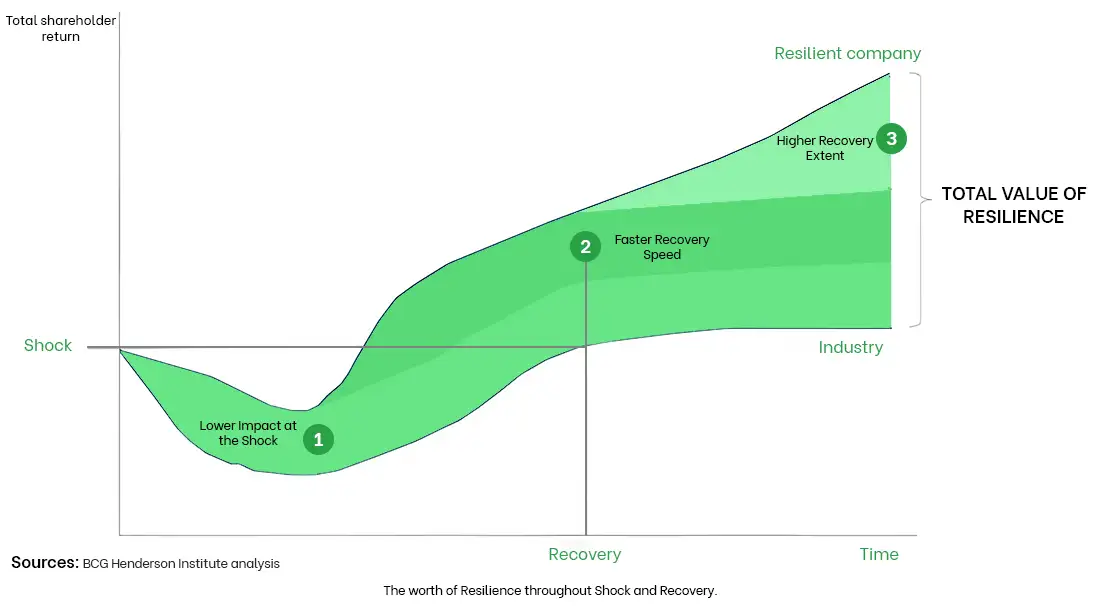
The value provided by resilience is most apparent during periods of disruption, such as the Covid-19 pandemic, which unpredictably and disproportionately impacted critical organizational functions. At the onset of the pandemic, many businesses experienced immediate declines in demand, labor availability, or supply chain continuity. Despite facing similar threats, even within the same industries, the pace and extent of recovery varied significantly across organizations. Resilient companies consistently outperformed peers across multiple dimensions of performance.
Immediately following an external shock, the performance impact on highly resilient organizations is cushioned relative to competitors. This immediate response capability is the primary driver of industry outperformance, with more than 60 percent of relative total shareholder return during crisis periods determined by the response in the initial phase following disruption. Long-term recovery contributes the remaining 40 percent.
While many large-scale transformation programs implemented during or after crises focus primarily on cost reduction, evidence continues to show that growth acceleration is the dominant contributor to value creation through successful resilient transformation. Large-scale transformations targeting growth acceleration deliver an average improvement of approximately six percentage points in performance relative to industry peers. In contrast, transformations focused primarily on cost reduction are associated with weakened future resilience.
After the shock: the value of resilience in stable quarters
In the recovery period following an initial shock, the speed of organizational recovery is a critical factor in outperforming competitors and maximizing long-term growth. Resilient organizations consistently demonstrate faster recovery trajectories following external disruption. While resilience delivers advantages across all sectors, the magnitude of value creation is more pronounced in volatile industries such as consumer durables and technology, compared to sectors with more stable demand profiles.
Another key variable in post-crisis recovery is the extent to which organizations are able to recover beyond prior performance levels. Performance during crisis periods exerts a disproportionate influence on long-term outcomes, accounting for roughly 30 percent of long-term relative total shareholder return, despite crises occurring far less frequently than stable periods. During crisis conditions, shareholder returns within the same industry diverge sharply, with the gap between underperforming and outperforming organizations nearly doubling.
Growth-oriented business transformations provide a significant resilience advantage during recovery by enabling organizations to adapt to new conditions and capitalize on emerging opportunities. While many organizations aim only to return to pre-crisis performance levels, resilient businesses are able to benefit from crisis dynamics and surpass prior performance, strengthening their competitive positioning. Over the long term, resilient business turnarounds approximately double the likelihood of sustained outperformance. Non-resilient organizations must execute flawlessly during stable periods to match the performance of resilient peers.

Is it possible to sustain resilience across all areas in the face of any crisis?
Every crisis faced by organizations is multifaceted and unique. The challenges presented by a global pandemic differ substantially from those arising from economic recessions, geopolitical conflict, or regulatory disruption. Resilience designed to address a single type of crisis may prove ineffective or even detrimental when applied to different forms of disruption. This has led to increased focus on the concept of general resilience and the feasibility of building organizations capable of performing across a broad range of adverse scenarios.
Recent research continues to demonstrate that general resilience is achievable, but only through deliberate, expert-led transformation efforts. Generally resilient organizations outperform competitors across the majority of crisis periods, sustaining long-term competitive advantage and retaining the ability to generate value during prolonged uncertainty.
Principles for achieving general resilience

General resilience is a complex capability rooted in adaptable, data-driven, and fluid transformation processes. Organizations structured for high levels of general resilience incorporate systems designed around core principles that support sustained adaptability and performance across changing conditions.
Forward-thinking
Organizations may hope for extended periods of favorable conditions, but external pressure, global disruption, and profit volatility remain inevitable. A forward-thinking approach to resilience recognizes multiple potential disruption scenarios and assesses which are most likely to materialize.
Processes such as contingency planning and early warning systems are established to mitigate risks before they escalate. Leading organizations monitor early indicators including anomalous market signals, competitor behavior, and reduced recovery time from smaller disruptions to anticipate crises before material impact occurs. Forward-thinking resilience provides the advantage of anticipation, enabling organizations to prepare for disruption rather than respond reactively.
Adaptability
Transformations that reduce debt and enhance operational flexibility continue to be strongly associated with improved resilience. Lower reliance on fixed assets enables shifts toward variable cost structures, increasing organizational adaptability. Adaptable systems adjust efficiently to changing industry dynamics, creating competitive advantage.
Beyond responding to change, adaptable organizations are able to shape future industry conditions to their benefit. Experimentation through digital transformation initiatives allows successful systems to be scaled and optimized using advanced analytics and algorithms, supporting agile decision-making under uncertainty.
Diversity
A diverse approach to resilience creates multiple response options within transformation strategies. Diversity may be applied across revenue streams, customer segments, and operational models.
Revenue diversity across customer bases and channels protects against abrupt demand shocks, as different segments respond differently to disruption. Operational diversity across supply chains, enabled through digitization and flexible production models, increases optionality and reduces vulnerability during shocks.
Buffering
Buffering introduces redundancy that cushions organizations against unexpected disruption. Operational buffers including inventory, talent, and production capacity provide flexibility during demand and supply volatility.
Financial buffering is achieved through higher cash-to-operating-cost ratios and lower debt-to-enterprise value ratios. These conditions allow organizations to sustain operations during downturns and pursue strategic opportunities such as distressed asset acquisition. Transformations focused on reducing debt burdens are associated with improved relative performance during market downturns, with average gains of approximately 2.5 percentage points.
Organizations with lower dependence on legacy assets retain greater flexibility to adopt new technologies and pursue emerging opportunities during and after crises. Higher proportions of variable costs allow revenues and costs to adjust more closely during periods of contraction.
By embedding these core principles, organizations can shift toward valuing resilience, adaptability, and forward planning alongside financial performance. Leaders who prioritize resilience view business systems holistically rather than functionally, enabling disproportionate success during both stable conditions and periods of disruption.

References
- Brende, Børge, and Bob Sternfels. “Resilience for sustainable, inclusive growth.” McKinsey, 7 June 2022
- Deegan, Tom. “Transform for Resilience: An Imperative for Good Times Too.” Boston Consulting Group, 14 July 2021
- “Future proof: Solving the 'adaptability paradox' for the long term.” McKinsey, 2 August 2021
- O'Keeffe, Dunigan, et al. “Getting Business Resilience Right.” Bain & Company, 7 January 2021
Read Our Other Insights : Deep Tech and Advanced Marketing to Maximize ROI
Authors

Content Strategy Consultant