Driving Enrollment Growth with Community Advantage | Cognitute

Enrollment Growth Using Community Momentum Advantage in Education

February 12, 2026
Business Transformation
Enrollment Growth Using Community Momentum Advantage in Education Sector
Executive Summary
In a market where students increasingly distrust traditional advertising, higher-education institutions in India and APAC are shifting toward community-led demand generation, where learners and alumni actively advocate for the institution. This approach builds reliance on authentic storytelling, peer validation, digital communities, and co-ownership of brand identity.
Institutions that successfully turn students into brand ambassadors are seeing:
- 30–50% lower cost per enrollment
- 1.8–3X higher inquiry-to-admission conversion
- Sustainable referral pipelines and higher retention
- Better alignment between learner expectations and institutional offerings
Community-led growth is no longer a marketing tactic , it is a strategic pillar for scalable admissions.
Why Community Matters Now
The education landscape across India and the wider APAC region has been experiencing a profound transformation. In the last few years, over INR 30,000 crores have been invested into digital learning and student-centric innovation. This is a clear signal that education delivery is no longer confined to physical classrooms.
The pandemic accelerated this shift dramatically, forcing educators, institutions, and learners to embrace online and hybrid learning models almost overnight. What began as a response to disruption has now become the preferred mode of learning for millions.
With this rapid digital transition, AI-powered personalisation has moved from a “nice-to-have” feature to a core differentiator. From predictive analytics to real-time progress tracking, technology is now enabling institutions to tailor learning journeys to each student’s pace, strengths, and aspirations.
However, this transformation has also intensified competition like never before. There are over 10,000 EdTech companies in India and the APAC region alone. And they are all vying for their share of attention, trust, and outcomes.
Learners' needs and expectations have also fundamentally evolved. They are no longer satisfied with just completing a course or gaining a certificate. Students want clear pathways to careers, stronger employability outcomes, and a sense of belonging to a wider, aspirational community. Social proof has become one of the strongest decision-making drivers; instead of believing brand marketing alone, students look for real stories and real results from people like them.
In fact, research shows that peer recommendations now influence 70–85% of education decisions, and alumni endorsements can generate up to 4X higher-quality leads than traditional channels. When learners are part of engaged communities who are regularly sharing experiences, celebrating progress, and learning collaboratively, it is found that institutions also benefit from higher retention, stronger outcomes, and deeper brand trust.
At its core, education has always been a social experience. The classroom, whether physical or virtual, is shaped by relationships, not just content. Today’s students explore, evaluate, and choose education with that same social mindset. If the past few years were about digitizing learning, the next chapter is about humanizing digital education and strengthening communities, creating identity, and building trusted networks that empower learner success.
Cracks in the Traditional Admissions Funnel
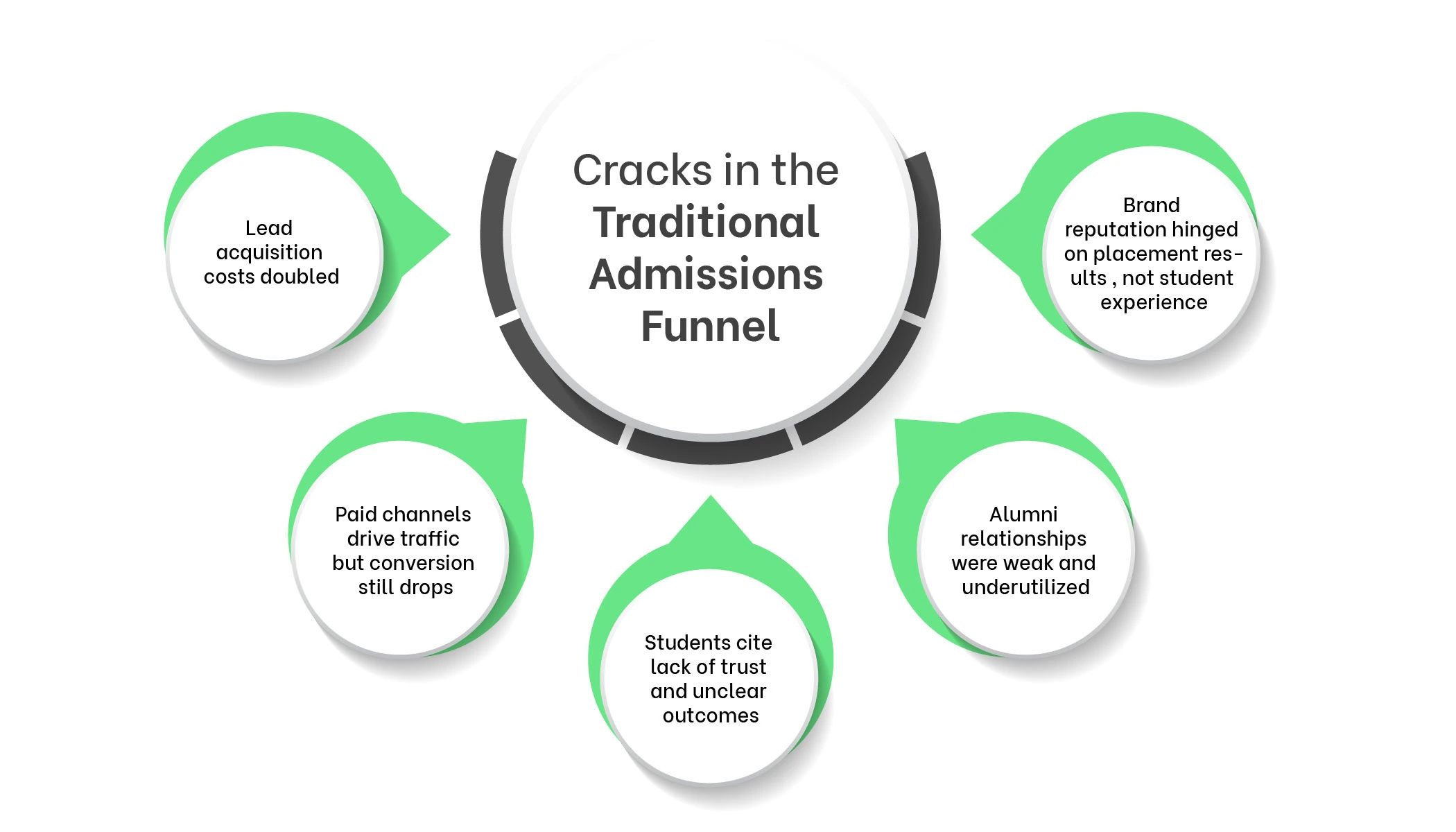
Imagine a large private university in India with a strong brand and modern infrastructure. Yet, over the last 3 years, they find that:
- Lead acquisition costs doubled
- Paid channels drive traffic but conversion still drops
- Students cite lack of trust and unclear outcomes
- Alumni relationships were weak and underutilized
- Brand reputation hinged on placement results , not student experience
Despite millions being spent on digital ads, admissions became less predictable and more expensive. This is the moment when community-led growth becomes not just advantageous, but necessary.

Community-Led Demand Generation
Forward-looking institutions across India and APAC are repositioning their admissions system around community confidence and student voice. Key levers driving the transformation are:
- Student Advocacy Programs <H3>
- Ambassador initiatives where motivated students share real experiences
- Organic content through student-run social handles, Instagram takeovers, and vlogs
- Peer-to-peer Q&A sessions for prospects
Impact : Higher authenticity → Lower skepticism → Faster decision-making
Institutions report:
- 2.5X higher engagement on student-created content vs brand-created
- Up to 40% more inquiries coming from referrals
2️. Alumni Advocacy
- Success stories mapped to career outcomes
- Alumni mentorship circles helping conversion
- Alumni-led masterclasses increasing program credibility
Alumni represent the promise delivered, not mere tall claims.
3️. Community as Proof of Value
Institutions co-create:
- Industry projects and innovation clubs
- Communities of interest (design, fintech, sustainability)
- Placement prep networks powered by alumni and students
This shifts messaging from institution-led claims to community-led demonstration.
4️. Technology-Enabled Engagement
Digital platforms amplify community efforts through:
- CRM + marketing automation
- Social listening tools
- AI-based matching (prospective students with relevant alumni or mentors)
- Analytics to identify high-potential advocates
Tech enables scaling trust without losing authenticity.
Related Reads :
Understanding Decision-Making in a Data-First World
The People Problem in Digital Talent Transformation
Why Community Drives Admissions Better Than Advertising
For founders of these institutions, seeking long-term differentiation, community-led advocacy offers structural advantages:
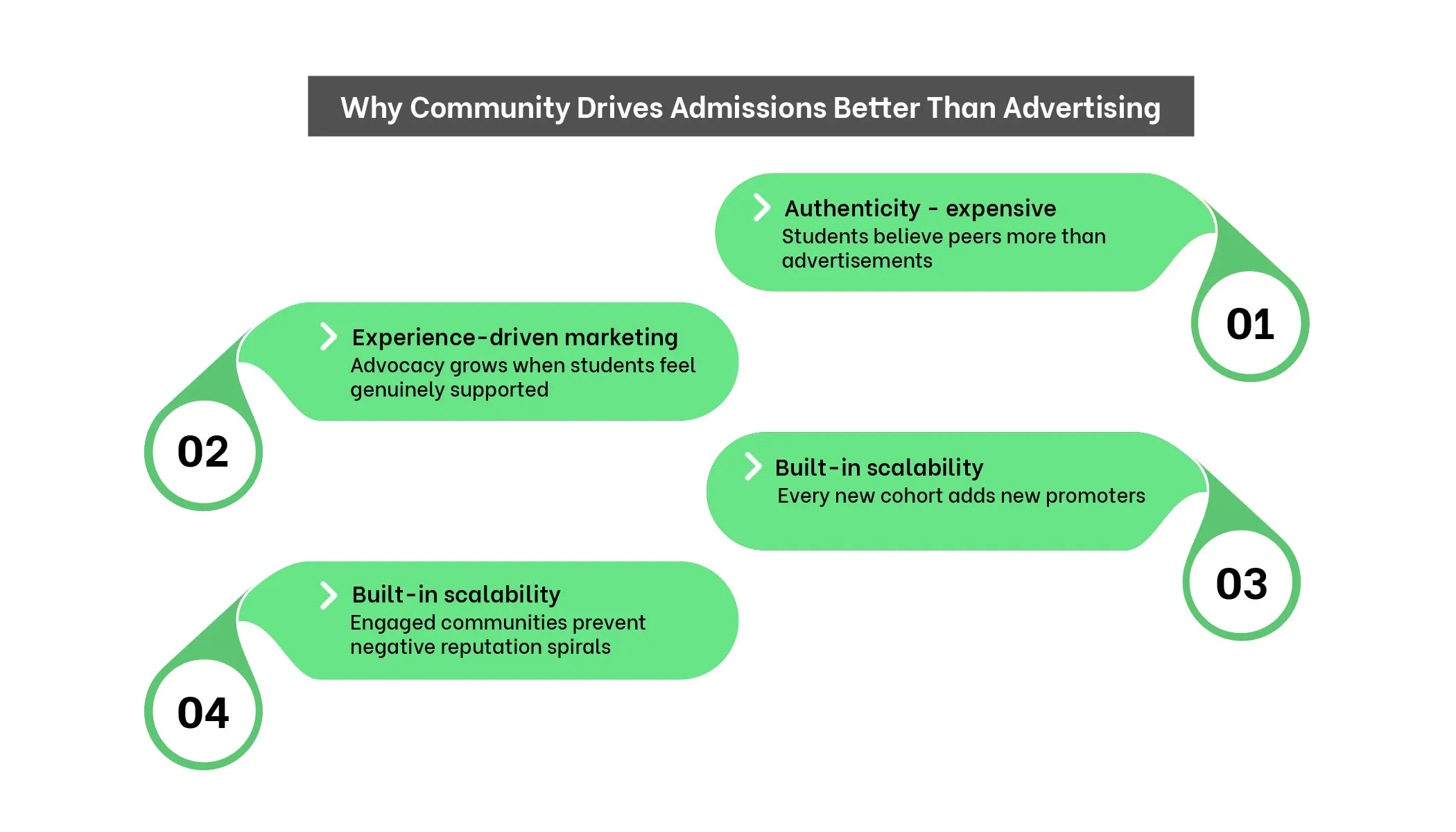
- Authenticity ≠ expensive
Students believe peers more than advertisements - Experience-driven marketing
Advocacy grows when students feel genuinely supported - Built-in scalability
Every new cohort adds new promoters - Risk reduction
Engaged communities prevent negative reputation spirals
How Institutions Can Begin
To effectively realise the power of communities, educational institutions must rethink how they operate and who they are serving.
The biggest transformation required is not technological, but a mindset shift. For decades, students have been treated primarily as customers: receivers of content, buyers of courses, and followers of institutional rules.
But now, students like to be thought of as not just consumers, but co-creators of the learning experience, ambassadors of the brand, and active participants in shaping institutional culture.
This shift brings with it a new set of priorities. The first step is reimagining how students participate in the journey long before they enroll. Empowering student voices in admissions outreach, for example: peer mentorship programs, student-led online sessions, and authentic storytelling, helps prospective learners connect deeply with the experience they are stepping into.
Alumni relationships also need to move beyond periodic newsletters and occasional reunions. A strong alumni community are not just a database; it is a living network of credibility, career outcomes, and shared pride. Strengthening CRM capabilities and building a powerful storytelling engine as part of a broader business transformation effort can unlock immense value, especially when alumni narratives become part of the admissions and engagement strategy.
Analytics, too, has a larger role to play. Understanding student sentiment like what excites or frustrates them, what keeps them engaged, etc., gives leadership the ability to act rapidly and intelligently. Embedding analytics into digital operations enables data-driven decisions around communication, curriculum, and support services, helping institutions transform outcomes at scale.
Lastly, advocacy must be earned, not bought. When institutions reward engagement with genuine opportunities, mentorship, learning benefits, and belonging, instead of mere merchandise, they create advocates who speak from experience and emotional connection.
Most importantly, communities must be cultivated, not constructed. A thriving education community is not a short-term marketing project or a campaign. It is a long-term cultural operating system; one that prioritizes safety, inclusion, identity, and shared purpose.
Institutions that embrace this strategic realignment are not just adapting to change. They are building the future of education.
Read Our Other Insights : Smart Sourcing Strategies for D2C Beauty & Wellness Brands
Authors
.webp)
Sr Consultant (Digital Growth & Marketing 4.0)
Related
No items found.