SUGAR Cosmetics Positioning-Led Growth Strategy | Case Study
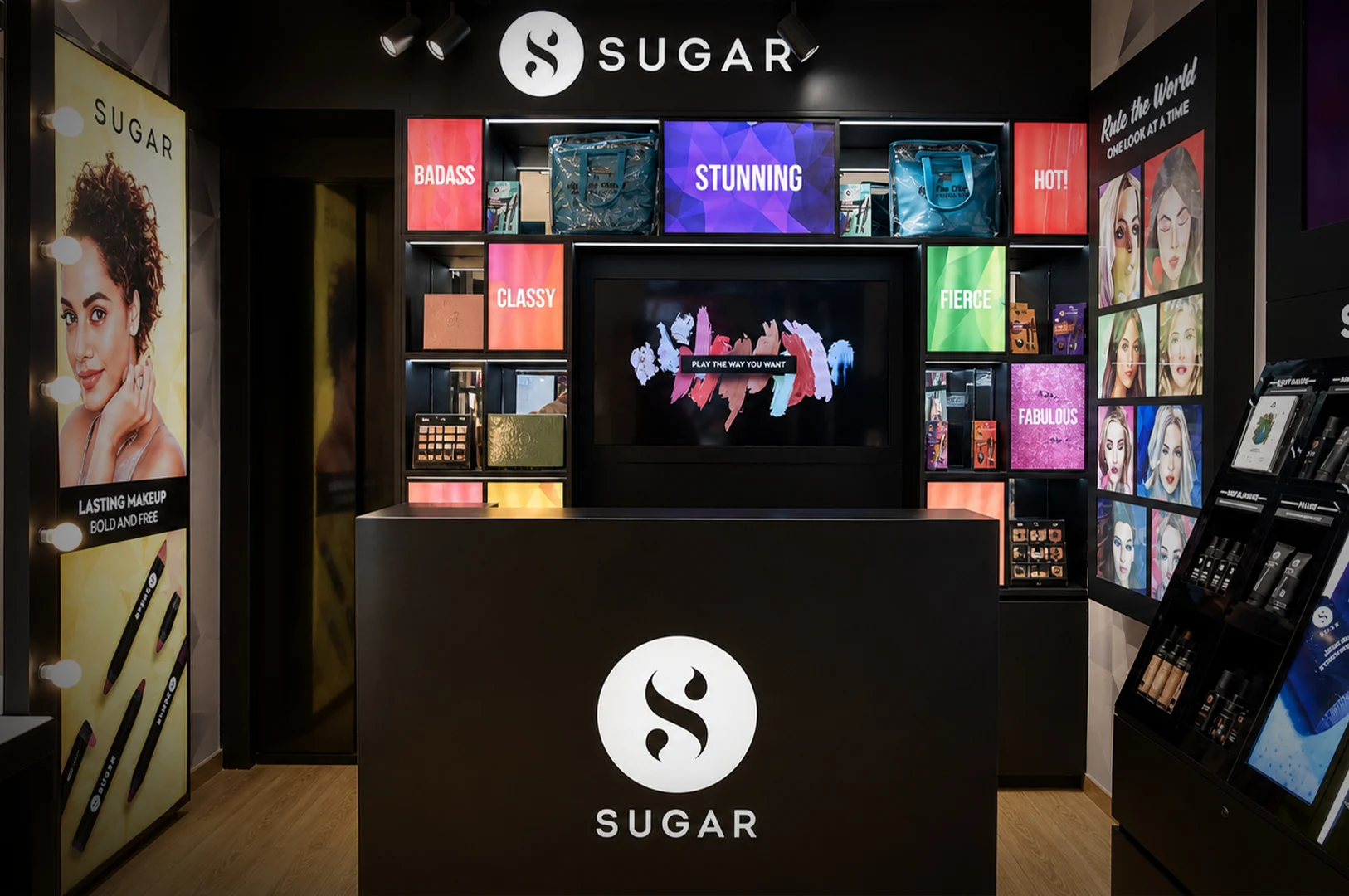
SUGAR Cosmetics: How a Positioning-Led D2C Brand Cracked Profitable Scale in India's Most Competitive Beauty Market
Introduction
India's beauty and personal care market crossed $2.1 billion in D2C revenue in 2024, growing 88% in a single year. Within that expansion, a large number of digital-native brands chased volume over viabilit and spending aggressively on customer acquisition while deferring the harder question of whether those customers would ever return and generate sustainable margin. SUGAR Cosmetics, founded in 2015 by Vineeta Singh and Kaushik Mukherjee, took a structurally different path.
By FY2025, SUGAR had generated Rs 412 crore in annual revenue, raised $96 million across sixteen funding rounds, and built a distribution presence across more than 40,000 retail touchpoints spanning online and offline channels, all while maintaining profitable unit economics across a meaningful share of its product portfolio. In a category where most D2C brands were still modelling their path to contribution breakeven, SUGAR had already arrived.
This case study examines the strategic architecture behind SUGAR's growth: what the brand got right in its early years, where structural challenges have emerged as scale increased, and what the strategic priorities look like for the brand's next phase of growth. For D2C brand leaders, investor teams, and consulting practitioners working across India's consumer and retail sectors, SUGAR's trajectory carries lessons that extend well beyond the beauty category.
The Market SUGAR Entered and the Gap It Chose to Own
When SUGAR launched in 2015, India's colour cosmetics market was structured around two relatively distinct segments. At the premium end, a set of international brands like Maybelline, L'Oreal Paris, MAC, ominated consumer aspiration but were formulated primarily for Western skin tones and climatic conditions. Their foundations oxidised against deeper complexions. Their lip shades read differently on brown skin than the fair-skinned models used in their campaigns. Their long-wear and transfer-proof claims frequently underperformed in India's heat and humidity.
At the mass end, domestic players competed largely on price without meaningfully addressing the formulation gap.
This left a substantial underserved segment: urban Indian consumers who wanted makeup that actually performed on their skin, in their climate, without compromise on colour payoff or wear durability. This was not a niche insight. It was a market-wide failure that the dominant players had either not recognised or not prioritised.
SUGAR entered at the intersection of a genuine product gap, an accelerating D2C distribution opportunity, and a generation of consumers whose identity was no longer defined by the fairness-centric aspiration that had shaped Indian beauty advertising for decades. The brand's early positioning, which was makeup made for Indian skin, with performance built for Indian conditions, this layer was specific, functional, and verifiable. A consumer could test the claim and confirm the outcome on their own face. This is the kind of product truth that does not require advertising to sustain. It generates its own advocacy.
The Strategic Foundations of Sugar’s Early Growth
.webp)
1. Functional Differentiation as Brand Architecture
SUGAR's most durable early advantage was that its product development brief was built from the consumer gap outward, not from category convention inward. Transfer-proof lipsticks, smudge-proof kajals, and long-wear foundations formulated for Indian pigmentation and climate durability became the brand's foundational SKUs. These were not incremental improvements on existing formats. They were product categories redesigned from a different starting assumption.
This specificity gave SUGAR a brand story that was both tangible and credible. Where legacy FMCG brands offered aspirational claims such as glow, fairness, radiance, SUGAR offered a verifiable performance outcome. Consumers could confirm it, which lowered purchase hesitation, accelerated repeat behaviour, and generated organic word-of-mouth in a category where trial risk is high and brand switching is otherwise frictionless.
The functional differentiation also gave SUGAR a natural content engine. How-to tutorials, shade-match guides, and wear-test content were not manufactured brand stories, they were direct demonstrations of the product's core claim. This made SUGAR's early digital content both credible and shareable, which is a combination that paid media alone cannot produce.

2. Digital-First Brand Building Before Offline Commitment
SUGAR's early growth was driven almost entirely by digital channels such as Meta advertising, Instagram content, influencer partnerships calibrated toward relatability rather than celebrity reach, and a direct-to-consumer website. This sequencing was strategic rather than circumstantial. Building brand awareness and product credibility digitally before committing to the capital-intensive requirements of offline retail gave SUGAR a real-time feedback loop that legacy players, governed by quarterly retail sell-through cycles, could not match.
The brand could identify which SKUs were converting, which claims were resonating, which consumer segments were returning, and which content formats were driving first purchase and adjust its product investment and marketing allocation accordingly. This data advantage, accumulated before the brand spent significantly on offline distribution, shaped a much more efficient offline entry than a cold market launch would have produced.
3. Sequenced Channel Expansion: The Phygital Architecture
Where many D2C beauty brands treated offline expansion as a future priority or a signal of digital limitation, SUGAR treated it as a deliberate next layer, activated at the right point in the brand's maturity curve.
The brand expanded from its own website and digital marketplaces into modern trade formats like Shoppers Stop, Lifestyle, Health and Glow, before extending into pharmacy retail and general trade across Tier-2 and Tier-3 cities. This sequencing was commercially sound. Modern trade environments allowed the brand to maintain visual merchandising standards and premium positioning consistent with its digital identity. They also allowed the brand to build trade partner confidence and retail execution discipline before entering lower-managed, higher-volume general trade formats.
By 2025, SUGAR operated more than 40,000 retail touchpoints alongside its digital presence. The result was a brand with the acquisition efficiency of a digital native and the distribution depth of a scaled consumer goods company, a combination that most D2C peers had not yet assembled.
4. Capital Discipline and Unit Economics Orientation
SUGAR raised $96 million across sixteen funding rounds, with its most recent round in August 2025 raising $3 million at a valuation of approximately Rs 1,600 crore. What distinguishes the brand's capital story is not the total quantum raised, the several D2C peers raised more, but it is the orientation with which that capital was deployed.
Rather than using funding to subsidise customer acquisition at unsustainable rates, SUGAR applied capital to the operational infrastructure like supply chain, quality control, offline expansion, and digital capabilities, that converted acquired customers into repeat purchasers. This orientation toward contribution margin discipline at the product and channel level, even as the brand continued to scale, is what separated SUGAR from D2C peers who reached similar revenue levels with significantly worse balance sheet positions and no clear path to self-sustaining unit economics.
The Challenges That Have Emerged at Scale
1. Customer Acquisition Cost Pressure Across Digital Channels
The structural economics of D2C digital marketing have deteriorated significantly across the market. Meta CPMs rose 40 to 60% since 2023. D2C brands in beauty and personal care are now spending Rs 800 to Rs 1,200 to acquire a single customer, with sustainable unit economics requiring a minimum 3.9x LTV to CAC ratio over a customer's first two to three purchase cycles. SUGAR is not immune to these pressures.
The challenge at SUGAR's scale is managing the transition from a growth-led to a profitability-led operating model without sacrificing the brand equity and market position that justify its valuation. Spending less on acquisition risks ceding digital shelf space to more aggressively funded competitors. Spending at the same rate with compressed ROAS erodes the contribution margin that has been one of SUGAR's distinguishing characteristics. This is not a binary trade-off but it is a difficult calibration that requires portfolio-level decision-making about which channels, SKUs, and customer segments warrant continued acquisition investment.
2. Competitive Intensification from Both Ends of the Market
As the D2C beauty category matured, SUGAR's competitive environment became considerably more complex. From the legacy FMCG end, Hindustan Unilever's acquisition of a majority stake in Minimalist in January 2025 for $350 million was the most prominent signal of an accelerating pattern that established consumer goods companies using their balance sheet depth and distribution muscle to acquire or launch digital-first brands in categories where D2C players had built the early consumer trust. These moves brought a qualitatively different level of competitive intensity than SUGAR had faced in its earlier years.
From the new entrant end, ingredient-led positioning, Indian-skin-tone formulation, and long-wear performance claims, all of which SUGAR had pioneered, were being adopted by newer brands with fresh funding, lower legacy cost structures, and a consumer base that was increasingly open to switching between credible alternatives. The category positioning that had been differentiated in 2015 was significantly more crowded by 2025.
3. Brand Consistency at Scale Across 40,000 Retail Touchpoints
Managing brand consistency across a distribution network of 40,000 touchpoints in visual identity, product quality, shelf placement, pricing discipline, and consumer communication is qualitatively different from managing a direct-to-consumer website and a set of digital campaigns. In digital environments, the brand controls every consumer touchpoint. At physical retail, the brand is dependent on retailer compliance, distributor execution, and beauty advisor knowledge, most of which are invisible to the marketing team unless specific infrastructure has been built to monitor them.
Rapid offline expansion without commensurate investment in retail execution standards and trade marketing capability typically produces increasing variability in how the brand is experienced at the shelf level. For a brand whose identity is built on premium positioning and product performance credibility, shelf-level inconsistency is a brand risk, not merely an operational inconvenience.
Strategic Diagnosis; What the Data and the Model Reveal
Cognitute's analysis of SUGAR's strategic position identifies several patterns that explain both its competitive strength and its current growth challenges.
The brand's early success was driven by the convergence of three factors that are individually replicable but rarely assembled simultaneously: a genuine product truth built from a consumer gap rather than category convention, a digital-first acquisition model that generated proprietary consumer intelligence before offline expansion, and a capital discipline orientation that prioritised contribution margin over GMV velocity. The convergence of all three is what made SUGAR's growth trajectory commercially defensible rather than acquisition-subsidy-dependent.
The current pressure points are the predictable consequence of scale, not strategic errors. Customer acquisition cost inflation is a market-level structural shift affecting all D2C brands, not a SUGAR-specific failure. Competitive intensification is the natural response of a market validating that a category positioning works. Brand consistency challenges at 40,000 touchpoints are a distribution scale problem, not a brand identity problem.
What this means strategically is that SUGAR's next phase of growth requires a different operating model than its early phase. The framework that drove category entry was mainly the digital-first acquisition, lean cost structure, single-minded positioning, which needs to evolve into a framework designed for sustained leadership: retention-led commercial architecture, trade equity built with the same intentionality as brand equity, and positioning maintained as an actively managed asset rather than an inherited one.
What SUGAR Should Prioritise Next: A Consulting Perspective
.webp)
1. Shift the Acquisition Model from Volume to Retention Architecture
The immediate commercial priority is rebalancing the media allocation away from peak dependence on paid acquisition channels and toward lifecycle value extraction from existing customers. Top-quartile D2C beauty brands in India are achieving 30%+ repeat purchase rates at 90 days. Brands that achieve this rate can defensibly spend more to acquire each customer because the LTV calculation supports a higher CAC ceiling. This creates a compounding advantage: better retention enables more efficient acquisition, which enables margin-positive growth at higher scale.
The mechanics of this shift include post-purchase lifecycle sequencing through email and SMS, loyalty programme architecture that rewards frequency rather than basket size alone, and community content platforms that keep the brand in a consumer's consideration set between purchase cycles.
2. Build Retail Execution Infrastructure as a Strategic Function
SUGAR's offline distribution reach is a significant commercial asset. The risk is that it remains an asset in distribution terms without being managed as an asset in brand terms. A retail execution audit programme with standardised scorecards covering shelf placement, planogram compliance, visual merchandising quality, pricing discipline, and stock depth would give the brand visibility into where its offline equity is being sustained and where it is being eroded.
This infrastructure investment is not a back-office operational cost. It is a brand protection investment. For a brand whose premium positioning is central to its pricing power and its trade partner relationships, shelf-level execution consistency is directly tied to commercial performance.
Read Also
Inside Blinkit’s Dark Store Network And AI Logistics Engine
3. Actively Manage Positioning Differentiation in a Crowded Category
The Indian-skin-tone formulation positioning that SUGAR pioneered in 2015 has been validated by the category filling in around it. This is a signal of category leadership, but it also means the positioning can no longer function as the primary differentiator without active management and refreshment. Cognitute's view is that SUGAR's next positioning layer should move from product performance claims, which are now table stakes in the category, toward a brand identity claim that is harder to replicate: a combination of community ownership, cultural resonance, and product innovation leadership that makes the brand the reference point in its category rather than merely a strong player within it.
This is a different kind of brand investment than media spend. It requires content strategy, community architecture, and product pipeline decisions that consistently demonstrate that SUGAR is ahead of where the category is going, not simply very good at where the category currently is.
4. Treat Channel Sequencing as an Ongoing Decision, Not a Completed One
SUGAR's sequenced channel expansion from direct-to-consumer to modern trade to general trade was strategically sound. The discipline that made that sequencing effective, included activating new channels only when the brand had the infrastructure to maintain its identity within them, which should remain the governing logic as the brand considers further distribution expansion, new geographies, or international markets.
Each new channel and geography should be evaluated not only on addressable revenue potential but on whether the brand has the retail execution capability, the trade marketing investment, and the supply chain reliability to protect brand quality at that layer of distribution before expanding further.
The Commercial Evidence of the Buisness Outcomes
SUGAR's strategic decisions have produced outcomes that are measurable and meaningful in the context of India's D2C beauty market.
Revenue performance: Rs 412 crore in annual revenue as of FY2025, with profitable unit economics across many product categories. This placed SUGAR among a small number of Indian D2C beauty brands that had achieved both scale and margin viability simultaneously.
Distribution reach: Over 40,000 retail touchpoints across online marketplaces, direct-to-consumer channels, modern trade, and general trade, a distribution architecture that took legacy FMCG brands decades to build.
Investor confidence: A valuation of approximately Rs 1,600 crore as of the August 2025 funding round, sustained through a period when many D2C brands saw valuation corrections, reflects continued institutional conviction in the brand's commercial model.
Category authority: SUGAR's transfer-proof and smudge-proof product lines became category references and the benchmarks that competitors measured their own formulations against. This is not a market share statistic. It is a measure of brand authority that compounds over time in a consumer's purchase consideration hierarchy.
Strategic Lessons for D2C Brand Leaders
Several lessons from SUGAR's trajectory carry direct applicability for brand leaders and investor teams working across India's consumer market.
Lesson 1: Positioning specificity is a structural advantage, not a limitation: SUGAR's decision to build around Indian skin tones and Indian climate conditions narrowed the initial addressable audience but deepened its credibility and relevance with that audience. The temptation for D2C founders is to broaden positioning early to maximise reach. SUGAR demonstrates that specificity, executed with operational discipline, produces stronger long-term brand equity and better unit economics than broad appeal pursued prematurely.
Lesson 2: Channel sequencing is a brand management decision, not only a capital allocation decision: The order in which distribution channels are activated determines what consumers encounter first and what brand impressions accumulate at the retail level. Brands that treat channel expansion as a pure distribution exercise, rather than a brand management exercise in a new environment, consistently find that scale erodes the equity that drove early growth.
Lesson 3: Contribution margin discipline is the operational foundation of profitable scale: ROAS as a single optimisation metric obscures the true economics of customer acquisition. The most durable D2C performance marketing models are built on per-SKU and per-channel contribution margin logic. This shift in analytical framework produces better acquisition decisions, better retention investment decisions, and better business outcomes.
Lesson 4: Positioning requires active maintenance, not just initial architecture: A precise positioning erodes over time not because it becomes wrong, but because the competitive environment fills in around it. Brands must treat differentiation as a living architecture that is periodically diagnosed and refreshed, not a one-time strategic decision made at launch.

Key Takeaways:
SUGAR Cosmetics is one of the clearest examples in India's D2C market of what deliberate positioning, sequenced channel strategy, and unit economics discipline can produce over a sustained period of growth. Its journey from a precise, underserved consumer insight to a multi-hundred-crore business with 40,000 retail touchpoints and institutional investor confidence demonstrates that the most defensible positions in consumer markets are not built on aggressive acquisition or broad appeal.
They are built on clarity about what the consumer actually needs, operational rigour to deliver it at scale, and the strategic discipline to protect and evolve the positioning logic that made the brand worth discovering in the first place.
For D2C brand leaders navigating the profitability pivot that now defines India's consumer market, SUGAR's trajectory offers a durable template, not because every decision is replicable in another brand's context, but because the strategic choices that drove the outcome are transferable principles: specificity, sequencing, margin discipline, and the sustained investment in the brand experience that converts first-time buyers into long-term customers.
Read our other case studies: How Fixderma Can Scale D2C Growth with Agentic AI Systems
.webp)
.webp)