

How Fixderma Can Scale D2C Growth with Agentic AI Systems
.webp)
How a Leading D2C Beauty & Wellness Brand, Fixderma, Can Accelerate Digital Growth by Building a Semi-Autonomous Marketing Engine with Agentic AI Systems
Fixderma has built its position in India’s skincare market by bridging pharmaceutical efficacy with cosmetic appeal, and the brand has publicly signaled continued growth ambition, including retail expansion and year-on-year growth targets. That kind of scale ambition creates a new marketing challenge. Growth no longer comes only from spending more on ads or publishing more content. It comes from building a marketing system that can sense, decide, execute, and improve faster than the market changes.
For a modern D2C beauty and wellness brand, the pressure is visible across every channel. Customer acquisition costs rise. Creative fatigue sets in faster. Search behavior shifts toward answer engines and intent-driven discovery. Retention depends on timely, personalized communication rather than one-size-fits-all campaigns. In that environment, traditional marketing stacks often create more dashboards than decisions. What brands increasingly need is not another isolated tool, but a semi-autonomous marketing engine built on agentic AI systems.
The Growth Challenge Facing Modern D2C Beauty Brands
D2C beauty brands operate in one of the most competitive digital categories. The buyer journey is fragmented across marketplaces, search, social discovery, creators, website content, reviews, and retention channels. For a brand like Fixderma, that creates four clear growth pressures:
- Rising customer acquisition costs as more brands compete for the same digital attention across Meta, Google, and other performance channels.
- Fragmented marketing execution because paid media, SEO, CRM, content, and analytics often run in separate workflows.
- Content velocity versus quality trade-off as the brand needs to produce more assets without compromising consistency and trust.
- Underutilized first-party data when customer behavior and purchase signals are not fully connected to campaign execution.
These challenges do not operate in isolation. Together, they create slower decision-making, weaker coordination, and a growing gap between market signals and marketing action.

Why Traditional Marketing Stacks Are No Longer Enough
Most marketing stacks today are tool-heavy but insight-light. Teams may already use separate systems for analytics, content creation, SEO tracking, email marketing, social scheduling, and paid media. But these systems rarely work as a coordinated decision layer.
The problem is not lack of software. It is lack of orchestration.
Manual campaign execution remains a major bottleneck. Teams still spend time moving briefs, checking dashboards, pulling reports, rewriting variants, following up on approvals, and making repetitive optimizations. Even strong teams lose speed because the operating model is manual.
Traditional stacks also struggle with real-time optimization. A rise in product searches, a drop in landing page engagement, a spike in cart abandonment, or a sudden change in top-performing creatives should trigger action. In many teams, those signals are noticed too late or acted on inconsistently.
Most importantly, brands miss cross-channel intelligence. SEO data should inform paid landing pages. Paid search queries should inform blog content. Retention behavior should inform acquisition targeting. High-performing product benefits in email should influence ad creative messaging. When tools are disconnected, that loop never closes.
This is why the next wave of marketing advantage will not come from adding more platforms. It will come from building systems that connect data, inference, and action. n8n, for example, positions itself as a workflow automation platform for AI agents and workflows that teams can see, control, connect widely, and deploy on their own infrastructure or in the cloud.
The Opportunity — A Semi-Autonomous Marketing Engine
.webp)
A semi-autonomous marketing engine does not replace the marketing team. It changes what the team spends time on.
In this model, agentic AI systems monitor signals, generate recommendations, trigger workflows, and in some cases execute specific tasks automatically within guardrails. Human teams remain responsible for strategy, brand judgment, creative direction, compliance, and escalation decisions. The machine layer handles coordination, pattern detection, speed, and repeatability.
That distinction matters.
For CMOs, agentic AI is not just generative AI that writes copy. It is a shift from content assistance to operational assistance. It means moving from dashboards that describe what happened to systems that help decide what should happen next.
A semi-autonomous model is especially useful for brands like Fixderma because it allows growth without surrendering brand control. Humans still approve the highest-stakes decisions. But the system handles the heavy lifting beneath them: search monitoring, clustering topics, drafting variants, adjusting workflows, pushing alerts, synchronizing data, and surfacing actions.
The result is not full autonomy. It is coordinated intelligence with human oversight.

The Ideal Agentic AI Stack for Fixderma
Content & Creative Intelligence Layer
Jasper AI can help Fixderma move from content production to content intelligence. In a category where education, trust, and consistency shape conversion, Jasper can support autonomous campaign ideation, high-volume ad and content generation, and personalization at scale.
This allows the brand to create faster across product pages, blogs, emails, landing pages, and creative variations while keeping communication aligned to one clear brand voice.
SEO Intelligence & Execution Layer
NightOwl can give Fixderma an always-on SEO intelligence layer built for modern beauty discovery. As customers increasingly search through concerns, ingredients, and treatment intent, NightOwl can support continuous SEO monitoring, keyword clustering by intent, and ongoing opportunity discovery.
This helps the brand identify emerging demand patterns earlier and respond with sharper content and search strategies.
Alli AI complements this by bringing execution speed into the system. With automated on-page SEO fixes, real-time metadata optimization, and technical SEO at scale, it can help Fixderma reduce execution lag and make search optimization a continuous process rather than a periodic exercise. Together, these tools can turn SEO into a more dynamic and compounding growth engine.
Paid Media Optimization Layer
MINT.ai can help Fixderma build a more responsive paid media function. Instead of relying only on static planning cycles, the platform can support autonomous media planning, smarter budget allocation across platforms, and real-time bid and performance optimization.
For a D2C beauty brand operating in a fast-moving digital environment, this creates a stronger ability to adapt campaigns, improve efficiency, and drive better returns from paid investment.
Retention & Lifecycle Marketing Layer
Klaviyo Marketing Agent (K:AI) can help Fixderma unlock more value from the customers it already acquires. Through behavior-driven email and SMS automation, predictive campaign launches, and revenue maximization from existing users, the brand can create a lifecycle engine that feels more timely, relevant, and commercially effective.
This is particularly important in skincare, where repeat purchase, replenishment, and education-led engagement play a major role in long-term customer value.
Workflow Orchestration & Custom Agent Layer
n8n can serve as the operational backbone of Fixderma’s semi-autonomous marketing engine. With backend automation workflows, API integrations across tools, and secure, self-hosted data control, it can connect the stack into one coordinated system rather than a collection of isolated platforms.
Gumloop adds an additional layer of agility through no-code agent creation, competitor tracking and alerts, and automated content updates. Together, these tools can help Fixderma build a marketing architecture that is not only more automated, but also more aware, more connected, and better equipped to scale with speed and control.
How the System Works Together, Architecture View
This system works best when it is designed as one connected marketing architecture rather than a group of separate tools.
At the core is a unified data layer where customer behavior, campaign performance, product trends, content engagement, SEO signals, and lifecycle data come together in one decision environment. This creates the foundation for faster and more coordinated action across the funnel.
Once that foundation is in place, the architecture begins to operate through a connected flow:
- The SEO layer identifies rising skin-concern searches, intent shifts, and content gaps.
- The content layer creates educational assets, landing pages, and campaign messaging aligned to those signals.
- The paid media layer amplifies the strongest opportunities based on audience response, channel performance, and return potential.
- The lifecycle layer personalizes follow-up journeys based on what customers viewed, engaged with, purchased, or ignored.
- Human teams continue to define strategy, guardrails, approvals, and brand direction.
The value of this architecture lies in the speed of these feedback loops. Instead of waiting for teams to manually connect insights across channels, the system helps translate signals into action continuously and at scale. Human oversight remains central, but the operating model becomes far more responsive, connected, and efficient.
Expected Business Impact for Fixderma
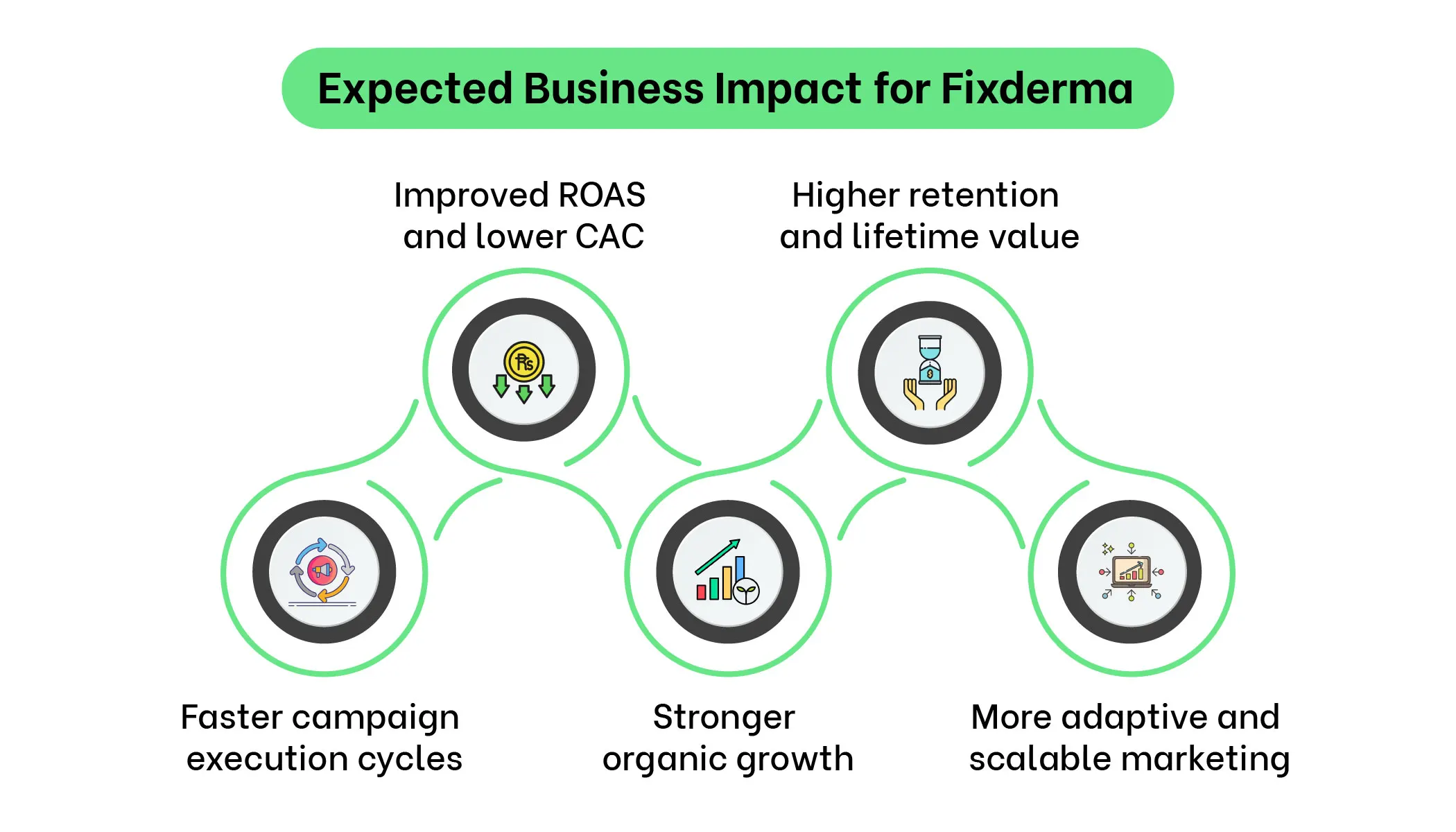
If Fixderma were to build this semi-autonomous marketing engine effectively, the impact would likely be visible across four business areas:
- Faster campaign execution cycles through AI-assisted content generation, workflow automation, and quicker activation across channels.
- Improved ROAS and lower CAC through more responsive media planning, budget allocation, and optimization.
- Stronger organic growth through continuous SEO monitoring, faster execution, and better discovery of high-intent search opportunities.
- Higher retention and lifetime value through behavior-driven lifecycle automation, replenishment journeys, and more relevant post-purchase engagement.
Taken together, these gains can help Fixderma build a marketing model that is not only more efficient, but also more adaptive and scalable.
What Fixderma Needs to Get Started
The first requirement is data readiness. No agentic system works well if source data is incomplete, disconnected, or delayed. Customer, product, campaign, and behavioral data need to be accessible and structured.
The second requirement is stack selection. Not every capability needs to be implemented at once. A practical rollout can begin with three priority layers: lifecycle automation, SEO intelligence and orchestration. Content and paid media agents can then be layered in progressively.
The third requirement is governance. Agentic systems need clear rules around approvals, brand voice, claim sensitivity, compliance review, escalation paths, and data access. This is especially important for beauty and wellness communication, where product claims and educational content require consistency and care.
The fourth requirement is internal adoption. The biggest shift is not technical. It is operational. Teams need to learn how to manage agents, review outputs, refine prompts and rules, and move from task ownership to system ownership.

The Future of D2C Marketing in India
The future of D2C marketing in India will increasingly belong to brands that build systems, not just campaigns.
As categories get noisier and customer journeys become more fragmented, the marketing advantage will shift toward brands that can connect insight, execution, and optimization in near real time. Teams will still matter. Creative judgment will still matter. Brand building will still matter. But the winning model will pair those human strengths with AI-led operating systems.
In that future, the marketing department starts looking less like a collection of isolated specialists and more like a coordinated growth engine.
For early adopters, that becomes a strategic advantage. Not because AI is fashionable, but because speed, consistency, and cross-channel intelligence are now central to profitable growth.
Fixderma does not need to wait for a perfect future-state transformation to begin. It can start by identifying where the current marketing system loses the most time, misses the most signal, or creates the most execution drag.
That is the right entry point for an agentic AI roadmap.
A focused strategy audit can help define the highest-impact use cases across SEO, content operations, paid media optimization, lifecycle automation, and workflow orchestration. From there, the brand can design a semi-autonomous marketing engine that fits its growth stage, data maturity, and governance needs.
The brands that move early will not simply automate tasks better. They will build a faster, more intelligent marketing system while competitors are still managing channels one by one.
Read our Other Case Studies : Reliance Campa Cola Reshaping India’s Cola Market
%20(1).webp)
