Blinkit’s Dark Store Network & AI Logistics | Case Study
.jpg)
Inside Blinkit’s Dark Store Network And AI Logistics Engine
Blinkit represents one of the most significant operating model transformations in Indian digital commerce. Originally launched as Grofers, the company evolved from a marketplace grocery platform into a quick commerce infrastructure built around dense urban micro-warehousing and real time logistics orchestration.
The strategic insight was simple but operationally demanding. For everyday retail categories such as groceries, snacks, and convenience items, delivery speed directly increases purchase frequency. However, achieving delivery in under ten minutes requires a supply chain fundamentally different from traditional e-commerce fulfilment.
Blinkit solved this challenge by building a distributed network of dark stores supported by algorithmic demand forecasting and automated dispatch systems. Inventory is positioned close to demand clusters, enabling thousands of SKUs to be delivered within minutes.
Today the platform processes over one million daily orders and operates one of the largest quick commerce logistics infrastructures in India. Its operating model demonstrates how logistics density, predictive inventory systems, and standardised operations can redefine the economics of urban retail.
Introduction
India’s early e-commerce growth focused primarily on two advantages. First, wider product assortment than physical retail. Second, lower prices enabled by centralised warehousing.
Delivery timelines typically ranged from one day to several days. This model worked well for discretionary purchases such as electronics, fashion, and household goods.
However, everyday consumption categories revealed a structural gap. Groceries, snacks, medicines, and household essentials often require immediate fulfilment rather than next day delivery.
Urban consumer behaviour gradually exposed this friction.
Quick commerce emerged as a response to this demand for immediacy. The sector has expanded rapidly. India’s quick commerce market grew from roughly $0.5 billion in FY2022 to more than $6 billion by FY2024, with projections exceeding $10 billion by FY2025.
Blinkit recognised that the winning model would not resemble traditional e-commerce marketplaces. Instead, success would depend on building a dense urban logistics infrastructure capable of near real time fulfilment.
In this model, the consumer app becomes the interface. The real competitive advantage lies in the supply chain architecture underneath.

What Made The Company Different
Early grocery delivery platforms relied heavily on partnerships with local stores. While this approach expanded product assortment quickly, it created operational limitations.
Inventory visibility varied across partner stores. Order preparation times were unpredictable. These factors made ultra fast delivery difficult to achieve consistently.
Blinkit addressed this challenge by replacing store partnerships with a dark store model.
Dark stores are small fulfilment warehouses located within residential neighbourhoods. Unlike retail stores, they are designed exclusively for online order processing and delivery dispatch.
Each dark store typically services a two to three kilometre radius, drastically reducing travel distance for delivery partners.
This shift created three structural advantages.
• Direct inventory control across thousands of SKUs
• Standardised picking and packing operations
• Predictable delivery timelines
Instead of designing logistics around warehouse scale, Blinkit designed it around urban proximity. Speed became a repeatable operational capability rather than a marketing promise.
Operational Engines
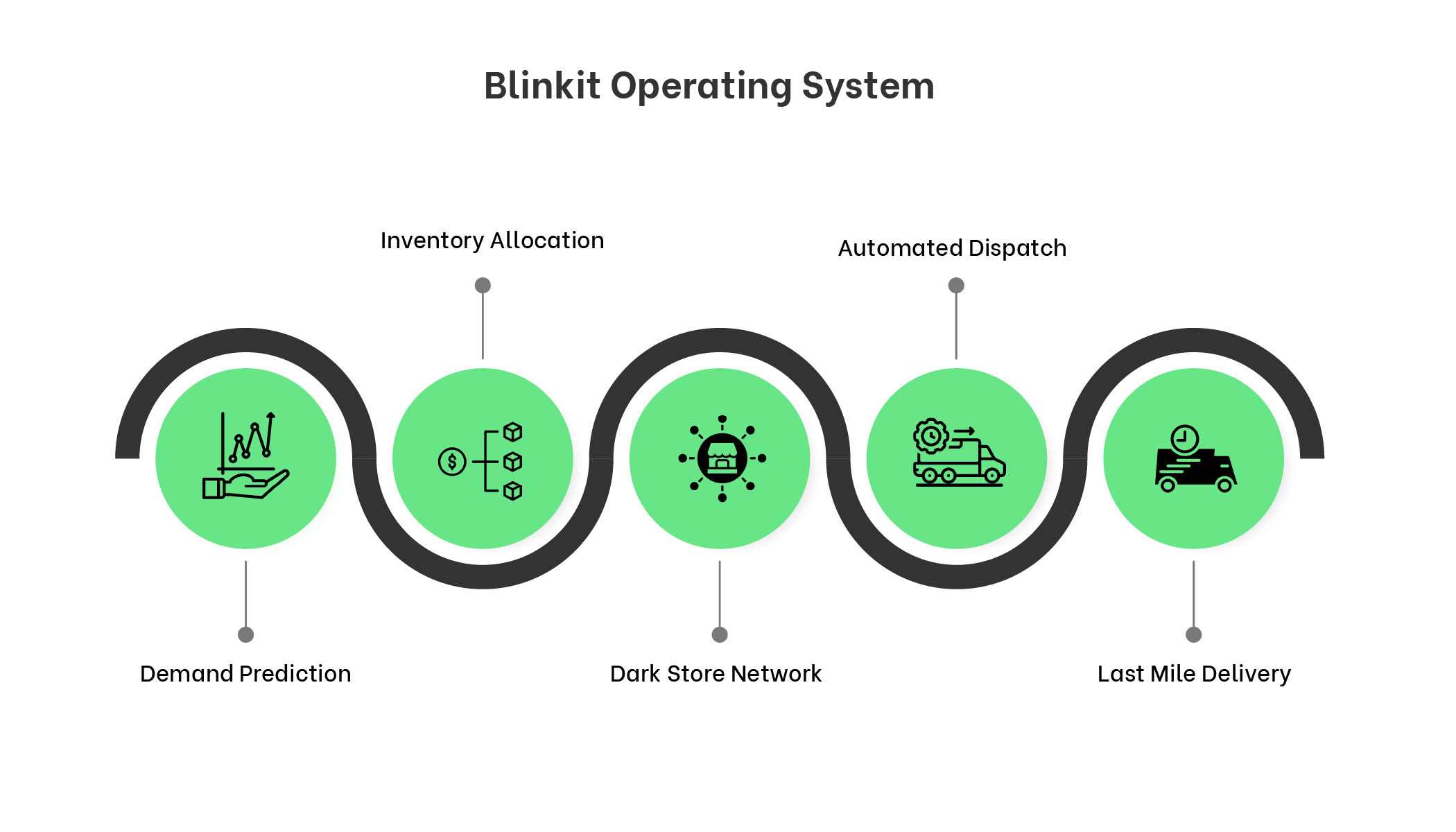
Blinkit’s quick commerce model relies on multiple operational systems working simultaneously. Together they form the company’s logistics operating stack.
Blinkit Operating System
Demand Prediction → Inventory Allocation → Dark Store Network → Automated Dispatch → Last Mile Delivery
Each layer reinforces the others.
1. Dark Store Supply Chain Architecture
The dark store network forms the backbone of Blinkit’s operating model.
Rather than relying on a few large warehouses, the company operates hundreds of micro fulfilment centres embedded inside urban demand clusters. Each location carries a carefully curated assortment of high frequency products designed for rapid turnover.
As of FY2026, Blinkit operates over 1,800 dark stores across Indian cities and plans to expand to 3,000 locations by 2027.
This distributed infrastructure significantly reduces delivery distances while ensuring inventory remains close to consumers. The system functions less like traditional retail and more like a city wide logistics grid.
2. AI Driven Demand Prediction
Operating thousands of micro warehouses introduces a complex planning challenge. Each store must stock the right products in the correct quantities.
Blinkit addresses this using predictive demand systems that analyse several variables simultaneously.
• historical ordering behaviour
• time of day demand patterns
• weather signals
• local purchasing preferences
• seasonal and festival demand spikes
The system continuously adjusts inventory allocation across dark stores.
For example, snack demand typically rises during evening hours, beverage sales increase during summer, and essential items surge during periods of rainfall or major festivals.
Predictive inventory planning ensures high probability products remain available within immediate delivery distance. Without algorithmic forecasting, distributed inventory networks would quickly become inefficient.
3.Real Time Logistics Routing
Delivery speed is determined not only by distance but also by operational coordination.
Blinkit’s dispatch systems assign orders to delivery partners dynamically based on multiple inputs.
• rider proximity to the dark store
• real time traffic conditions
• batching opportunities across nearby orders
• current store order load
These algorithms reduce idle time while optimising delivery routes.
The city effectively becomes a real time logistics grid, where inventory movement and rider dispatch are continuously synchronised.
4.Store Level Throughput Optimisation
Another critical driver of unit economics is store level productivity.
Blinkit tracks throughput metrics such as daily gross order value processed per store.
As network density improved, store productivity increased significantly. Average throughput rose from roughly ₹6 lakh per store per day to around ₹10 lakh, with top performing stores processing up to ₹18 lakh daily.
Higher throughput improves store economics because fixed costs such as rent and labour are spread across more orders.
This improvement is a key factor in moving quick commerce closer to sustainable economics.

Growth Mechanisms
Blinkit’s growth has been driven by operational density rather than aggressive marketing.
The first lever was increasing dark store density across major cities. Higher density reduces delivery distance and increases delivery reliability.
The second lever involved expanding product assortment beyond groceries into categories such as beauty products, electronics accessories, toys, and pet care.
This expansion increases average order value while improving platform engagement.
The third driver emerged from consumer behaviour itself. When delivery time approaches real time, consumers begin treating the platform as an extension of their kitchen or neighbourhood convenience store.
Instead of fewer large baskets, the platform sees more frequent impulse orders.
This behavioural shift is the true growth engine behind quick commerce.
Structural Risks And Trade Offs
Despite its rapid growth, the quick commerce model contains several structural tensions.
Capital intensity remains high. Building dense dark store networks requires substantial real estate investment in expensive urban locations.
Operational costs also remain elevated due to rider incentives, inventory holding expenses, and logistics infrastructure maintenance.
Forecasting complexity increases as the number of SKUs expands across hundreds of micro warehouses.
Competitive intensity has also escalated rapidly. Platforms such as Zepto, Swiggy Instamart, Flipkart Minutes, and JioMart are aggressively expanding their infrastructure.
Quick commerce is therefore becoming an infrastructure race, where the winner is determined by operational scale and efficiency rather than marketing spend.
Strategic Transition And Consolidation Phase
Blinkit’s acquisition by Zomato marked an important moment of consolidation within the sector.
The integration provided Blinkit with access to stronger capital resources and operational synergies with an established delivery ecosystem.
The acquisition also reflected a broader shift in digital commerce. Food delivery platforms recognised that their logistics networks could support a wider range of hyperlocal services.
For Blinkit, the partnership accelerated both dark store expansion and technology investments.
The platform gained the ability to scale infrastructure faster while leveraging an existing consumer ecosystem.
Market Pressure And Competitive Landscape
The quick commerce sector has become one of the most competitive segments in Indian digital retail.
Platforms including Zepto, Swiggy Instamart, Flipkart Minutes, and JioMart are expanding aggressively across major cities.
Collectively, leading platforms now process more than four million daily quick commerce orders in India.
At the same time, operational scrutiny is increasing. Issues such as warehouse hygiene, worker conditions, and urban zoning regulations are receiving greater regulatory attention.
Companies must therefore balance delivery speed with operational discipline and regulatory compliance.
Strategic Lessons For CXOs And Operators
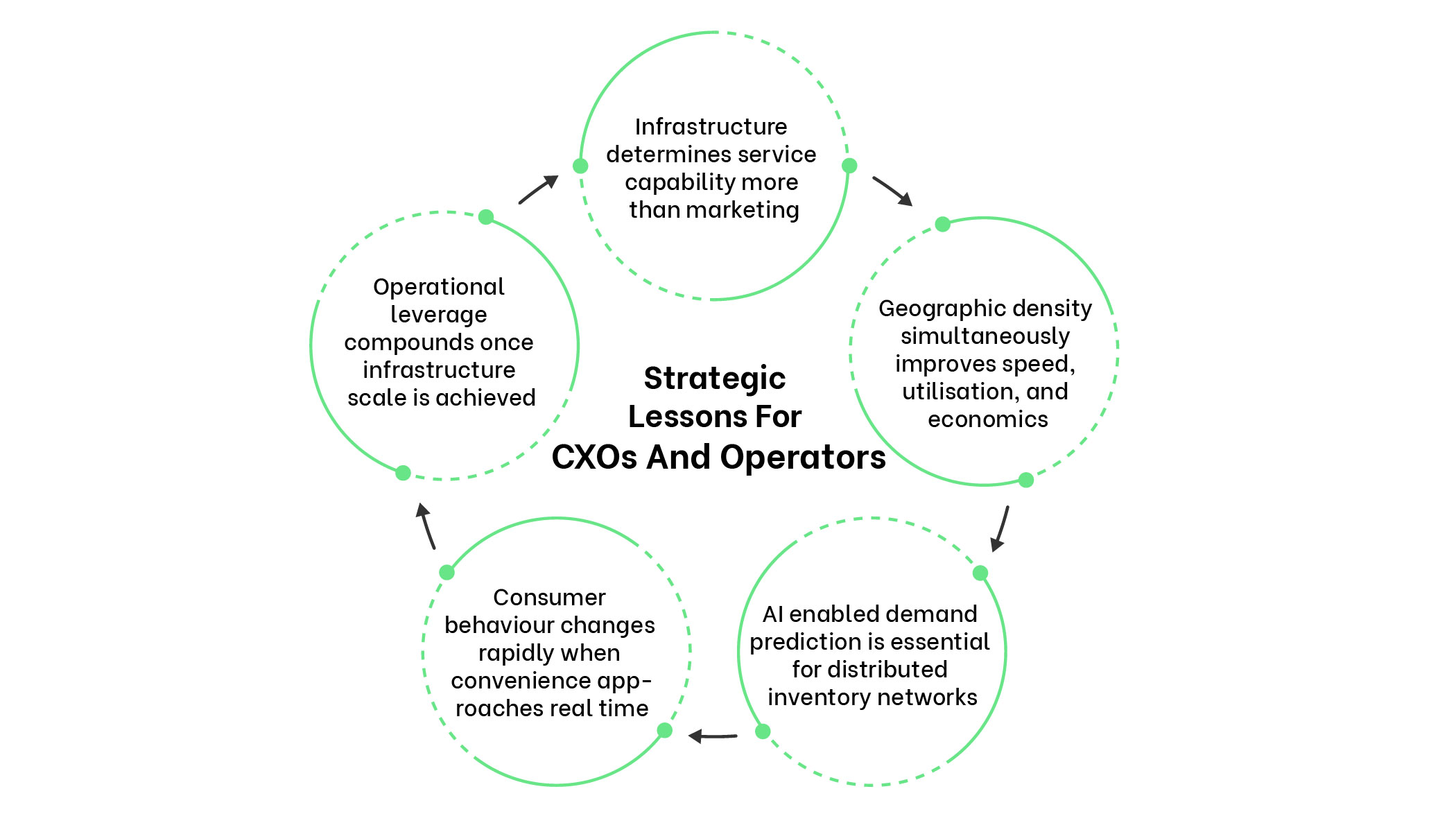
Blinkit’s evolution highlights several broader principles about building high velocity operating systems.
• Infrastructure determines service capability more than marketing
• Geographic density simultaneously improves speed, utilisation, and economics
• AI enabled demand prediction is essential for distributed inventory networks
• Consumer behaviour changes rapidly when convenience approaches real time
• Operational leverage compounds once infrastructure scale is achieved
These principles extend beyond retail into logistics, mobility platforms, and hyperlocal service ecosystems.

The Road Ahead
Blinkit’s next phase will be shaped by two parallel developments. The first is expanding its infrastructure toward a 3,000 dark store network. The second is diversifying beyond groceries into a broader instant retail platform.
The company now delivers over 30,000 products, with nearly 20 percent of sales expected to come from non grocery categories such as electronics, beauty, fashion, and home appliances.
The economic logic is clear. Grocery margins typically remain around 2 to 4 percent, while categories such as electronics and beauty can generate 10 to 25 percent margins, improving overall unit economics.
Supporting this diversification has required structural changes. Blinkit has introduced an inventory ownership model for high value products and developed a hybrid warehouse system combining standard dark stores with larger express facilities.
However, diversification also introduces operational challenges. Electronics and fashion require reverse logistics systems, specialised handling, and larger delivery fleets. Slower moving inventory also increases capital risk.
The strategic question for Blinkit is therefore operational rather than technological.
Whether a logistics system designed for speed can successfully expand product breadth without compromising the core promise of instant delivery.
Read Our Other Case studies : Reliance Campa Cola Reshaping India’s Cola Market
.webp)