
Agentic AI for D2C Brands: Boost ROAS in 2026
How D2C Brands in India Can Use Agentic AI to Boost ROAS: A 2026 Playbook
How India's fastest-growing D2C brands are replacing fragmented marketing stacks with semi-autonomous systems to drive better returns, lower acquisition costs, and compounding organic growth in an increasingly competitive digital environment.
India's D2C category has matured faster than most markets anticipated. What began as a wave of digitally native challenger brands riding low customer acquisition costs and social media discovery has now entered a second, more demanding phase. The early tailwinds are gone. Meta and Google advertising costs have risen sharply. Category leaders have consolidated their search visibility. Marketplace competition has intensified. And consumers, now more informed and less loyal than ever, expect brands to meet them with precision rather than volume.
In this environment, the brands that are pulling ahead are not simply the ones spending more. They are the ones building smarter. Specifically, they are the ones replacing disconnected tool stacks and manual execution cycles with agentic AI systems that can sense market signals, generate strategic responses, and execute across channels faster than any traditional team structure allows.
This is not a trend. It is a structural shift in how marketing advantage is built and sustained.

The Pressure Facing D2C Marketing Teams in India Today
The growth pressure facing D2C brands in India is not new in kind, but it is new in intensity. Four forces are converging simultaneously, and most brands are trying to manage all four with operating models designed for only one of them at a time.
The first is rising customer acquisition cost. Across categories including beauty, wellness, food, fashion, and consumer electronics, brands are competing for the same digital attention on the same platforms. As more players enter paid media, auction dynamics push costs upward. Brands that built their early unit economics on a cost per acquisition that no longer exists are now running campaigns that look busy but return less than they used to.
The second is content velocity pressure. Modern D2C customers interact with a brand across search, social, email, product pages, creator content, and marketplace listings. Each of those touchpoints requires fresh, consistent, and strategically aligned messaging. Most marketing teams are producing more content than ever before and still falling short of what the full channel mix demands.
The third is signal fragmentation. Analytics, paid media, SEO, CRM, and content tools each generate data. But that data rarely talks to itself. A spike in branded search should inform email subject lines. A drop in landing page engagement should trigger creative refresh. A cohort of high-value customers should influence lookalike targeting. In most D2C teams, those connections happen slowly, if they happen at all.
The fourth is retention underperformance. Customer lifetime value is the metric that separates profitable D2C businesses from those permanently dependent on acquisition spend. Yet most brands still operate lifecycle marketing as a series of manual campaigns rather than a behavior-driven system. Replenishment reminders go out on schedules, not signals. Post-purchase journeys are static. Churn is noticed after it happens, not before.
Together, these four pressures do not just make marketing harder. They make the traditional marketing operating model structurally insufficient for what profitable D2C growth now requires.
Why the Existing Stack Is Not Solving the Problem
The instinctive response to these pressures has been to add more tools. Most mid-scale D2C brands now run eight to fifteen separate platforms across their marketing function. There are analytics platforms, SEO trackers, content generation tools, email service providers, paid media management systems, social schedulers, and CRM platforms.
The problem is not the tools. It is the absence of orchestration between them.
Each tool produces outputs. But without a coordination layer, those outputs exist in isolation. The SEO team discovers a high-intent keyword cluster. The content team is not briefed on it in time. The paid team is bidding against organic for the same terms. The email team is running a promotion that contradicts the landing page message. None of these failures are caused by a lack of effort. They are caused by a lack of connection.
Traditional stacks are also reactive by design. They report on what happened. They surface insights after the campaign has already underperformed. By the time a team has noticed a shift in top-of-funnel conversion, reviewed it in a weekly meeting, revised the brief, produced new assets, and relaunched the campaign, the market opportunity has passed.
The intelligence gap is widening. And the answer to an intelligence gap is not more dashboards. It is a smarter operating system.
The Architecture of a Semi-Autonomous Marketing Engine
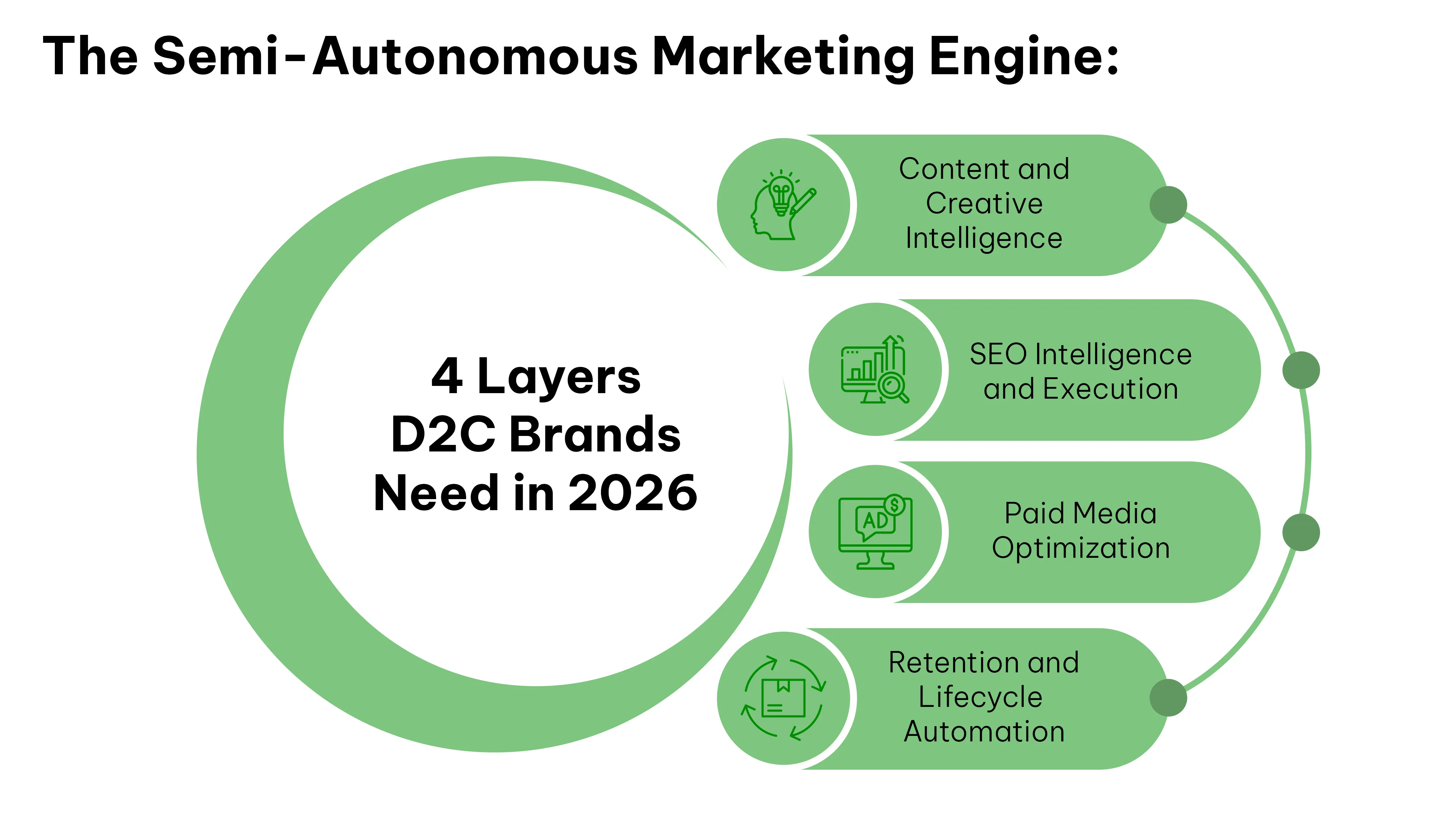
The solution that high-performing D2C brands are beginning to build is not a single platform. It is an architecture. A semi-autonomous marketing engine combines agentic AI systems across four functional layers: content and creative intelligence, SEO intelligence and execution, paid media optimization, and retention and lifecycle automation. These layers are connected through a workflow orchestration system that allows signals to flow between them and trigger coordinated action.
The word semi-autonomous matters. This model does not replace marketing teams or remove human judgment from brand decisions. It changes what the team is spending its time on. Humans retain responsibility for strategy, brand positioning, creative direction, compliance, and high-stakes decisions. The machine layer handles monitoring, pattern recognition, briefing, variant generation, workflow triggers, and optimization at a speed and consistency that human teams cannot match manually.
The content and creative intelligence layer uses agentic tools to move from one-off production to continuous content operations. Instead of a team manually briefing writers, reviewing drafts, and approving variants for each campaign, the system maintains a live understanding of brand voice, product priorities, and channel requirements. It can generate first drafts of blog content, email copy, ad variants, and product descriptions aligned to current search demand and campaign strategy. Human review remains part of the process, but the volume of work the system can produce and pre-organize dramatically reduces execution lag.
The SEO intelligence and execution layer moves search optimization from a periodic activity to a continuous one. Agentic SEO tools can monitor keyword movement, identify emerging intent clusters, flag technical issues, and recommend on-page optimizations in real time. For D2C brands, where organic search is often the highest-quality acquisition channel, treating SEO as an always-on intelligence function rather than a quarterly project compounds significantly over time. The brands that rank in 2026 built their search architecture in 2025. The ones that wait will find the gap difficult to close.
The paid media optimization layer shifts budget and bidding decisions from manual review cycles to AI-driven responsiveness. Rather than reviewing weekly reports and adjusting campaigns based on what happened, agentic paid media systems can monitor performance signals continuously and reallocate resources in near real time. This matters most in categories with high competitive density, where the difference between a well-timed bid adjustment and a missed window can determine whether a campaign delivers or drains.
The retention and lifecycle marketing layer is often where the greatest untapped value sits. Most D2C brands have a CRM. Few have a CRM that responds to behavior rather than schedules. Agentic lifecycle systems can monitor purchase gaps, engagement patterns, replenishment windows, and churn signals. They can trigger personalized communications at the right moment rather than the next scheduled send. For categories with natural replenishment cycles, such as skincare, nutrition, and home care, this shift from calendar-based to signal-based retention can move lifetime value metrics meaningfully within a single quarter.
How the System Closes the Intelligence Gap
The real value of this architecture is not in any individual layer. It is in what happens when the layers communicate.
Consider a mid-scale beauty brand running this system. The SEO layer identifies a rising search cluster around a specific skin concern that the brand's product range addresses but has not explicitly targeted in content. That signal feeds into the content layer, which generates a cluster of articles, product page updates, and email educational content aligned to that intent. The paid layer sees that organic engagement on these new assets is outperforming existing campaigns and adjusts budget allocation toward the audience segment driving that behavior. The lifecycle layer identifies existing customers in the brand's database who have purchased products relevant to that concern and triggers a targeted retention sequence before a competitor captures their attention.
That entire loop, from signal to action, happens faster than any manually coordinated team structure could achieve it. And it happens consistently, not only when a skilled analyst notices the pattern and has time to act on it.
This is the intelligence gap that agentic AI closes. Not through automation for its own sake, but through the removal of the coordination failures that slow every marketing function down.
What D2C Brands Need Before They Can Build This System
Three foundational requirements must be in place before an agentic marketing architecture can operate effectively.
The first is data readiness. Agentic systems make decisions based on the signals they can access. If customer data, campaign performance data, behavioral data, and product data sit in disconnected systems with inconsistent structures, the system cannot close the loop between insight and action. Brands that have invested in clean data infrastructure will move faster. Those that have not will need to address that gap before expecting agentic tools to perform.
The second is governance design. Agentic systems operate at speed. That speed is an advantage, but it also requires clear guardrails. Brands need to define what the system can execute autonomously, what requires human review, and what must always involve senior approval. This is particularly important for product claims, promotional pricing, regulatory compliance, and brand voice consistency. Governance is not a limitation on agentic AI. It is the design principle that makes it trustworthy.
The third is a staged rollout approach. Trying to implement all four layers simultaneously is a recipe for underperformance. The highest-impact entry point for most D2C brands is lifecycle automation, because it delivers measurable returns against an existing customer base without requiring the full stack to be operational. SEO intelligence and orchestration comes next, followed by content operations, followed by paid media optimization. Each stage builds the data foundation and organizational readiness that the next stage requires.
The Expected Impact Across the D2C Marketing Funnel
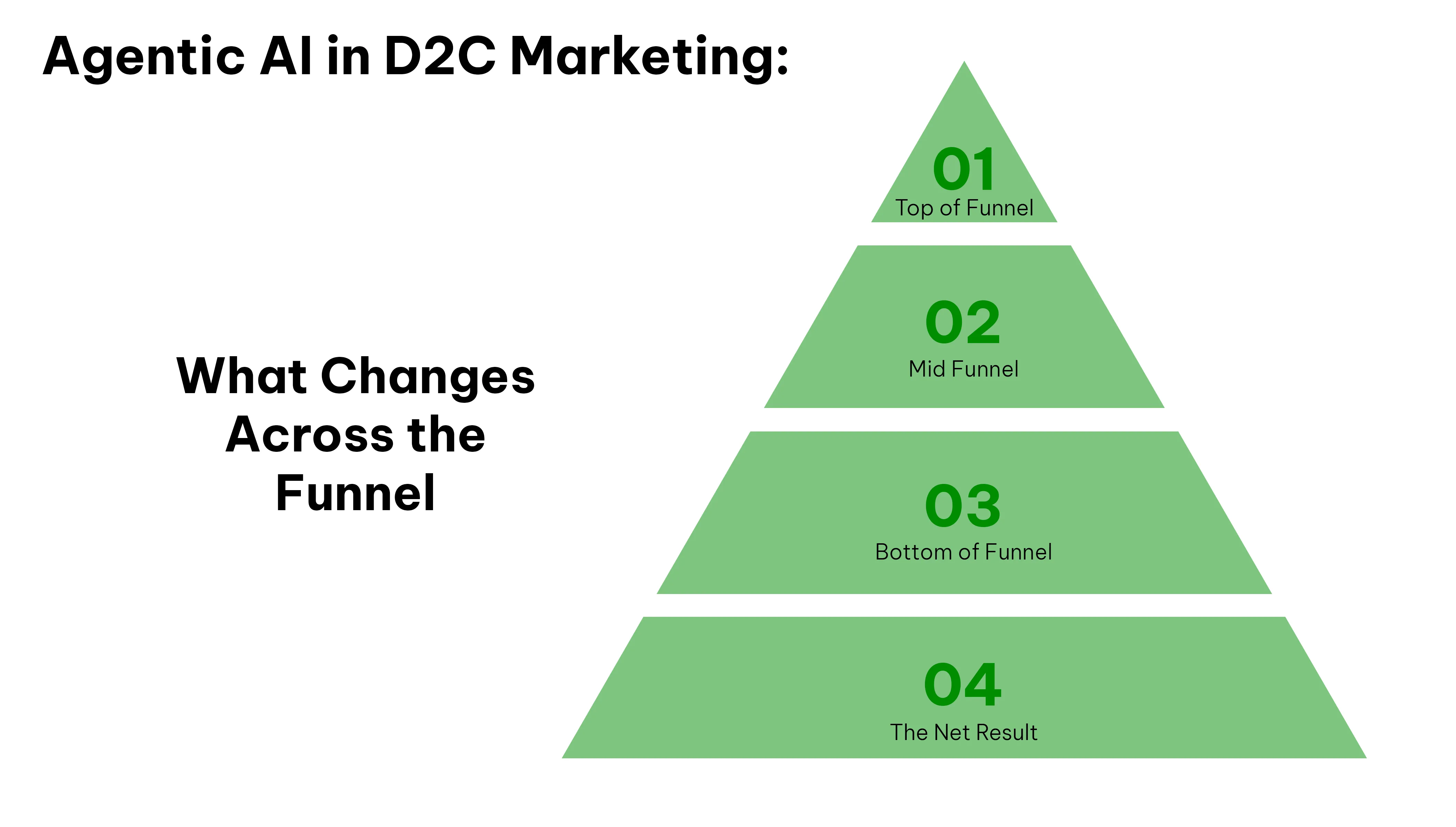
For D2C brands that build this architecture effectively, the business impact becomes visible across the full funnel.
At the top of the funnel, continuous SEO intelligence and faster content execution improve organic visibility and reduce dependence on paid acquisition for discovery traffic. Brands that have historically relied on Meta and Google performance spend to drive new customer volumes begin to build a compounding organic acquisition channel alongside it.
In the middle of the funnel, better cross-channel coordination and creative responsiveness improve conversion rates. When landing page messaging aligns with the search intent that brought a customer there, when ad creative reflects the same benefit language that content has validated, and when product pages are continuously updated to match current demand signals, conversion improves without requiring additional spend.
At the bottom of the funnel, behavior-driven retention systems reduce churn, increase purchase frequency, and grow lifetime value. The brands that master lifecycle automation in 2026 will build customer economics that their acquisition-dependent competitors cannot match.
Taken together, the shift from a fragmented manual stack to a semi-autonomous marketing engine does not just improve individual metrics. It changes the cost structure and scalability of the entire marketing function.

The Future of D2C Marketing in India
The next phase of D2C competition in India will not be won by the brands with the largest budgets or the most tools. It will be won by the brands that build the most intelligent marketing systems.
The market conditions are clear. Customer acquisition is more expensive. Organic reach requires greater sophistication. Retention is now a competitive differentiator rather than an afterthought. And the volume of signals, channels, and execution demands has exceeded what traditional team structures can manage with speed and consistency.
Agentic AI is not a solution looking for a problem. It is a response to a structural change in what D2C marketing now requires to generate profitable growth.
The brands that move early will not simply automate faster. They will build a marketing operating model that compounds over time, while their competitors are still managing channels one by one and waiting for last week's data to tell them what to do next.
The right moment to build that system is not when the pressure becomes unbearable. It is before the gap becomes unclosable.
Read our Other Case Studies : How Fixderma Can Scale D2C Growth with Agentic AI Systems
.webp)
.webp)