
What Is GEO? The CMO's Guide to AI Search in 2026

What Is GEO and Why Every CMO Needs a Strategy for It in 2026
Executive Summary: Search as organizations have known it for two decades is undergoing its most consequential structural shift since Google's founding. Generative Engine Optimization, or GEO, is the discipline of structuring content so that AI-powered platforms cite it when generating answers for users. With nearly two thirds of all Google searches now ending without a single click to any website, and AI-referred traffic having jumped 527 percent year over year in 2025, the old playbook of ranking for keywords and converting organic clicks is no longer sufficient. For CMOs and marketing leaders, GEO is not an experimental channel. It is the next mandatory layer of digital strategy.

The Shift That Is Rewriting Digital Marketing Economics
For most of the last two decades, digital marketing operated on a reliable model. A brand created content, optimized it for search engines, earned a position on page one, and captured traffic that converted into pipeline. The logic was straightforward. Visibility equalled clicks. Clicks equalled leads. The entire marketing stack, from content teams to SEO agencies to attribution models, was built on top of this assumption.
That assumption is now structurally broken.
In 2026, nearly 60 to 93 percent of searches on AI-powered interfaces end without any click to an external website. Google's AI Mode, launched in early 2025, now resolves the majority of queries inside the search interface itself. ChatGPT processes over 2.5 billion prompts per day. Perplexity has crossed 780 million monthly queries. Users are no longer going to search engines to find destinations. They are going to AI platforms to get answers. The destination is the AI itself.
Individual websites that once ranked on page one are reporting organic CTR drops of 34 to 79 percent for their target keywords following AI Overview appearances. Brands that built their entire acquisition model on SEO-driven traffic are experiencing pipeline compression they cannot explain through conventional analytics alone.
The economics of digital visibility have changed. Not gradually. Structurally.
What Is GEO
Generative Engine Optimization is the practice of structuring content so that AI-powered platforms retrieve it, synthesize it, and cite it when generating answers to user queries. Where traditional SEO was about earning a ranked position on a results page, GEO is about being selected as a source inside an AI-generated response.
When a CMO asks ChatGPT to recommend a management consulting firm for a digital transformation mandate, or when a procurement lead uses Perplexity to research marketing strategy frameworks for their sector, those platforms are not returning a list of blue links. They are generating a synthesized answer from sources they have already evaluated for authority, structure, and relevance. The brands whose content is cited in those answers capture mindshare and influence buying decisions without the user ever visiting their website.
This is the new surface of digital competition.
GEO goes by several names across the industry including Answer Engine Optimization, Large Language Model Optimization, AI Optimization, and Generative Search Optimization. The terminology varies across practitioners and platforms. The discipline is the same: making content legible, credible, and citable for AI systems that now mediate the majority of information-seeking behavior among senior decision makers.
GEO vs SEO: The Critical Distinctions Leaders Need to Understand
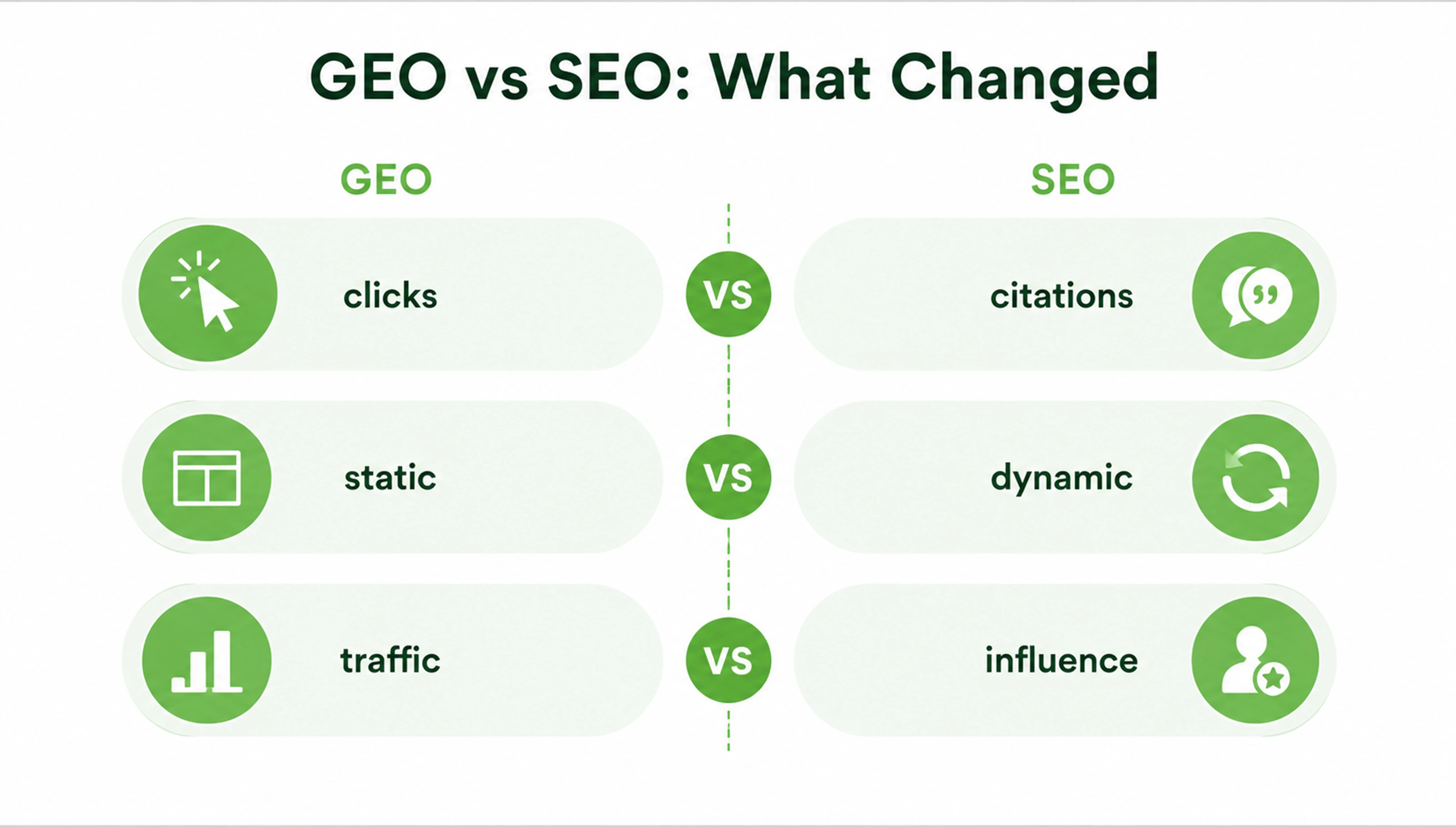
The two disciplines are not mutually exclusive but they operate on fundamentally different logic.
SEO optimizes for clicks from a ranked list. GEO optimizes for citations inside a synthesized answer.
SEO rewards comprehensive long-form content that signals topical authority to search engine crawlers. GEO rewards self-contained, well-structured answer blocks that AI engines can extract, attribute, and surface cleanly.
SEO rankings are relatively stable. A well-optimized page can hold its position for months or years. GEO citations are dynamic. Research shows that 50 percent of content cited in AI-generated answers is less than 13 weeks old. Recency is now a structural variable in visibility, not just a tie-breaker.
SEO performance is measurable in clicks and sessions. GEO value is frequently zero-click. The content shapes a decision before the user ever visits the site. This makes traditional attribution models blind to a growing proportion of brand influence in the buying journey.
For marketing leaders operating in a multi-touchpoint environment, ignoring GEO means accepting invisibility in the channel where a significant and growing share of senior buyers are conducting research.
Why GEO Is a Board-Level Conversation, Not a Content Team Experiment
The framing of GEO as an SEO sub-discipline or a content team initiative is one of the most common and consequential mistakes organizations are making in 2026.
GEO sits at the intersection of brand strategy, content architecture, digital PR, and technical infrastructure. Its outcomes are felt in pipeline, not just traffic reports. And the competitive window for establishing citation authority is closing faster than most leadership teams realize.
Research from Georgia Tech, Princeton, and the Allen Institute for AI demonstrated that targeted GEO optimization techniques can increase a brand's visibility in AI-generated responses by up to 115 percent. Early movers are building citation share while the category is still undercrowded. Late adopters will face the same compounding disadvantage in AI search that brands faced when they delayed investment in organic SEO in the early 2010s.
According to Gartner, by the end of 2026, 40 percent of enterprise applications will include task-specific AI agents. McKinsey's 2026 survey data shows that marketing and sales remains the top function reporting revenue gains from AI integration. The Jasper survey of 1,400 marketers found that 91 percent now actively use AI in their workflows, but fewer than one in three are using it for high-value agentic capabilities including brand governance and predictive optimization.
Adoption of AI tools is no longer the differentiator. Structural integration of AI-first content strategy, including GEO, into the marketing operating model is where the competitive gap is opening.
The CMO's Exposure in a Zero-Click Environment
Consider the implications at the CXO level.
A brand with strong traditional SEO equity but no GEO strategy is now effectively invisible to users who search via ChatGPT, Perplexity, or Google's AI Mode for queries in its category. Those users are not bouncing from a website they visited. They are never arriving. The brand never enters their consideration set.
In B2B categories, where the buying cycle is long and research is intensive, this exposure is especially significant. Decision makers at the Director, VP, and C-suite level are disproportionately high users of AI-powered research tools. A consulting firm, a technology provider, or an enterprise services brand that does not appear in AI-generated responses to category-relevant queries is losing influence at the most critical stage of the buying journey.
How AI Platforms Decide What to Cite
Understanding which signals drive AI citation is the foundation of any GEO strategy. The major platforms operate on different architectures but share several common evaluation criteria.
Authority and Entity Recognition
AI platforms prioritize sources that have clear, consistent entity signals. This means the brand, its leadership, its services, and its positioning must be referenced coherently across owned and earned digital channels. Wikipedia-style entity clarity, where a subject is described factually, consistently, and in multiple independent contexts, is one of the strongest citation-readiness signals.
ChatGPT's citation patterns show that Wikipedia accounts for nearly 48 percent of its top-cited sources on factual queries, not because Wikipedia is the best content, but because its entity structure is exceptionally machine-readable. Brands that invest in structured entity presence across their own content, press mentions, analyst citations, and third-party publications are building the same structural advantage.
Content Structure and Answer-Block Architecture
AI engines do not extract pages. They extract passages. Content that is organized into self-contained, directly answerable blocks with clear question-aligned headings performs significantly better in AI citations than dense long-form prose optimized purely for human reading.
This means that pillar pages, blog posts, and service content need to be re-architected around discrete answer units. Each section should be independently extractable and should provide a complete response to a specific query without requiring the reader to have read the sections before it.
Recency and Content Freshness
The 13-week half-life of AI-cited content is one of the most important operational implications of GEO. Unlike traditional SEO where a high-authority evergreen page can hold a position for years, AI platforms weight recency heavily in their citation decisions. This reframes content strategy from a publish-and-maintain model to a continuous publishing and refresh model.
For organizations accustomed to producing a moderate volume of long-form content quarterly, this represents a meaningful operational shift. Content calendars, editorial workflows, and performance measurement frameworks all need to be reconfigured around the recency requirement.
Perplexity, Reddit, and the Trust Signal Architecture
Perplexity's citation patterns are structurally different from Google's. Nearly 47 percent of Perplexity's top-cited sources originate from Reddit and community-driven platforms alongside recently published content. This reflects a broader shift in how AI platforms evaluate trustworthiness. Conversational credibility, peer validation, and community-anchored authority carry significant weight alongside domain authority.
For B2B brands and consulting firms, this has direct implications for where thought leadership content is distributed, how executive voices are built across forums and professional communities, and how earned media coverage is structured to maximize AI retrievability.
The GEO Strategy Framework for Marketing Leaders
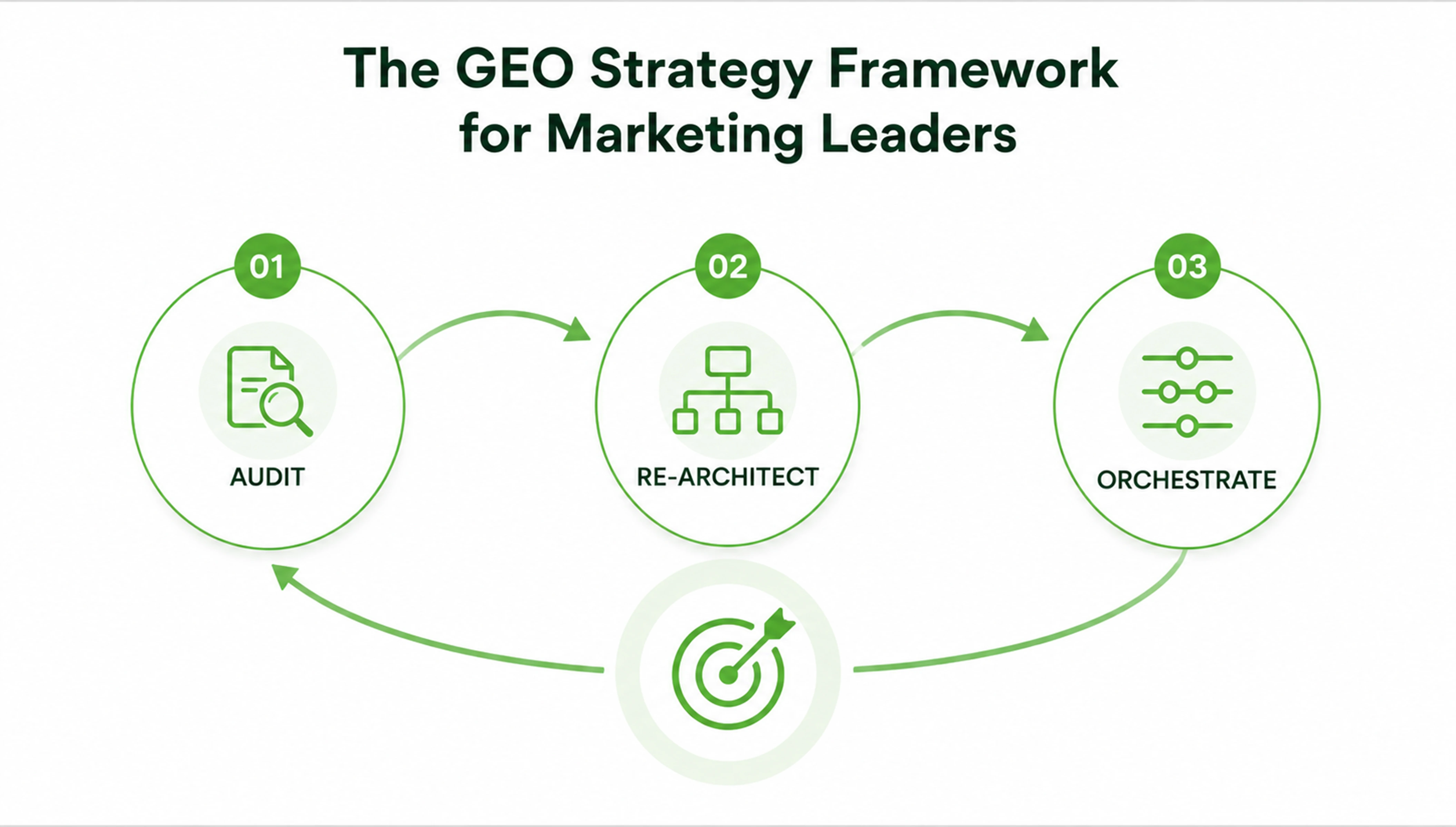
Building a GEO strategy is not a single-team initiative. It requires orchestration across content, brand, digital PR, and technical functions. The following framework outlines the core workstreams.
Audit Your Current AI Visibility
Before optimizing, leaders need to understand their current citation footprint. This means systematically querying ChatGPT, Perplexity, Google AI Mode, Gemini, and Claude with the high-intent questions their buyers are asking, and documenting which brands and sources are being cited in the responses. This baseline audit reveals both the competitive landscape and the content gaps that need to be addressed.
Tools including Otterly.ai, Ahrefs Brand Radar, Rankscale, and OmniSEO are now purpose-built for AI visibility monitoring. Incorporating AI search performance tracking into the standard marketing analytics stack is a prerequisite for managing GEO as a strategic channel.
Re-architect Content for AI Extractability
High-performing GEO content shares a consistent structure. Short, direct introductions that define the topic immediately. Section headings that mirror the exact language of user queries. Answer blocks of 40 to 60 words that can stand alone as a response to a specific question. FAQ sections built around high-intent searches. Data citations from credible third-party sources embedded within the content.
This is not a cosmetic change to existing content. It is a structural redesign that often requires rethinking how service pages, thought leadership articles, and insight content are written from the first sentence.
Build Entity Authority Across Channels
GEO rewards brands with consistent, multi-source entity presence. This means coordinating across the following surfaces: owned website content with structured schema markup, executive profiles on LinkedIn and professional platforms, press coverage in industry publications that AI platforms index and trust, analyst and research mentions, and community participation in high-authority forums relevant to the brand's category.
For management consulting firms and enterprise service providers, building author authority under named individuals, not just the brand entity, is particularly important. AI platforms increasingly differentiate between institutional authority and individual subject-matter credibility. Both need to be built and maintained.
Build a Content Refresh Cadence Around AI Recency
Given the 13-week citation half-life, content teams need a systematic refresh cycle that prioritizes the pages most likely to be queried by AI platforms. This is not the same as a general content audit. It requires identifying the specific questions your buyers are asking AI platforms, mapping those to existing content, and scheduling regular updates that signal freshness to AI indexing systems.
Organizations that maintain active, recently updated content across their highest-priority topic clusters will consistently outperform those with large volumes of static, undated content, regardless of how authoritative that content was at the time of original publication.
Integrate GEO into the Broader Digital Orchestration Model
GEO does not sit outside the marketing strategy. It sits inside a broader digital orchestration model that includes traditional SEO, paid search, content distribution, digital PR, and social amplification. The organizations seeing the highest AI visibility gains in 2026 are those that treat GEO as a cross-functional discipline rather than a channel-specific tactic.
This means CMOs need to close the gap between the 91 percent of marketing teams using AI tools and the under 20 percent that are currently tracking meaningful KPIs from their AI-related activities. Measurement infrastructure is not a post-deployment consideration. It is the prerequisite for running GEO as a managed, accountable function.
What This Means for Leaders Across Industries
The GEO imperative is not uniform across sectors. Its urgency and shape vary by buyer behavior, query volume, and category dynamics.
For D2C and consumer brands, AI platforms are increasingly mediating product discovery, comparison, and purchase intent. Brands that are not being recommended by AI shopping assistants are absent from a growing share of the consideration funnel.
For B2B firms, consulting companies, and enterprise service providers, the stakes are concentrated at the top of the funnel. AI-generated responses to category queries, capability questions, and thought leadership topics shape whether a firm enters a prospect's consideration set before any human conversation takes place.
For regulated industries including healthcare, financial services, and education, the GEO challenge is compounded by the need to maintain compliance while building AI-citable authority. This requires closer coordination between marketing, legal, and content governance functions than most organizations have historically maintained.
Across all sectors, the common thread is that the organizations with the highest AI visibility in their categories will disproportionately capture mindshare, trust, and commercial consideration from buyers who are conducting AI-mediated research, which in 2026 is most buyers.
Strategic Implications for Leaders
1. Treat GEO as an executive-level mandate, not a content team experiment. The brands capturing AI citation share now are building a compounding visibility advantage that will be structurally difficult to close in 18 to 24 months. This is an investment decision that belongs in the marketing leadership agenda.
2. Restructure your content operating model around recency and answer-block architecture. The publish-and-maintain model of traditional SEO is not compatible with GEO performance. Content teams need new workflows, new editorial standards, and new measurement frameworks built specifically around AI retrievability.
3. Measure visibility, not just traffic. In a zero-click environment, traffic metrics alone no longer capture the full value of content. AI citation share, brand mention frequency in AI responses, and query-level visibility audits need to become standard components of the marketing performance dashboard.

Final Thoughts
GEO is not a future consideration. It is an active competitive dynamic in 2026, one that is reshaping how brands are discovered, evaluated, and chosen by buyers who increasingly begin their research inside AI platforms rather than traditional search engines.
The organizations that understand this shift and build the structural capabilities to respond, through content architecture, entity authority, recency management, and cross-functional orchestration, will define the new hierarchy of digital visibility in their categories.
For marketing leaders, the question is no longer whether to build a GEO strategy. It is whether to build it now, while the competitive window is still open, or to absorb the cost of catching up later.
Read our Other Case Studies : Agentic AI for D2C Brands: Boost ROAS in 2026
.webp)