Nike Digital Business Transformation | Case Study | Cognitute
How Nike Rewired Its Business for the Digital Age
Executive summary : Nike shifted from product-led mass distribution to a digitally enabled, consumer-direct model investing in data, platforms and experiences and while the journey delivered major gains in customer engagement and gross margin, it also exposed the company to execution risk and near-term revenue volatility that required a strategic reset in 2024–2025.
Situation Before The Transformation
In the 2010s Nike was the undisputed leader in athletic apparel and footwear, defined by product innovation, marketing scale and broad wholesale relationships. Growth increasingly depended on winning brand mindshare and pushing product through global retail partners. By the late 2010s the company recognized two structural shifts: consumers were migrating to digital channels, and owning the customer relationship (and data) would create both revenue upside and margin advantage. That insight led to the “Consumer Direct Offense” and a heavy multi-year investment in digital platforms, Nike-run retail, and data capabilities.
Challenges Driving The Transformation
Nike faced four interlocking challenges that made digital transformation existential rather than optional:
.webp)
- Channel Economics And Margin Pressure. Wholesale partnerships were efficient for scale but diluted margins and customer data. Nike perceived DTC (direct-to-consumer) as the way to improve gross margins and lifetime value.
- Changing Customer Behavior. Younger consumers expected personalised, mobile-first experiences (apps, loyalty programs, in-store digital integration). Nike needed to meet them where they spent time.
- Operational Complexity. Moving to DTC required reworking supply chain, inventory velocity, pricing discipline and logistics all while maintaining product innovation.
- Nike needed to build world-class digital teams, cloud platforms, CRM and analytics to personalise at scale. Platform And Capability.
What Nike Changed The Transformation Program
Nike executed a multi-dimensional transformation across strategy, organization, operations and marketing. The program combined product, platform and process workstreams:
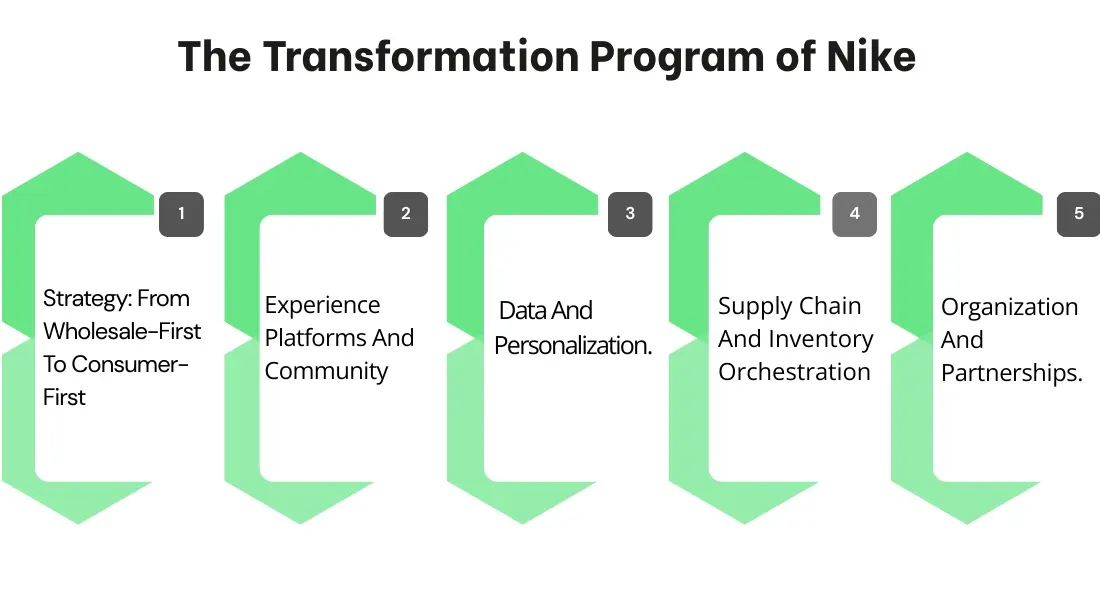
1. Strategy: From Wholesale-First To Consumer-First (Dtc Focus).
Nike elevated DTC as a strategic priority, setting public targets for higher DTC mix and redirecting investment from mass TV to digital channels and Nike-owned retail experiences. The company used marketplace exits and selective wholesale renewals tactically.
2. Experience Platforms And Community (Apps + Membership).
Nike invested aggressively in digital products the Nike App, SNKRS, Nike Training Club and membership programs to convert downloads into repeat buyers and data signals. These platforms became both marketing channels and product R&D labs (for demand signals).
3. Data And Personalization.
A centralized data lake, improved analytics and real-time personalization allowed Nike to target offers, optimise pricing and personalise product recommendations increasing conversion and average order value for users who engaged across apps and in-store digital touchpoints.
4. Supply Chain And Inventory Orchestration.
Nike reshaped its supply chain for speed and flexibility (fewer slow-moving SKUs, localized fulfillment), enabling buy-online-pickup-in-store, ship-from-store and tighter inventory turns essential when DTC volumes rose.
5. Organization And Partnerships.
Nike built digital talent internally, restructured commercial teams to prioritize consumer segments, and selectively re-engaged wholesale partners (including a 2024 return to Amazon) to balance reach and control. The return to Amazon reflected a pragmatic shift after DTC-exuberance produced channel gaps.

Metrics And Financial Outcomes
Nike’s public financials and third-party analyses illustrate both the upside and the volatility of the shift.
- DTC Gains And Scale: In fiscal 2023 NIKE Direct revenues were reported at $21.3 billion, up 14% year-over-year driven by digital growth of ~24% that year. Nike’s DTC share was widely cited in industry analyses; BCG reported Nike had prioritized DTC and cited ~39% of sales as DTC with an ambition to reach ~50%.
- Company-Wide Revenue: Nike’s total revenues hovered around the low-$50B range in recent years (Nike’s reported FY2024/2025 totals and Macrotrends data show FY2023 ~$51.2B and FY2024 near $51.36B; FY2025 reported revenues declined amid resets to assortment).
- Gross Margin And Profitability: The DTC focus helped gross margin resilience (pricing power, SKU rationalization), but margin effects were mixed when digital sales declined or when Nike invested in promotions/discounting to drive traffic. Nike reported margin improvements in parts of FY2024 due to strategic pricing and lower logistics costs.
- Volatility And Rebalancing: By fiscal 2024–2025 Nike experienced declines in digital sales (NIKE Brand Digital decreased substantially in some quarters for example, Nike reported NIKE Brand Digital down 20–26% in parts of FY2025 reporting), prompting a strategic rebalancing that included re-engagement with wholesale partners like Amazon and traditional retailers. That pivot was explicit: the company acknowledged DTC underperformance and adjusted assortment and wholesale strategy.
- Investment Scale: External industry analyses estimate Nike’s annual ICT/digital spend in the low billions (one estimate cited ~$1.3B annual IT/ICT spending in 2023), underscoring that transformation required sustained capital and operating investment.
Why The Change Was (Partly) Successful And Where It Strained The Business
Success Factors
- Stronger Customer Economics Where Execution Held: Membership and app users showed higher LTV and conversion; Nike gained direct pricing and promotion control versus wholesale partners. Personalization increased share-of-wallet among engaged customers.
- Platform Moat: Investments in apps and data created differentiable capabilities (e.g., SNKRS demand signals, membership telemetry) that competitors found harder to replicate quickly.
Strains And Lessons
- Execution Risk At Scale: Heavy DTC weighting exposed Nike to inventory and promotional sensitivity; when digital demand softened, near-term revenue and stock market reactions were swift. Nike’s 2024–2025 results show that rapid channel shifts must be coupled with robust scenario planning.
- Channel Diplomacy: Walking back from a wholesale-light stance (e.g., returning to Amazon, re-engaging partners) was necessary to recover reach an important reminder that multi-channel orchestration, not absolute channel exclusion, is often wiser for global brands.
References to McKinsey / BCG insights
- McKinsey has been explicit about Nike’s “secret formula” combining consumer obsession with digital and sustainability to re-engineer retail growth; McKinsey’s practitioner interviews and podcasts document how Nike used digital platforms to serve customers more directly.
- BCG’s analysis of DTC strategy cites Nike as a textbook example: prioritizing DTC to capture margins and data, aiming for a DTC mix approaching 50% (BCG referenced ~39% then) and outlining the organizational changes required to manage this shift. These perspectives guided industry expectations and deserve attention when benchmarking results.
Strategic Implications For Leaders
- Prioritise Customer-Owned Channels But Keep Reach Flexible. Owning the relationship is high value, but don’t treat wholesale as an enemy; orchestrate channels strategically.
- Build Platform And Data Capabilities Before You Rebalance Assortment At Scale. Personalization pays only when the supporting analytics, fulfillment and product processes are mature.
- Plan For Volatility And Scenario-Test Aggressively. Heavy investments change the risk profile; ensure liquidity and playbooks for demand softness or inventory imbalances.

Conclusion
Nike’s digital transformation is a powerful, realistic case study: an ambitious bet on owning consumers that created real strategic advantage (better margins for engaged consumers, platform defensibility and data-driven product signals), but also produced short-term channel and revenue complexity requiring a pragmatic course correction. For leaders, Nike’s experience reinforces that digital transformation is as much about orchestration channels, partners, inventory and people as it is about technology and apps.
Key Sources Consulted :
- Nike investor releases (FY2023–FY2025 results),
- McKinsey practitioner podcast on Nike’s customer obsession,
- BCG analysis on DTC strategies,
- Reuters and The Verge reporting on Nike’s channel decisions.
Read our Other Case Studies : How PayPal Survived Competition