Dot & Key’s D2C Beauty Growth Without Brand Burn | Case Study

How Dot & Key Stayed Ahead During India’s D2C Beauty Boom
Executive Summary
India’s D2C beauty wave has produced dozens of fast-growing brands, but very few have successfully navigated from early momentum to scaled relevance and strategic consolidation. Dot & Key stands out not just for how fast it grew, but for how deliberately it used digital marketing, community storytelling, and product velocity to build a brand that could survive beyond the hype cycle.
This case study analyses Dot & Key as a modern D2C operator rather than a cosmetic success story. It examines what worked, where tensions emerged, and why its eventual acquisition by Purplle reflects maturity rather than failure. For CXOs, founders, and operators, the real value lies in understanding how growth engines evolve, how platform dependence compounds risk, and how brand equity ultimately becomes the most defensible asset.
Introduction
Dot & Key entered a beauty market already crowded with legacy FMCG brands and emerging digital-first players. Indian consumers were becoming ingredient-aware, social-media-led, and far more willing to try challenger brands. At the same time, customer acquisition costs were rising rapidly across Meta, Google, and marketplaces.
The founding thesis was clear: build a science-backed skincare brand that speaks the language of digital natives. Instead of positioning skincare as aspirational luxury, Dot & Key leaned into clarity, transparency, and problem-solution framing. This approach resonated with younger consumers navigating acne, pigmentation, and barrier repair for the first time.
Early traction came not from scale but from relevance. The brand aligned product storytelling with search behaviour, social content, and influencer education. This alignment became the foundation of its marketing system.
What Made Dot & Key Different
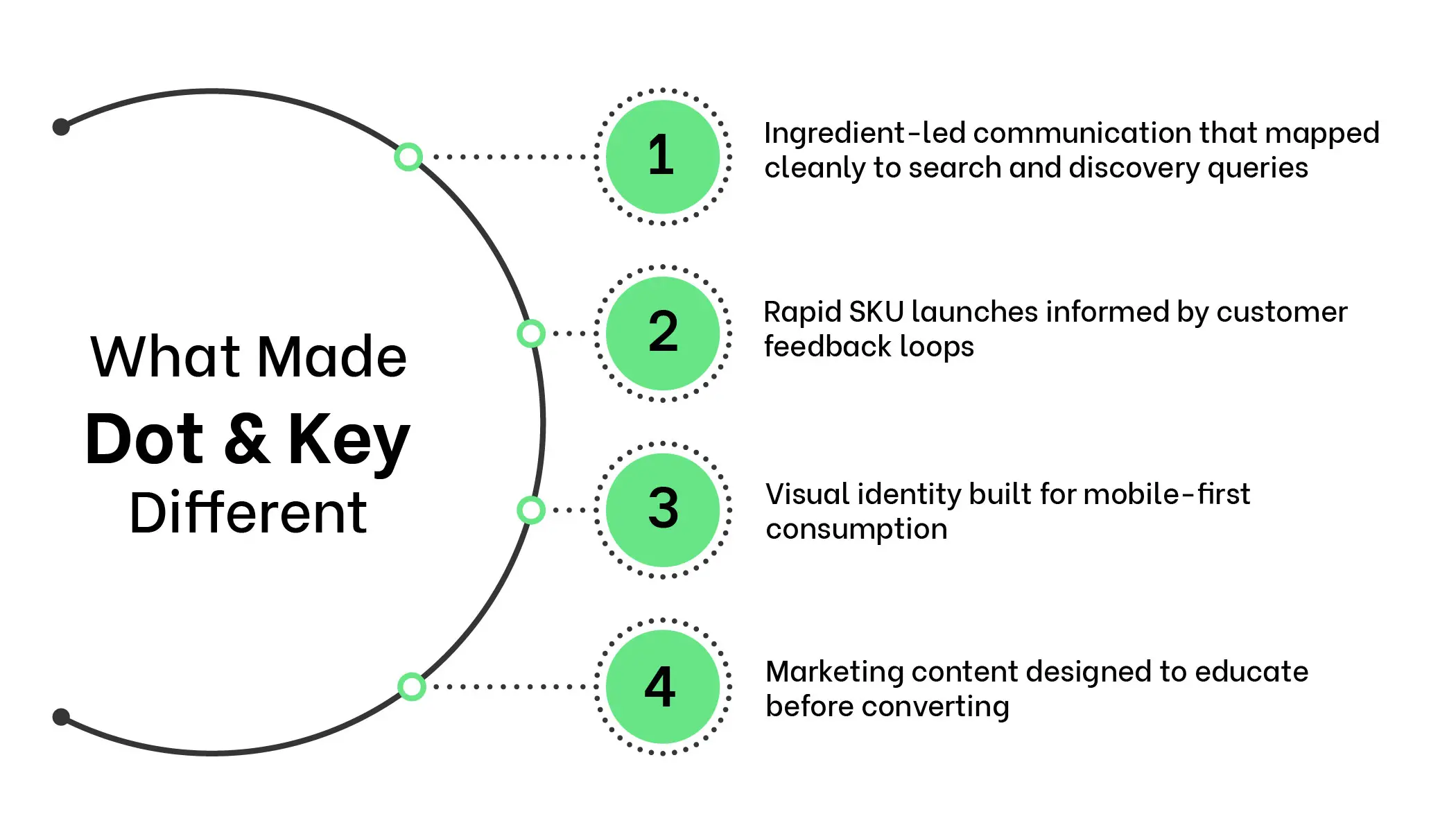
Most D2C beauty brands begin with influencer visibility and figure out the rest later. Dot & Key inverted this sequence by tightly integrating product development, content strategy, and performance marketing from the outset.
Key differentiators included:
- Ingredient-led communication that mapped cleanly to search and discovery queries
- Rapid SKU launches informed by customer feedback loops
- Visual identity built for mobile-first consumption
- Marketing content designed to educate before converting
This reduced friction across the funnel. Consumers did not need to be “sold” skincare; they needed reassurance and clarity. Dot & Key positioned itself as a guide rather than a promoter.
The Marketing Engine
Dot & Key’s marketing strategy worked because it was treated as an operating system, not a set of campaigns.
Influencer-Led Brand Building
Influencers were used not just for reach but for validation. The brand collaborated with dermatology-aware creators, skincare educators, and micro-influencers who could explain ingredients and routines. This drove higher trust and lower refund rates compared to purely aesthetic campaigns.
Performance Marketing with Feedback Loops
Paid acquisition was continuously optimised using SKU-level performance data. Products that showed early traction were amplified quickly, while underperformers were deprioritised. This tight loop between ads, reviews, and product tweaks allowed Dot & Key to scale without bloating inventory.
Community and Social Proof
User-generated content, reviews, and before-after narratives became core creative assets. Rather than polished brand films, the focus remained on authenticity and repeatability. This approach improved retention and lowered blended CAC over time.
Product Velocity as a Growth Lever
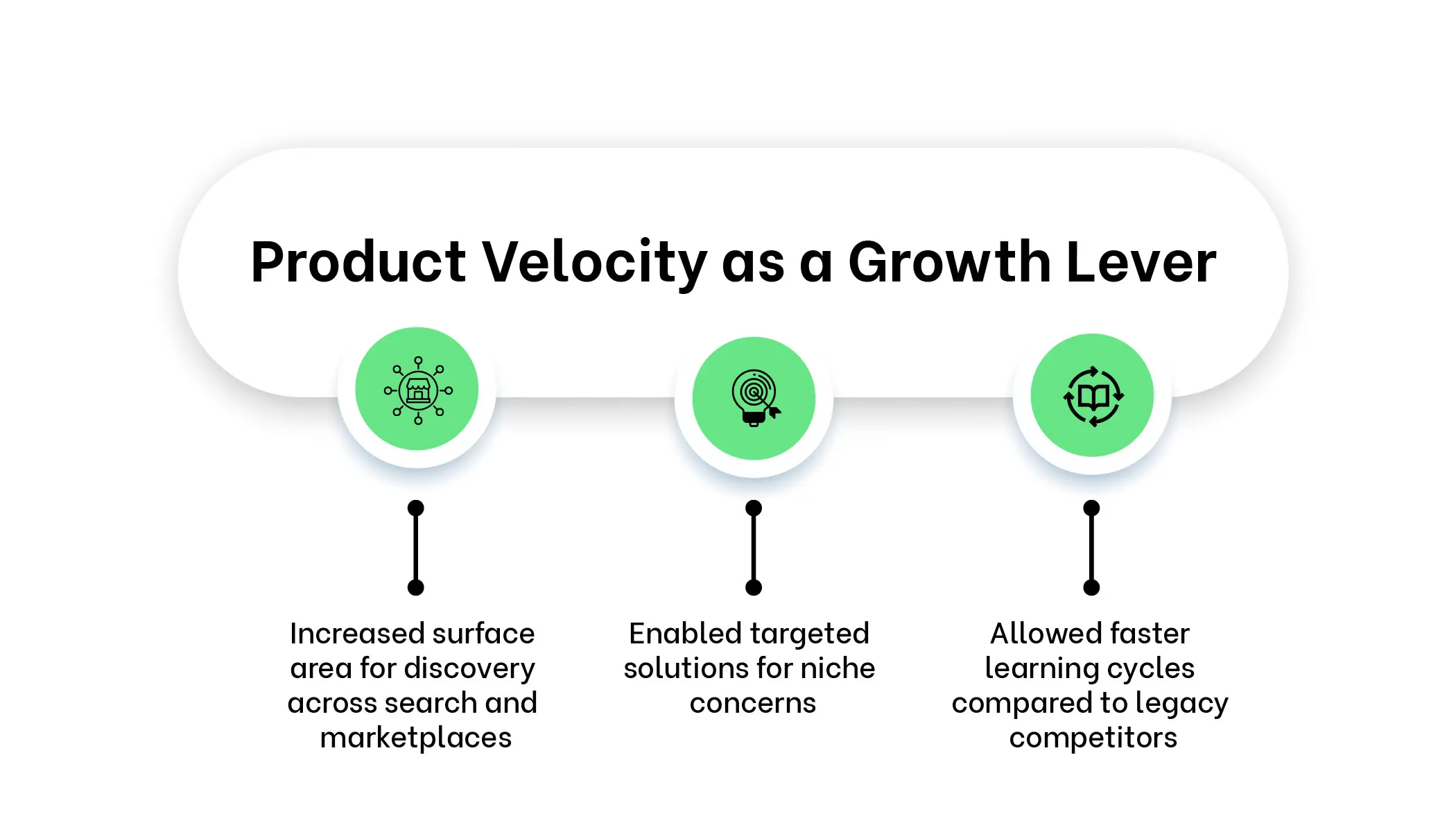
One of Dot & Key’s most underappreciated strengths was its ability to launch, test, and iterate products rapidly. In a category where consumer needs evolve with trends, seasons, and social discourse, speed became a strategic advantage.
Product velocity served three purposes:
- Increased surface area for discovery across search and marketplaces
- Enabled targeted solutions for niche concerns
- Allowed faster learning cycles compared to legacy competitors
However, this also introduced complexity. Managing SKU sprawl while maintaining profitability required operational discipline and data-backed decision-making.
Data-Driven CAC and Retention Strategy
Dot & Key did not chase vanity growth. Marketing teams tracked cohort behaviour closely, focusing on repeat purchase rates and lifetime value rather than just first-order conversions.
Retention was driven by:
- Routine-based product bundling
- Educational content that extended post-purchase engagement
- Loyalty mechanics that rewarded usage, not discounts
This balanced approach allowed the brand to grow aggressively without eroding long-term margins, a mistake that many D2C peers struggled to recover from.

Platform Dependency and Its Trade-Offs
Platform leverage accelerates early growth but compresses margins as competition intensifies, making owned channels a strategic hedge rather than a branding exercise. Like most D2C brands, Dot & Key benefited immensely from platforms such as Instagram, marketplaces, and influencer ecosystems. These channels accelerated scale but also introduced dependency risk, shaping the early phase of its digital transformation journey.
As competition intensified, the cost of visibility increased. Algorithmic changes reduced organic reach. Marketplaces demanded higher commissions. These pressures highlighted a structural challenge: growth engines that are externally owned cannot be fully controlled. Recognizing this inflection point, the brand began aligning its strategy with a broader business transformation roadmap focused on long-term sustainability rather than short-term acquisition spikes.
Dot & Key’s response was not immediate disengagement but strategic recalibration. The brand began investing more deliberately in owned channels, CRM, and brand recall, strengthening its first-party data capabilities and customer experience transformation efforts. This shift laid the groundwork for its next phase.
The Consolidation Phase
The acquisition by Purplle marked a transition rather than an endpoint. For Dot & Key, consolidation offered access to deeper distribution, operational leverage, and capital efficiency. For Purplle, it brought a digitally-native brand with strong consumer trust and marketing DNA.
From a strategic perspective, this move reflects a broader D2C reality. As markets mature, scale alone is insufficient. Synergies, distribution depth, and capital discipline become decisive.
The acquisition allowed Dot & Key to preserve brand identity while benefiting from platform economics that are difficult to build independently at scale.
Mixed Results and Market Slowdown
Like many consumer brands, Dot & Key faced headwinds as discretionary spending tightened and digital ad costs surged. Growth moderated, and margins came under pressure. These challenges were not unique but systemic.
What matters is how the brand responded. Instead of doubling down on discounting, Dot & Key focused on portfolio rationalisation, messaging clarity, and operational efficiency. This restraint protected long-term brand equity even during slower periods.
As acquisition costs across Meta rose industry-wide, Dot & Key’s repeat purchase cohorts softened the impact, allowing the brand to maintain marketing efficiency longer than many peers.
Lessons for CXOs and Founders
Growth Is a System, Not a Campaign
Dot & Key’s success was not driven by one viral moment but by interconnected decisions across product, content, and performance.
Influencers Work Best as Educators
Trust scales when creators add value rather than noise.
Platform Leverage Must Be Matched with Ownership
External channels accelerate growth but amplify risk if not balanced with owned assets.
Consolidation Is a Strategic Choice
Exits are not failures when they preserve brand relevance and unlock the next stage of growth.

The Road Ahead
Dot & Key’s future strength lies in deepening its product science narrative, investing in long-term brand memory, and expanding into adjacent personal care categories with discipline. The brand already owns trust. The next phase is about sustaining relevance in a maturing market.
For modern CXOs, Dot & Key offers a clear message: building a D2C brand today requires equal fluency in storytelling, systems, and strategic restraint. Growth is easy to initiate. Longevity is earned.
Read our Other Case Studies : How GIIS Achieved Growth Through Digital Transformation