
Nykaa Omnichannel Growth Strategy
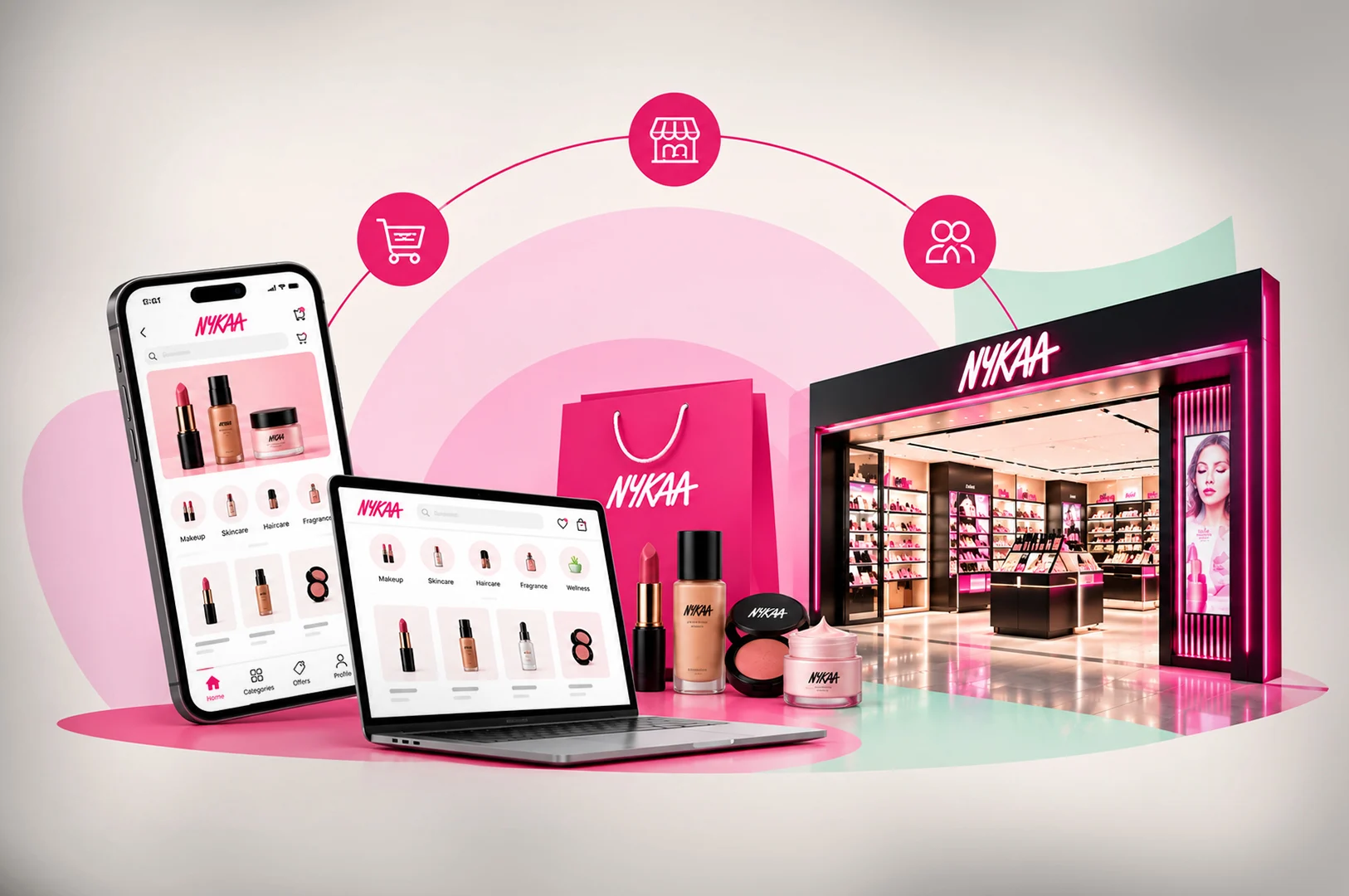
How Nykaa Turned Digital Trust into an Omnichannel Growth Engine
A strategic case study on why the future of retail will not be online versus offline—but a connected system of content, stores, customer intelligence and commerce.
Nykaa did not treat physical retail as a retreat from digital commerce. Its store network appears to have become an extension of the trust, education and product discovery capabilities it had already built online.
By FY26, Nykaa reported 313 stores across 99 cities, including 76 stores added during the year. It also reported double-digit same-store sales growth and a beauty business whose gross merchandise value, or GMV, had doubled in three years. Nykaa FY26 investor presentation
The strategic lesson is bigger than beauty retail. A digital-first brand should enter physical retail when a store can remove customer uncertainty, deepen the experience and improve the wider business—not merely add another place to sell.
%20(5).webp)
The central challenge: beauty is digital, but it is also deeply physical
Beauty products appear naturally suited to e-commerce. Customers can explore thousands of products, read reviews, watch tutorials and compare prices without leaving home.
But beauty purchases also contain forms of uncertainty that a screen cannot always remove:
- Will the foundation shade suit my skin?
- How does the fragrance smell?
- What does the texture feel like?
- Which product fits my specific concern?
- Is the product authentic?
- Can I trust the recommendation?
These questions are particularly important in premium beauty, fragrance, skincare and new product categories. The customer may discover the product digitally but still want physical reassurance before making the final decision.
This creates a strategic tension. Online channels offer scale, assortment and convenience. Stores offer sensory experience, consultation and immediate confidence.
Nykaa’s response was not to choose one channel over the other. It built a system in which each channel could resolve a different part of the customer’s decision.
Nykaa first built trust digitally
Before physical stores could strengthen the model, Nykaa needed to earn a credible position in digital beauty commerce.
Curation reduced the burden of choice
Beauty marketplaces can easily become overwhelming. A large catalogue creates value only when customers can navigate it confidently.
Nykaa’s digital experience combined product assortment with category organisation, filters, reviews, recommendations and editorial guidance. This helped the platform operate as more than a transactional catalogue.
Curation became a form of decision support.
For founders, this distinction matters. Digital businesses often assume that offering more choice automatically produces greater customer value. In reality, an excessive number of poorly explained options can increase uncertainty and abandonment.
The stronger model combines assortment with guidance.
Content made the customer more capable
Beauty commerce is closely connected to education. Customers need help understanding ingredients, routines, techniques, trends and product suitability.
Content therefore performs several commercial roles:
- It attracts customers before they have selected a product.
- It helps them define the problem they are trying to solve.
- It improves their confidence in evaluating alternatives.
- It makes the eventual transaction feel better informed.
Nykaa’s FY26 disclosures continue to connect premium beauty with education, expertise and exclusive content. The company also reported online dermatology consultation flows and AI-supported skin-analysis tools within its app. Nykaa FY26 investor presentation
This is an important component of the Nykaa business model: content is not positioned outside commerce. It helps create the confidence that enables commerce.
Authenticity strengthened platform trust
In beauty, customers are not only evaluating the product. They are also evaluating whether the seller is credible.
Direct brand relationships, curated launches and access to global labels can strengthen confidence in authenticity. Nykaa reported more than 200 new brand launches in FY26, including Korean, global and ultra-luxury brands.
This breadth gave its digital platform a strong foundation. When Nykaa subsequently expanded its stores, those locations carried an identity and customer relationship that had already been built online.
Why physical retail became a logical next step
Nykaa’s offline expansion should not be understood simply as an attempt to capture customers who do not shop online.
Its stores address forms of friction that digital channels struggle to remove completely.
Stores converted uncertainty into experience
A store allows customers to test colours, textures and fragrances. It can provide personalised recommendations and human consultation. It can also make unfamiliar or premium brands feel more accessible.
The physical location therefore does not merely distribute inventory. It lowers the customer’s perceived risk.
That is a stronger reason to open a store than reach alone.
Different formats served different shopping missions
By FY26, Nykaa’s 313-store network included:
- 142 Nykaa On Trend stores
- 96 Nykaa Luxe stores
- 61 House of Nykaa locations, including kiosks, carts and Kay Kafe
- 12 Kiehl’s and Charlotte Tilbury boutiques
- Two Nykaa Perfumery stores
The company also reported six differentiated experiential formats introduced within one year. Nykaa FY26 investor presentation
This suggests a portfolio approach to physical retail rather than a single standardised store model.
A trend-oriented shopper, a luxury-beauty customer and a fragrance buyer do not require the same experience. Different formats allow the brand to match investment, assortment and service to the customer mission.
%20(5).webp)
Physical retail extended digital credibility
A well-positioned store can make an online brand feel more tangible. Customers can see the breadth of its assortment, interact with advisors and experience the brand in a controlled environment.
The trust can then flow in both directions:
- Digital familiarity can encourage a store visit.
- A positive store experience can increase confidence in future online purchases.
- Online content can prepare customers before they arrive.
- Digital data can help inform product selection and recommendations.
- Stores can introduce customers to categories they may later repurchase online.
The result is not two separate channels. It is a connected customer-learning system.
For organisations considering similar transformation, Cognitute’s approach to customer experience transformation emphasises connecting customer journeys, data and engagement across touchpoints.
The numbers indicate expansion with improving productivity
Store growth can increase revenue while quietly weakening a business through rent, staffing, inventory and operational complexity. The quality of expansion therefore matters more than the number of openings.
Nykaa’s FY26 disclosures provide several relevant signals:
Source: Nykaa Q4 and FY26 investor presentation.
These figures do not prove that every store or format is equally productive. Nor do they isolate the precise incremental effect of physical retail on digital sales. However, double-digit same-store sales growth is particularly relevant because it indicates that growth did not depend entirely on opening additional locations.
Nykaa’s connected trust system
The most useful way to interpret the strategy is as a five-part system.
1. Content creates discovery
Editorial content, tutorials, creators and category education help customers recognise a need and understand possible solutions.
2. Curation reduces complexity
A structured assortment helps customers narrow their choices without requiring specialist knowledge.
3. Data improves relevance
Search behaviour, product interactions and purchase histories can help a retailer understand changing customer interests and improve recommendations.
4. Stores create sensory confidence
Physical locations allow customers to test products, speak to advisors and experience the brand.
5. Commerce preserves convenience
Once trust and product familiarity have been established, customers can purchase through the channel that is most convenient at that moment.
Each interaction can generate information that improves the next one. This is what turns a multichannel presence into an omnichannel growth engine.
A similar principle sits behind effective digital transformation: technology, operations and customer experience must support the same strategic outcome.
When should a digital-first brand expand offline?
Opening stores because competitors are doing so is not a strategy. Neither is treating physical retail as a symbol of maturity.
A digital-first brand is more likely to be ready when five conditions are present.
1. Customers face unresolved purchase uncertainty
The product may need to be touched, tried, demonstrated, configured or explained.
2. The brand already has concentrated demand
Searches, orders, repeat purchases and customer enquiries can reveal where physical demand may exist. Stores should follow evidence rather than executive intuition alone.
3. The store has a role beyond transactions
The proposed location should deliver at least one additional advantage: consultation, discovery, community, service, fulfilment or product education.
4. The economics work across the whole customer relationship
Founders should look beyond store-level revenue. They should examine:
- Customer-acquisition cost
- Repeat-purchase behaviour
- Online sales in the surrounding market
- Inventory productivity
- Average order value
- Customer lifetime value
- Incremental operating costs
- Cannibalisation between channels
5. The organisation can manage added complexity
Physical retail introduces leases, staffing, training, inventory allocation, local compliance and service-quality risks.
Expansion should not move faster than the company’s ability to maintain customer trust.
What founders should not copy blindly
Nykaa’s growth journey contains useful principles, but its execution cannot simply be transferred to every D2C business.
Do not mistake stores for brand building
An expensive location does not automatically create credibility. The experience must reinforce a brand promise customers already recognise or find relevant.
Do not expand nationally before proving a repeatable format
Different store concepts may have different roles and economics. Pilot formats, measure their effects and define clear criteria for further investment.
Do not separate online and offline teams completely
When incentives, customer data and inventory decisions are divided by channel, teams may compete for revenue instead of improving the total customer relationship.
Do not evaluate stores only through immediate sales
Some locations influence online purchases, product discovery and retention. That value should be measured—but not assumed without evidence.
Do not allow physical growth to weaken the digital experience
Stores should add a new capability. They should not compensate for unresolved problems in product quality, positioning or online customer service.
The future of retail is a connected trust system
The old debate asked whether physical retail would defeat e-commerce or whether digital channels would make stores obsolete.
The more useful question is: Which combination of channels gives customers the greatest confidence with the least friction?
In an AI-mediated retail future, discovery may become even more fragmented. Customers could begin with a creator, consult an AI assistant, compare products on a marketplace, test them in a store and complete the purchase through an app.
The winning retailer may not own every interaction. It will need to preserve a coherent identity and dependable experience across all of them.
Physical locations may also acquire new roles:
- Experience and consultation centres
- Community and creator spaces
- Hyperlocal fulfilment points
- Sources of first-party customer insight
- Trust infrastructure for premium or unfamiliar products
- Environments where digital recommendations can be physically validated
This is why the future is unlikely to be online versus offline. It will be a network of connected moments in which content explains, technology personalises, stores reassure and commerce converts.
Strategic lessons from the Nykaa case study
Nykaa’s omnichannel strategy offers six transferable lessons:
- Build trust before building distribution.
- Open stores to resolve customer friction, not to follow a retail trend.
- Treat content as part of the commercial journey.
- Use differentiated formats for different customer missions.
- Measure the combined customer relationship—not channels in isolation.
- Allow digital and physical interactions to improve one another.
The most important takeaway is simple:
Physical expansion creates strategic value when it makes the customer more confident—not merely when it makes the product more available.
That distinction separates an additional sales channel from a genuine omnichannel growth engine.
This case study is based on publicly available company disclosures and represents independent strategic analysis. Cognitute is not asserting a consulting relationship with Nykaa.
Sources and further reading
- Nykaa Investor Relations
- Nykaa Q4 and FY26 Investor Presentation
- Cognitute Customer Experience Consulting
- Cognitute Digital Transformation Solutions
Last reviewed: September 2026
.webp)
.webp)