How PhysicsWallah Transformed Community-Led Education in India
.webp)
PhysicsWallah And The Rise Of Community Led Education In India
Executive Summary
PhysicsWallah represents one of the most structurally important shifts in India’s education economy. Instead of scaling through capital-heavy marketing or institutional prestige, the company built growth through trust, accessibility, and community participation. What began as free YouTube lectures evolved into a hybrid education ecosystem serving millions of students across Tier 2, 3, and 4 India.
This case study analyses how creator-led credibility replaced traditional coaching acquisition models, how radical affordability expanded market access, and how organisational choices enabled sustainable scaling during a volatile edtech cycle. For CXOs and founders, PhysicsWallah demonstrates how community, technology design, and operational discipline can become stronger competitive moats than funding alone.
Introduction
India’s edtech boom created rapid innovation but also exposed structural fragility. Many platforms pursued aggressive expansion supported by venture capital, high marketing spends, and premium pricing. Growth was visible, but profitability and trust often lagged behind.
PhysicsWallah entered this environment with a fundamentally different thesis. Founded by Alakh Pandey, the company did not begin as a startup but as a teaching initiative focused on accessible learning. Years before monetisation, free physics lectures on YouTube attracted students seeking clarity rather than coaching prestige.
The early audience came largely from Bharat markets where affordability, language accessibility, and reliable teaching mattered more than brand positioning. This foundation shaped every strategic decision that followed.
Building Trust Before Monetisation
Unlike legacy coaching institutes charging premium fees, PhysicsWallah prioritised reach before revenue. Full-year courses priced around ₹4,000 dramatically expanded access compared to traditional coaching models costing over ₹1.5 lakh.
This pricing strategy was not discounting. It redefined the category by aligning education with inclusion rather than exclusivity. Students experienced value long before becoming paying users, creating unusually strong conversion trust.
The founder’s teaching style played a central role. Relatable communication, humour, and emotional transparency created a direct bond between educator and learner. The brand identity became inseparable from student outcomes, turning engagement into loyalty.
Trust became PhysicsWallah’s first scalable asset.

Community As The Primary Growth Engine
PhysicsWallah’s growth was community-led rather than campaign-led. Students formed peer ecosystems that extended learning beyond the platform itself. The emergence of “PWians” reflected identity formation, not just customer segmentation.
This community dynamic reduced dependence on paid acquisition. Lecture sharing, peer recommendations, and organic discussions replaced traditional marketing funnels. Growth increasingly travelled through student networks rather than advertising channels.
For CXOs, this represents a structural shift. Distribution moved from media buying to social validation. Community became both marketing channel and retention mechanism.
The Trust-Led Growth Flywheel
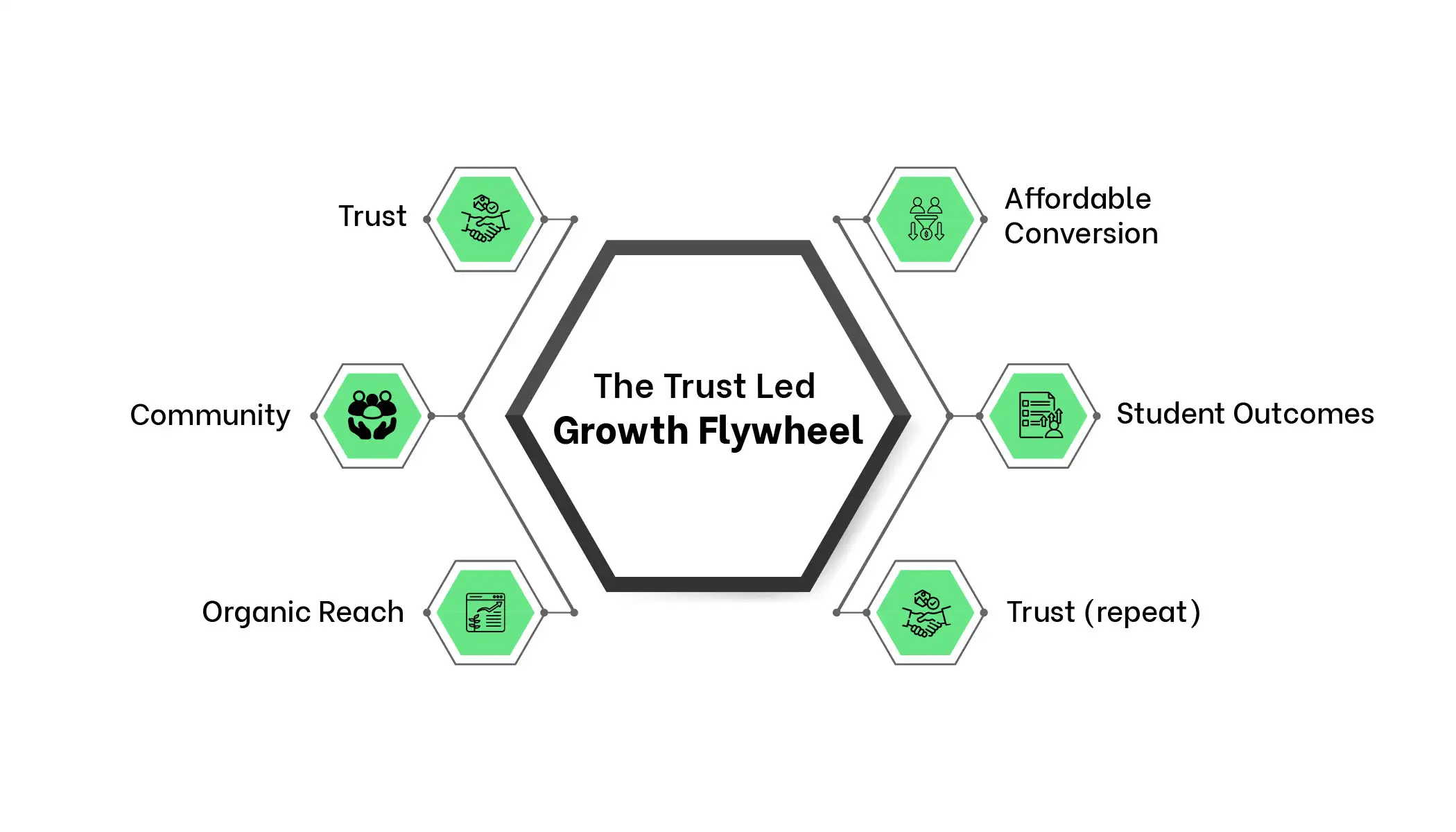
PhysicsWallah’s expansion cannot be explained through pricing or reach alone. Its real advantage emerged from a self-reinforcing system that converted trust into scale. This can be understood as a Trust Led Growth Flywheel.
The cycle began with authentic value creation. Free educational content established credibility before monetisation. Students experienced outcomes first and transactions later, reversing conventional acquisition logic.
Trust evolved into community participation. Learners behaved as contributors within a shared movement rather than passive consumers.
Community enabled organic distribution. Students shared lectures and recommendations across peer networks, driving near-zero customer acquisition cost growth.
Affordable monetisation converted this trust into revenue without eroding goodwill. Student success stories then reinforced credibility, restarting the cycle.
Trust → Community → Organic Reach → Affordable Conversion → Outcomes → Trust
PhysicsWallah did not optimise marketing campaigns. It engineered a system where trust itself functioned as growth infrastructure.
Digital Transformation Designed For Bharat
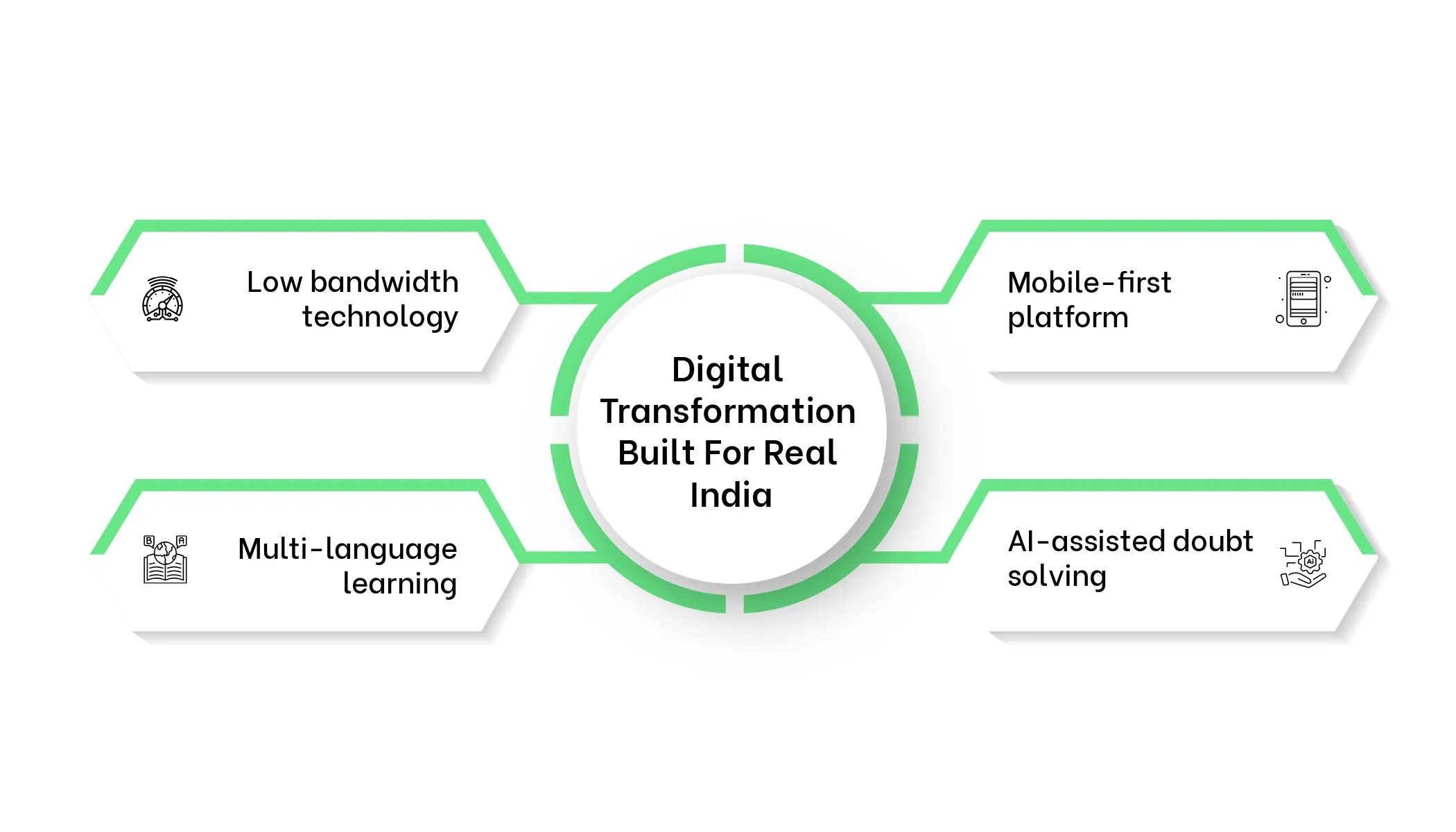
Technology decisions reflected deep contextual understanding of Indian users. The platform was built to operate efficiently on low-bandwidth networks and entry-level smartphones, expanding accessibility beyond metro markets.
Content expanded into multiple Indian languages, unlocking adoption among students historically underserved by English-centric platforms. This localisation strategy significantly widened the addressable market.
Student experience remained central to product innovation. The launch of AI-powered learning tools such as personalised doubt resolution systems enhanced learning outcomes while keeping teachers at the core of delivery. Technology amplified educators instead of replacing them.
Digital transformation, in this case, meant removing friction rather than adding complexity.
Hybrid Scaling Through The “Phygital Model”
As online adoption matured, PhysicsWallah recognised that many students still valued physical learning environments for discipline and mentorship. The company introduced offline Vidyapeeth and Pathshala centres across numerous Indian cities.
This hybrid model combined online scalability with offline credibility. Digital channels drove discovery and affordability, while physical centres strengthened trust and academic structure.
The result was operational diversification without abandoning the original community-first philosophy.

Organizational Change Behind Sustainable Growth
PhysicsWallah’s internal evolution contrasts sharply with venture-funded peers. Instead of scaling headcount and marketing aggressively, the organisation focused on academic delivery, teacher onboarding, and operational efficiency.
Revenue growth increasingly relied on retention rather than new acquisition. The company maintained relatively low marketing spend while expanding offerings across competitive exams and learning categories.
During the broader edtech funding slowdown, this disciplined structure allowed PhysicsWallah to maintain stability while competitors faced restructuring pressures.
Organisational alignment around student outcomes created resilience rarely seen in high-growth startups.
Competitive Context And Strategic Positioning
Competitors in India’s edtech sector largely pursued premium positioning supported by heavy advertising and celebrity branding. While this accelerated early adoption, rising acquisition costs and declining engagement exposed structural weaknesses.
PhysicsWallah positioned itself differently. Instead of competing for elite urban segments, it expanded the market itself by targeting underserved learners. Affordability and authenticity became differentiation rather than compromises.
Trust replaced marketing intensity as the primary competitive moat.
Lessons For CXOs And Founders
Community Can Replace Paid Distribution
When users identify with a mission, growth becomes organic rather than transactional.
Affordability Can Expand Market Size
Lower pricing does not always reduce margins if it unlocks scale and retention.
Technology Must Reflect User Reality
Designing for real infrastructure constraints creates adoption advantages.
Creator Credibility Can Become Institutional Strength
Founder authenticity scaled into brand trust stronger than traditional advertising.

The Road Ahead
PhysicsWallah’s next phase depends on sustaining trust while expanding responsibly across formats and categories. As India’s education market matures, differentiation will rely less on pricing and more on learning outcomes, personalisation, and long-term brand memory.
The company already owns one of the strongest emotional connections in Indian edtech. The strategic challenge now is institutionalising that trust without losing authenticity.
For modern leaders, PhysicsWallah offers a broader insight. Digital transformation succeeds not when technology leads strategy, but when human trust becomes the foundation upon which technology scales.
Read Our Other Case Studies : mCaffeine’s Marketing Strategy Success