
BFSI Digital Adoption via Next-Gen Operating Models

Next-Gen Operating Models How Cost-Excellence Centers Accelerate Digital Adoption in BFSI

What is Business Strategy: A Definitive Guide To Transform Organizations in 2025
Many businesses must continually play catch-up to gain competitive advantage by overcoming forces changing market realities leading to depleting profits. A compelling explanation for this continuous tug-of-war is that businesses often need to recognize a game-changing strategic shift and are unprepared to anticipate or adapt to industry disruption. Developing a well-designed business strategy can counteract these challenges, but formulating a winning strategy can be difficult, especially for businesses that need to be action-oriented.
This brings us to an important question: What exactly is business strategy? And how does it relate to business success? In this article, we will discuss these questions and present guidance on a sound business strategy for 2025. Let us begin with the obvious.
What is Strategy?
Strategy is a roadmap that guides organizations toward their desired goals by making informed decisions and taking calculated risks. It often involves defining the long-term goals of an organization and allocating resources to achieve them. But, more than just being a blueprint for success, it also consists of integrating an organization's operations into a chain of mutually reinforcing connections while excluding imitators.
Michael Porter, a strategy expert and professor at Harvard Business School, noted that strategy defines and communicates an organization's unique position, determining how organizational resources, skills, and competencies combine to create a competitive advantage.
The foundations of a good strategy lie in several calculated steps:
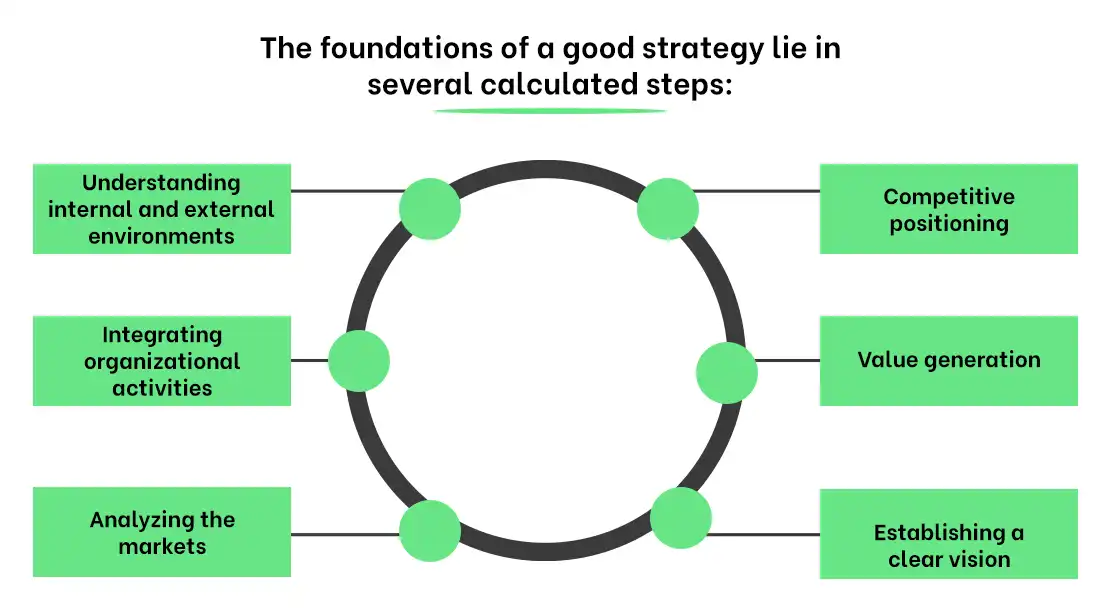
- Understanding internal and external environments
- Integrating organizational activities
- Analyzing the markets
- Competitive positioning
- Value generation
- Establishing a clear vision
Strategy takes a hierarchical form for any organization, helping them devise and climb ladders of success.
Levels of Strategy
At its core, strategy is built on three primary unit levels: operational, corporate, and business. The operational strategy focuses on the objectives of the organization's day-to-day operations, while the corporate strategy focuses on creating value across the organization. In comparison, the business unit-level strategy focuses on how each business unit creates value. Each level of strategy has its own objectives, resources, and methodologies, but they should all operate in concert to achieve the organization's overall goals.
Operational Level Strategy
Operational Level Strategy envisions how each department and business unit's strategy aligns with the organization's overall objective. The functional strategy encompasses optimizing achievable goals in functional areas such as production, marketing, research and development, finance, and operations. It details the resources needed to execute plans and metrics to measure results. Collaboration across teams ensures alignment with overall business goals.
Corporate Level Strategy
Corporate Level Strategy is the highest level of strategic planning in an organization. A winning corporate strategy identifies the ideal business portfolio, sets implementation plans, prioritizes growth platforms, and establishes a financial roadmap. It defines mission, values, and long-term goals, enabling organizations to measure progress and make strategic decisions.
Business Level Strategy
Business strategy is an ongoing evaluation of the business and the industries it operates in. It considers competitive advantages such as cost leadership, capabilities, IP, data access, differentiation, and business unit opportunities. Leadership teams translate the business vision into actionable steps that drive competitive positioning and market strength.
Academics and leaders agree that all three strategies — business, operational, and corporate — must align to achieve organizational success.
Business Strategy: Definition and Meaning
The quest for profitability and growth has increased the need for structured principles that guide long-term success. Since the 1960s, companies have used data-driven models to create strategies.
A viable business strategy connects ideas, goals, customer satisfaction, and organizational effectiveness. It focuses on:
- Strategic units
- Competitive positioning
- Product scope
- Value creation
Its role is to outline actionable plans across business units to achieve goals, guide decisions, generate value, and build sustainable competitive advantage.
Types of Business Strategy
A variety of strategies help businesses build success. The best strategies balance advantage with visionary thinking across core areas, adjacencies, and future frontiers.
Cost Leadership
Businesses aim to become the most cost-efficient provider through optimized production, reduced overhead, and expense control. True cost leadership must align with strategy, not blanket cost-cutting.
Product Differentiation
Businesses create unique products, upgrade features, innovate design, or improve service to stand apart. This creates a distinct value proposition.
Growth Vector Strategy
Growth vectors define the future shape of the business, competitive advantage foundations, and mix of core vs. adjacent growth. Examples include diversification, product extension, and market penetration.
Focus (Niche) Strategy
This strategy targets a specific demographic or niche, enabling precise product tailoring and efficient resource allocation.

Diversification Strategy
Businesses expand by investing in unrelated products or features, reducing risk and increasing profitability. Often achieved via new offerings, expansion, or M&A.
Value-Based Strategy
Pricing and offerings are based on perceived customer value rather than production cost. This approach strengthens loyalty and satisfaction.
Integrative Strategy
Integrative strategies combine multiple strategic approaches into one unified plan, optimizing both short-term and long-term goals.
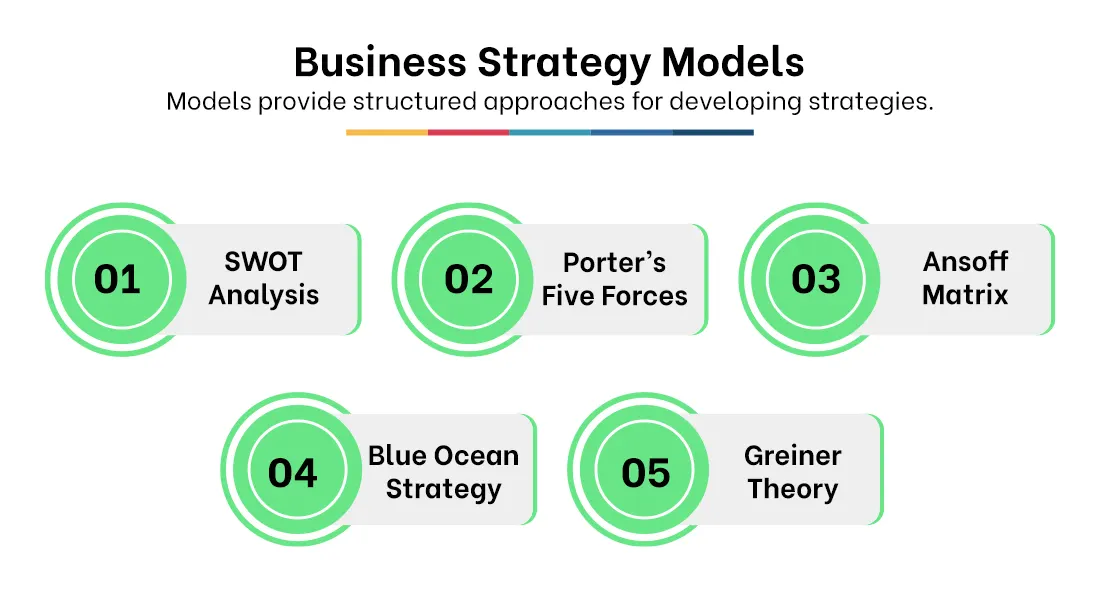
Business Strategy Models
Models provide structured approaches for developing strategies.
- SWOT Analysis
- Porter’s Five Forces
- Ansoff Matrix
- Blue Ocean Strategy
- Greiner Theory
Many more models exist, each offering unique perspectives for competitive decision-making.
Related Reads :
| Harnessing Predictive Analytics for Educational Success
| Exploring the Role of Generative AI in Shaping Consumer Behavior Across Industries.
Business Strategy Plan and Templates
Beyond models, businesses need clear, realistic, actionable plans with defined roles, timelines, KPIs, resources, and benchmarks. Templates help identify trends and behavior, enabling scalable planning.
Execution — with measurable KPIs, timelines, responsibilities, and contingencies — determines strategy success.
Examples of winning strategies:
- Best Buy: Mini-warehouse store strategy
- Amazon: Cost leadership + innovation pillars
- Starbucks: Customer value and community engagement
- Tesla: Multi-dimensional differentiation
- PayPal: Digital disruption via superior tech
- HubSpot: Creating the inbound marketing category
Business Strategy vs. Corporate Strategy
Business strategy = competitive advantage + market execution.
Corporate strategy = direction for the entire organization.
Both are interdependent — business strategy excels with the clarity of corporate strategy, while corporate strategy becomes real through business-level execution.
Building Blocks of an Effective Strategy
A strong strategy includes:
- Deep insight into vision & mission
- Understanding where value is created/destroyed
- Forward-looking forecasting
- Combining elements of multiple strategies
- Resource reallocation
- Risk analysis and mitigation
- Alignment across teams
Environmental changes, internal culture, and human factors also shape success.
Organizations outperform when strategy evolves from idea to operational reality through structured building blocks.
Effective Strategies for the Year 2025
The market has transformed post-pandemic, requiring companies to adopt new strategic approaches.
Design Thinking + Digital Transformation
Combining customer-centric design with modern technology enhances efficiency, speeds innovation, and improves services.
Sustainability within a Culture of Innovation
Prioritizing environmental responsibility drives investor and customer trust while fostering innovation.
Customer Experience
Exceptional customer experience boosts loyalty, revenue, referrals, and brand equity.
Leveraging Data Analytics
Data enables smarter decisions, operational optimization, and competitive foresight.
Exploring New Markets
Market segmentation and geographic expansion allow targeted, efficient, high-impact growth.

Five Best Business Strategy Books To Read
Entrepreneurs and aspirants can learn a lot from these historical and contemporary examples to build good strategies for their business ideas. In addition, there is some good literature available in the market that will also add to the knowledge base of business people who want to plan their own success stories. Some good books available on the topics include:
- Your Next Five Moves: Master the Art of Business Strategy by Patrick Bet-David and Greg Dinkin.
The book challenges readers to think like chess grandmasters and predict chains of reactions. The author urges business strategists to plan their next moves sequentially rather than treating each as an individual decision, with a focus on team-building skills and getting an advantage over formidable competitors.
- Good Strategy Bad Strategy: The Difference and Why It Matters by Richard Rumelt
This Richard Rumelt book outlines the essential components of strong organizational strategy and the incorrect thinking underpinning a bad strategy. This is one of the best books on strategic thinking, covering topics such as leverage, proximate objectives, and chain link systems.
- Blue Ocean Strategy by W. Chan Kim & Renée Mauborgne
This book argues that cutthroat competition results in nothing but a bloody red ocean of competition, and it advocates finding and seizing untapped opportunities.
- The Art of Strategy: A Game Theorist's Guide to Success in Business and Life by Avinash K. Dixit and Barry J. Nalebuff
Drawing on the principles of game theory, the book discusses how to predict and prepare for competitors' next moves. It is filled with case studies and real examples that make game theory applicable in broad situations.
- The Innovator's Dilemma by Clayton Christensen
The innovator's dilemma advocates experimentation instead of following tried-and-tested formulas. Clayton Christensen argues that organizations can only sometimes rely on proven methods as they need to forge new paths to remain relevant and competitive.
Read our Other Insights : EdTech Learning Ops Using SaaS Best Practices
Authors
Related
No items found.
More From The Authors
No items found.