Agentic AI Revolutionizes Customer Support into Care | Cognitute

Agentic AI Revolutionizes Customer Support into Care | Cognitute

January 20, 2026
Artificial Intelligence
How Agentic AI is Transforming Fire-Fighting Customer Support into Pre-emptive Customer Care
For most service-intensive companies, a pet peeve would read as follows :
“We get to know about an unhappy customer only when he’s already decided to either escalate or exit the system altogether.”
Despite world-class tools and dashboards, most customer success teams are still into fighting fires - instead of preventing them. Issues escalate. Product adoption warnings go unnoticed, problems pile up,... the list is endless, but surely erodes into customer satisfaction and repeatability, and ultimately, profitability.
Today, that story is changing. The reason? The rise of Agentic AI.
Agentic AI is that which can act autonomously toward business goals. It is reshaping how companies sense, understand, and respond to customer needs. Instead of waiting for a support ticket, the system detects the early signals of friction and acts before customers feel the need to complain.
This shift represents the most meaningful transformation in customer experience since the introduction of cloud CRM. And it is accelerating fast. By 2029, Gartner estimates 80% of common service issues will be autonomously resolved by agentic AI, driving operational cost reductions by nearly 30% and dramatically lifting satisfaction scores.
The era of reactive support is ending. The future is anticipatory.
The Shift from Response to Foresight
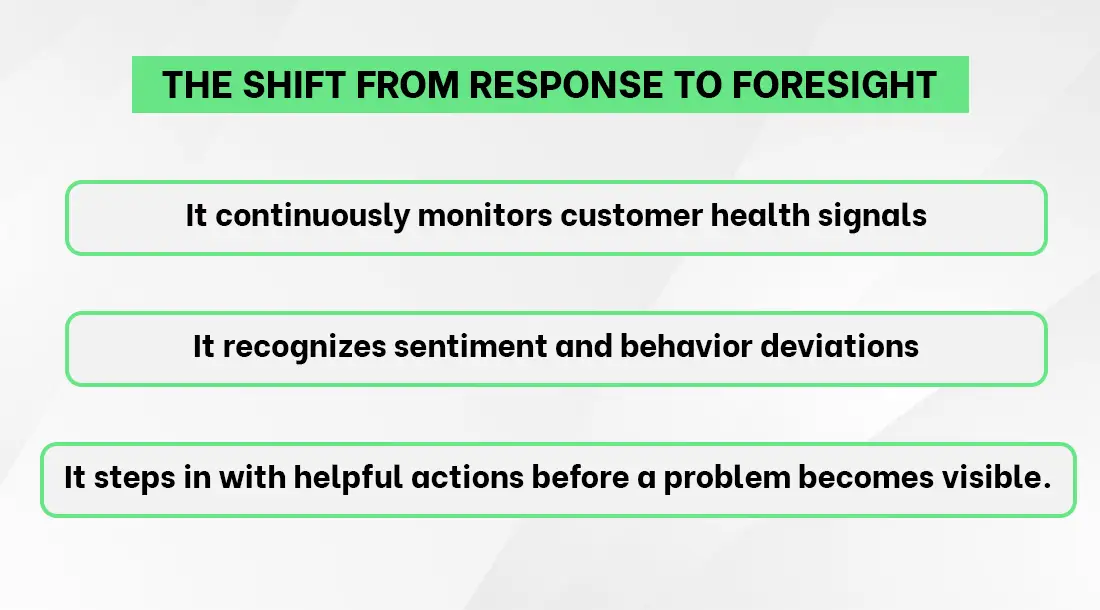
We have grown used to AI assistants and chatbots that wait for instructions. Agentic AI changes the paradigm entirely. Instead of passively responding:
- It continuously monitors customer health signals
- It recognizes sentiment and behavior deviations
- It steps in with helpful actions before a problem becomes visible.
Imagine the following scenarios :
- A telecom provider noticing a sudden spike in data usage and extending a temporary plan before the customer hits a limit.
- A banking customer about to miss a payment receives a plan adjustment proactively, with options tailored to their history.
- A B2B SaaS platform detecting stagnating usage and automatically launching targeted user coaching.
This is support with intuition, something that feels less like automation and more like care.
Agentic AI gains strength by combining:
- Predictive analytics (forecasting future needs and risks)
- Autonomous execution (resolving or escalating issues without waiting for humans)
- Contextual reasoning (understanding situations rather than responding to keywords)
It behaves not like a script, but like a highly capable teammate.
Strengthening Human Connection at Scale
Proactive automation often raises the question: What happens to the human element?
In reality, the opposite occurs:
Humans are finally free to engage where they matter most, i.e for empathy, creativity, and relationship-building. Across industries, we are seeing new possibilities:
- Retail
Agentic AI Systems understand not just “what customers buy,” but “why would they buy our products?”. This enables more intuitive, emotionally aligned recommendations. - Healthcare
AI assistants that track patient signals, anticipate complications, and guide adherence, thus improving outcomes through continuity of care. - Financial Services
AI that detects vulnerability, e.g. sudden changes/spikes in spending, missed steps in onboarding, etc. and proactively steps in with human-approved sensitivity. - Enterprise Software
Onboarding journeys that dynamically adjust based on user role, behavior, and intent, while collapsing the time-to-value window.
The end result is that customers feel seen, supported, and valued - not managed. For companies operating in a market defined by rising expectations and shrinking margins, this loyalty becomes priceless.
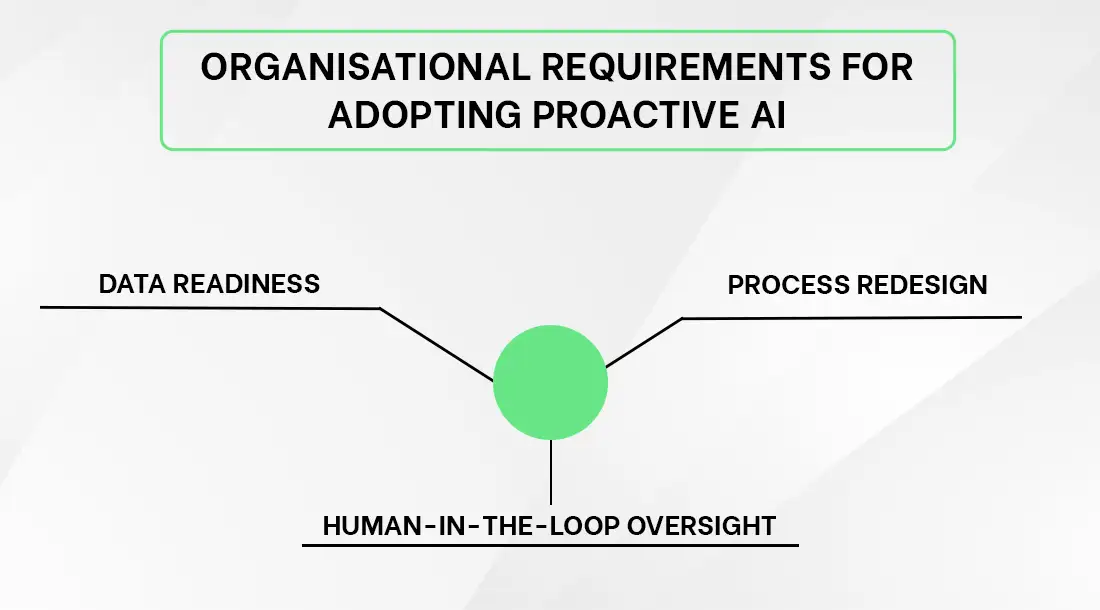
Organisational Requirements for Adopting Proactive AI
Peer organizations reveal a consistent truth: “Technology isn’t the barrier. Transformation is.”
For adoption and seamless execution of Agentic AI, there are three fundamental requirements:
Data Readiness: A unified, clean view of the customer journey. Scattered dashboards with information loop-holes would provide imperfect solutions.
Process Redesign: The people management systems must adopt the policy of “risk anticipation” instead of “complaint resolution”.
Human-in-the-Loop Oversight: Need for Governance that blends AI autonomy with ethical and empathetic human judgment
In essence, we need to stop thinking about AI as a tool, and start treating it as a member of the customer team.
It is important to acknowledge the risks:
- Bias may creep into predictions
- Privacy must remain sacred
- Teams must learn how to collaborate with AI effectively.
The Competitive Advantage of Anticipation
Customer trust has always depended on responsiveness — fixing what’s broken, quickly. Now, the new gold standard is preventing the breakdown. Proactive support reduces operational cost, yes. But the more meaningful value lies in
- reducing effort for the customer
- strengthen lifetime loyalty
- transform service into a brand advantage
Today, a company that waits for a support ticket loses the race before it starts. Tomorrow’s winners are already operating differently:
- They measure retention preventions, not ticket resolutions
- They celebrate interventions, not escalations
- They design journeys where the ideal experience is the one that avoids friction entirely
In simple terms: Proactive support is the new customer loyalty strategy.
Human Empathy, Machine Effiency
When organizations embrace agentic AI, something remarkable happens:
Customers stop feeling like problems to be managed. They begin to feel understood. Support becomes a safety net. Experience becomes seamless. Trust is built quietly, through what doesn’t go wrong.
And that is a future worth leading.
Read Our Other Insights : The People Problem in Digital Talent Transformation
Authors
.webp)
Creative & Content Head